
20 Small Group Activities for Preschoolers: Low-Prep Math, Literacy & Fine Motor Ideas
Practical small group activities for preschoolers organized by skill, with simple ways to adjust difficulty so teachers, parents, and homeschool families can spend less time planning and more time interacting with children.
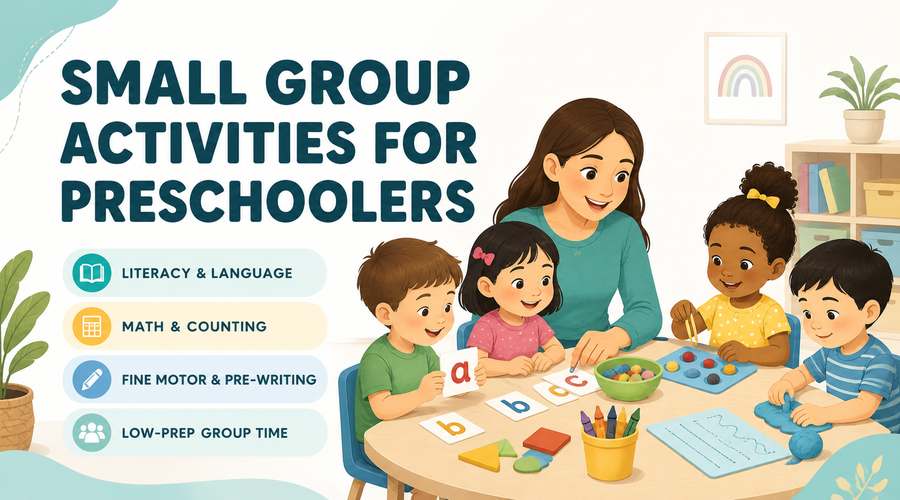
Quick Answer
The best small group activities for preschoolers have one clear learning goal, use familiar hands-on materials, and give every child frequent chances to respond or act. Choose the skill first, keep the group flexible, and make the same activity easier or harder instead of preparing a completely new lesson for every level.
Small group time is useful because fewer children make it easier to notice what each child understands and what support is needed next. NAEYC specifically highlights differentiated learning and richer back-and-forth conversation as advantages of small-group learning, while Head Start standards for its preschool programs include opportunities for individual, small-group, and large-group learning.
This guide turns those principles into a practical format: choose a skill, select one low-prep activity, observe what happens, and adjust the next round. The 20 ideas below cover literacy, math, fine motor, pre-writing, cooperation, music, and movement without turning small group time into a second full lesson plan.
How to Choose Small Group Activities for Preschoolers
Start with an observable skill rather than a theme. “Count five objects accurately” gives you a clearer teaching target than “do a farm activity.” Flexible grouping also matters: children do not need to stay in the same group all year, and the task should change as their understanding changes.
| Children need practice with… | Try… | Main skill |
|---|---|---|
| Recognizing letters | Letter Match and Say | Early literacy |
| Recognizing their name | Build Your Name | Print awareness |
| Counting objects | Count and Cover | Counting |
| One-to-one correspondence | Feed the Animals | Number sense |
| Comparing attributes | Sort and Explain | Classification |
| Recognizing shapes | Shape Match and Build | Geometry |
| Pencil control | Trace the Path | Pre-writing |
| Scissor control | Cut and Sort | Fine motor |
| Taking turns | Partner Matching | Social participation |
| Listening and patterns | Copy My Rhythm | Listening & sequencing |
Literacy Small Group Activities
Small-group literacy should create more opportunities to hear language, notice print, talk, and respond. Keep the task playful and use only as many cards or choices as children can manage successfully.
1. Letter Match and Say
Place several familiar letters on the table. Give each child one matching card, find its partner, and say the letter name together.
2. Build Your Name
Use a printed name card as a model. Children find the matching letters and arrange them from left to right.
3. Beginning Sound Sort
Choose two beginning sounds. Say each item’s name slowly and let children place it with the matching sound group.
4. Rhyming Pairs
Show a picture such as cat and offer two or three choices. Children listen for the picture that rhymes, such as hat.
5. Story Retell With Picture Cards
After a familiar story, let children arrange a few important events and explain what happened first, next, and last.
If letter identification is the main need, continue with Letter Recognition Activities for Preschoolers instead of adding unrelated literacy targets to the same session.
Small Group Math Activities for Preschoolers
Hands-on materials make children’s thinking visible. Stanford DREME’s guided preschool math resources use a similar structure: each activity has a clear math objective and can be offered in different versions for different levels of difficulty.
6. Count and Cover
Show a numeral and ask children to count out that many objects. Let them move each counter as they say one number word.
7. Feed the Animals
Give an animal a target amount of pretend food. Children move one piece at a time while matching one number word to each object.
8. Roll, Count and Build
Roll a die, count the dots, and add that many blocks to a tower. Compare towers after several turns.
9. Sort and Explain
Let children sort a small collection, then ask why the items belong together. The explanation matters as much as the finished groups.
10. Shape Match and Build
Match identical shapes, then talk about sides, curves, and corners. Children who are ready can build simple shapes with craft sticks.
Fine Motor and Pre-Writing Small Group Activities
Demonstrate the movement briefly, then give children time to do it. Fine motor small groups are more useful when hands are active than when children are waiting through long instructions.
11. Trace the Path
Trace broad straight, curved, zigzag, or looping paths. Begin with large movements before expecting small, precise lines.
12. Cut and Sort Strips
Use short strips with one or two bold cutting lines. After cutting, sort the pieces by color or picture.
13. Playdough Lines and Shapes
Roll playdough into ropes, then bend the ropes into lines, circles, simple shapes, or the first letter of a child’s name.
14. Tweezer Transfer
Move items from one container to another with tongs. Add color sorting only after children can comfortably manage the transfer.
For ready-to-use path practice, see the Dinosaur Pre-Writing & Fine Motor Activity Pack and Vehicles Pre-Writing Paths.
Music and Movement Small Group Activities
18. Copy My Rhythm
Clap a short pattern and let children copy it. Start with two or three beats, then invite children to create a pattern for the group.
19. Movement Pattern Game
Demonstrate a short sequence such as clap → jump → turn. Children copy it, then change one movement at a time.
20. Freeze and Listen
Children move while music plays and pause when it stops. Add one short instruction after each stop, such as “touch your knees.”
Make One Activity Work for Different Skill Levels
Differentiation does not require three separate lesson plans. Keep the activity familiar and change the quantity, number of choices, teacher support, or reasoning required. This is one of the clearest ways to make preschool small group activities manageable over time.
For example, one counting activity can become:
- Offer fewer or more letter choices.
- Use wider or narrower tracing paths.
- Sort by one attribute or explain two possible rules.
- Retell three story events before adding more.
- Copy a two-step movement pattern before trying three steps.
- Add a visual model when verbal directions are not enough.
This approach aligns with Stanford DREME’s guided small-group math materials, which pair explicit objectives with different versions of the same activity.
A Simple 5-Day Preschool Small Group Plan
Reuse successful formats. Familiar routines reduce explanation time, so children can spend more of the session practicing the actual skill.
If a task works well, repeat it the following week with one small change. Repetition is not wasted planning time when children are practicing a skill at a new level.
Free Printables That Fit Small Group Time
A printable is most useful when it supports conversation, matching, counting, tracing, or another active goal. These Nini Printables resources already match several activities in this guide:
Optional Supplies for Low-Prep Small Groups
Most activities in this guide work with ordinary classroom or household materials. If you regularly run small groups, a few reusable supplies can reduce prep time.
Useful Reusable Supplies
- Large foam dice for counting games
- Blocks or reusable counters
- Child-safe scissors
- Child-safe tweezers or tongs
- Dry-erase pockets for reusable tracing pages
- Washable markers or thick crayons
- Laminating supplies for frequently reused cards
Buy only what solves a recurring classroom or home-learning problem; the activity should still work without a long shopping list.
Frequently Asked Questions
How many preschoolers should be in a small group?
There is no single number that fits every setting. Keep the group small enough that each child can participate frequently and you can notice individual responses. Activity type, staffing, children’s needs, and program or licensing requirements should guide the final group size.
How long should preschool small groups last?
There is no universal duration. Start brief, watch engagement, and stop or change the task when children are no longer productively participating. A hands-on activity may naturally last longer than a teacher-directed matching or naming task.
What should you teach during preschool small group time?
Small groups can support early literacy, counting, number sense, shapes, sorting, fine motor development, pre-writing, oral language, listening, and cooperation. Choose one main goal so children get repeated practice instead of a long sequence of unrelated tasks.
Should preschool small groups stay the same all year?
Usually not. Flexible grouping allows you to change the children, task, or level of support as interests and skills change. Observation should guide the next grouping rather than treating a child’s current level as a permanent label.
Are worksheets good for preschool small groups?
A printable can be useful when it supports an age-appropriate active goal such as matching, tracing, counting, or discussing pictures. It should complement—not replace—play, conversation, manipulatives, movement, and exploration.
What if a preschooler does not want to join the group?
Consider whether the task is too difficult, too long, unfamiliar, or poorly timed. Simplify the first step, offer a clear invitation, allow appropriate observation, and follow your classroom or program guidance rather than turning participation into a power struggle.
Keep Small Group Time Simple
Strong small group activities for preschoolers do not need elaborate materials. Pick one skill, use a task children can understand quickly, give everyone frequent turns, and adjust the challenge based on what you observe.
That structure helps teachers and families spend less time preparing activities and more time listening, prompting, and responding to children—the part of small-group learning that is hardest to replace with a worksheet alone.
Social and Cooperative Small Group Activities
Keep the social target concrete: take one turn, listen to one peer, share one set of materials, or contribute one idea. Small groups can support conversation and cooperation without turning the activity into a behavior test.
15. Cooperative Drawing
Skill: Turn-taking & communication · Materials: Large paper, crayons
Use one large sheet. Each child adds something to the shared picture and briefly tells the group what they added.
16. Partner Matching
Skill: Matching & cooperation · Materials: Matching picture cards
Children take turns placing a card while the group looks for its partner. Ask children to explain what makes the pair match.
17. Emotion Faces and Stories
Skill: Emotion vocabulary & conversation · Materials: Simple face cards
Show one expression and describe a short situation. Invite children to suggest how someone might feel and why.