
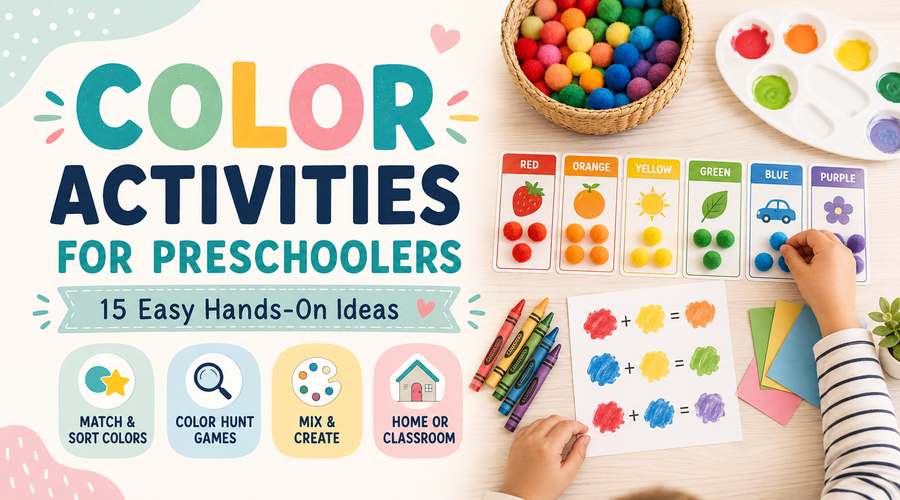
15 Color Activities for Preschoolers: Easy Hands-On Ideas
These low-prep color activities for preschool use matching, sorting, movement, art, and simple color mixing to make color learning active and useful at home or in the classroom.
Quick Answer
Easy color activities for preschoolers include color hunts, matching games, sorting real objects, movement games, one-color art, collages, and simple color mixing. Start with two or three clearly different colors. Then add more choices when the activity feels easy.
Learning colors in preschool does not need a long worksheet session. Children can notice color while they play, clean up, make art, move around a room, or explore everyday objects. That makes color practice easy to repeat without turning it into a test.
A useful sequence is simple: first notice a color, then match it, name it, sort by it, and finally use it in a new way. Instead of treating the ideas below as a checklist, use the quick choice guide to pick the activity that best matches what the child needs next.
What Do Color Activities Help Preschoolers Practice?
Color activities can support more than color naming. They also give children a reason to compare objects, notice what is the same or different, follow a simple rule, and describe what they see.
That fits naturally with early math exploration. NAEYC notes that preschoolers can sort collections by size, color, and shape, then compare the groups and talk about their choices.[1] Head Start also describes classification in preschool as grouping objects by characteristics such as color, shape, or size.[3]
Keep the goal flexible. Color knowledge varies with experience, language, vision, and learning context. Use these activities for practice and conversation, not as a developmental test.
Choose a Color Activity Based on What the Child Needs
Instead of trying every idea, choose one activity that matches the next useful step. Repeat it with new objects or colors before adding more complexity.
15 Easy Color Activities for Preschoolers
Most of these ideas use materials already found at home or in a preschool classroom. Choose one or two activities at a time, keep directions short, and stop while the child is still interested.
1. Go on a One-Color Hunt
Pick one color, such as red. Ask the child to find three to five objects with that color in the room, playground, or yard. Name each object as it is found.
Practice: visual attention, color words, and everyday vocabulary.
2. Match Objects to Color Cards
Place the cards on a table. Then invite the child to put each object beside a card with the same color. Begin with obvious matches before adding similar shades.
Practice: matching, comparison, and color vocabulary. For more pair-and-compare ideas, see Matching Activities for Preschoolers.
3. Make a Color Parking Game
Use the paper as parking spaces. Ask the child to park a blue vehicle on blue, a red vehicle on red, and so on. If the toy colors do not match the paper exactly, treat close matches as a conversation rather than a mistake.
Practice: color matching, visual scanning, and pretend play.
4. Sort Everyday Objects by Color
Put a small mixed group in the center. Ask the child to make two or three color groups. Once that feels easy, ask how the groups are alike and different.
Practice: classifying and explaining a sorting rule. For a wider range of sorting ideas, use Sorting Activities for Preschoolers.
5. Try a Clothespin Color Match
Add a small color mark to each clothespin, then clip it onto the matching card. Use large, easy-to-open clothespins and supervise closely.
Practice: color matching plus hand strength and coordination. Find more hand-skill ideas in Fine Motor Activities for Preschoolers.
6. Play Color Hop
Place the papers far enough apart for safe movement. Call out a color and ask the child to step, hop, or tiptoe to it. Change the movement instead of adding too many colors at once.
Practice: listening, color recognition, and gross-motor control. For more active breaks, visit Movement Activities for Preschoolers.
Want a Quiet Follow-Up Activity?
After a hands-on game, a short printable can give children another way to match, trace, count, or practice visual skills without replacing play.
7. Play Color Freeze with Music
Play a short song while children move. Pause the music and give one prompt, such as “Touch something yellow.” Start again after everyone finds a safe object.
Practice: listening, movement, and color vocabulary. Pair it with other Music Activities for Preschoolers.
8. Make One-Color Art
Offer one main color and let the child draw freely. If several shades are available, talk about lighter, darker, bright, or pale rather than expecting exact labels.
Practice: observing color variation, creative choice, and descriptive language.
9. Stamp and Compare Colors
Make a few prints in two colors. Then compare them. Ask which prints look the same, which look different, and what happens when prints overlap.
Practice: color comparison and process art. For more stamping and printing ideas, see Printmaking Activities for Preschoolers.
10. Make a Color Collage
Choose one color family and collect pieces that fit. Glue them onto a page to create a simple collage. Adults can pre-cut pieces when cutting is not the learning goal.
Practice: visual discrimination, choice making, and fine-motor control.
11. Mix Colored Water
Add two colors to separate cups. Ask the child what might happen before combining small amounts. Then mix and describe the change together.
Practice: prediction, observation, and cause-and-effect language.
12. Mix Paint Colors
Put two paint colors side by side and let the child blend them in the middle. Ask what changes as more of one color is added.
Practice: experimenting, comparing, and describing change.
13. Look Through Colored Cellophane
Hold one piece in front of a familiar object and compare the view with normal vision. Try two colors together if the material is safe and large enough to handle easily.
Practice: observation, comparison, and simple science talk.
14. Make a Simple Color Pattern
Start an AB pattern such as red-blue-red-blue. Ask the child what should come next. If needed, build the first few repeats together.
Practice: color recognition and early patterning. If shapes are also part of the activity, keep color as the main rule first, then explore Shape Activities for Preschoolers.
15. Read and Find Colors in a Picture Book
Read normally first. On a second look, invite the child to find something blue, red, yellow, or another familiar color. Keep the search conversational so the book still feels like reading, not a quiz.
Practice: color vocabulary, visual scanning, and conversation around books.
How to Make Color Activities Easier or Harder
A good activity changes with the child. If the child guesses often or loses interest, reduce the choices. If the task feels automatic, add one small challenge.
Make It Easier
- Use two clearly different colors.
- Reduce the number of objects.
- Match colors before asking for names.
- Use real objects the child already knows.
- Model the first turn together.
- Accept pointing before expecting a verbal answer.
Make It Harder
- Add another color choice.
- Compare lighter and darker shades.
- Ask the child to explain a sorting rule.
- Sort by color, then try a different attribute.
- Create an AB or AAB color pattern.
- Predict a result before mixing colors.
Color Activities at Home vs. in the Classroom
At Home
Keep setup small. A five-minute color hunt, laundry sort, toy match, or art invitation can fit into a normal routine. Household objects also help children connect color words with real life.
In a Preschool Classroom
Use reusable cards, baskets, large counters, washable art materials, and short small-group rotations. A teacher can repeat the same activity with different colors instead of preparing a new center every day.
Small-group tip: Put fewer materials on the table than the total number available. A clear workspace makes the learning rule easier to notice and reduces waiting.
Optional Supplies for Preschool Color Activities
Most color activities for preschool work with items already at home or school. However, a small reusable supply shelf can make repeat practice easier.
Useful, Not Required
- Washable tempera paint
- Washable markers or crayons
- Large colored counters
- Child-safe tweezers or tongs
- Large clothespins
- Clear cups and droppers
- Translucent color paddles or sheets
- Reusable page sleeves
Hands-On Color Activities vs. Worksheets
Hands-on play works well for noticing, matching, sorting, moving, mixing, and talking about color. A printable can work well after that experience when the goal is quiet review, visual matching, tracing, or another table-based task.
In other words, the two formats do not need to compete. Start with real objects when possible, then use a printable as a short follow-up when it fits the child and setting.
Keep the Next Activity Low-Prep
Nini Printables offers free preschool and kindergarten printables for matching, counting, tracing, pre-writing, shapes, and other early-learning skills.
Frequently Asked Questions
What are easy color activities for preschoolers?
Start with color hunts, object matching, simple sorting, Color Hop, one-color art, or a picture-book color search. These activities need little setup and can use familiar objects.
How can I teach colors without worksheets?
Use colors during normal play and routines. Match socks, sort blocks, find a named color in the room, paint with one color family, or talk about colors while reading. Real objects give children repeated chances to notice and use color words.
Is color sorting good for preschoolers?
Yes. Sorting by color gives children practice comparing objects and applying one clear grouping rule. Once that becomes easy, they can sort the same objects in another way, such as by shape or size. See the full guide to preschool sorting activities.
How do you teach color mixing to preschoolers?
Use two colors at a time. Ask the child to predict what might happen, mix a small amount, and then describe the result. Colored water and washable paint both make the change easy to observe.
What if a preschooler can match colors but mixes up the names?
Keep matching while adding color words naturally. For example, say “You found the blue match” instead of repeatedly testing with “What color is this?” If a family has concerns about vision, language, or learning, they can discuss them with the child’s teacher or an appropriately qualified professional.
More Easy Preschool Learning Ideas
Keep Color Learning Simple and Playful
The best preschool color activity is usually the one a child will happily repeat. Begin with noticing and matching, then add naming, sorting, patterns, or mixing when the next step feels useful.
There is no need to complete all 15 ideas. A few familiar activities, repeated with new objects and colors, can create plenty of meaningful practice.