
Preschool Matching & Visual Learning
15 Matching Activities for Preschoolers: Easy Hands-On & Printable Ideas
These matching activities for preschoolers use toys, household objects, pictures, movement, and free printables to help young learners notice what is the same, what is different, and what belongs together.
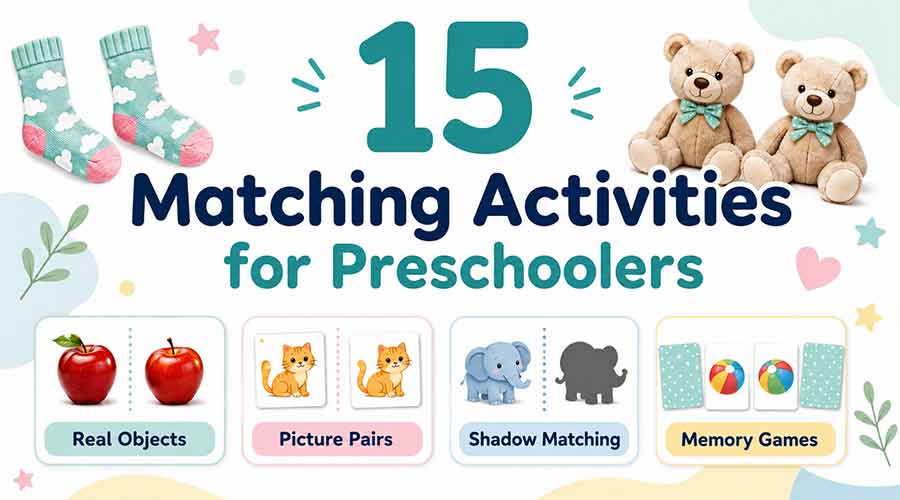
Matching is more than finding two pictures that look alike. It asks a child to notice features, compare choices, and decide why two things belong together. Head Start describes matching as pairing objects by characteristics such as color, shape, or size, while also emphasizing how matching and sorting help children notice similarities and differences.
You do not need a complicated lesson. In fact, short activities with familiar objects are often the easiest place to begin. Then, when you want a quieter table activity, a printable can add picture matching, pencil control, and review without replacing hands-on play.
What Do Matching Activities Help Preschoolers Practice?
Good matching activities for preschoolers keep the task simple enough that the child can focus on comparing. Depending on the activity, children may practice:
- Noticing similarities and differences
- Comparing color, shape, size, and picture details
- Recognizing familiar objects and pictures
- Building vocabulary while naming what they see
- Following a simple one-step direction
- Using controlled hand movements to point, place, draw, or cut
The National Association for the Education of Young Children (NAEYC) also highlights everyday sorting, patterns, and shape exploration as meaningful parts of early math learning. In other words, matching does not need to happen only on a worksheet. Cleanup baskets, socks, blocks, toys, and picture cards can all become useful practice.
Start Simple: A Matching Progression That Makes Sense
If a child is new to matching, do not begin with a crowded page of tiny pictures. Instead, increase the challenge one step at a time.
This is a teaching sequence, not an age test. A child may find one type easy and another surprisingly difficult. When that happens, reduce the number of choices or return to a more concrete version of the same idea.
15 Easy Matching Activities for Preschoolers
Choose one or two ideas at a time. Repeating a familiar activity with slightly different objects is often more useful than setting up a brand-new game every day.
1. Match Pairs of Socks
Put three or four clean pairs of clearly different socks in a small pile. Ask the child to find the two that belong together, then explain what looks the same.
2. Match Toy Animals
Use duplicate toy animals, animal figures, or a mix of toys and matching photo cards. Start with exact pairs before asking the child to match an object to a picture.
3. Match Toy Cars by Color
Place a few colored paper squares on the floor and park each toy car on the matching color. If the cars have different features, ask the child to focus on color first.
4. Match Identical Picture Cards
Print or draw simple pairs of familiar pictures. Keep every card face up and place only two or three pairs on the table. The child finds the identical pictures and places each pair together.
5. Try Farm Animal Matching
Farm animals work well because the pictures are familiar and easy to name. Start with same-animal matching, then move to shadows, mother-and-baby pairs, homes, or footprints.
6. Match Ocean Animals
Use familiar sea creatures such as fish, turtles, octopuses, or crabs. Begin with identical pictures, then ask the child to notice smaller details, body shapes, or shadows.
7. Play a Shadow Matching Game
Place a clear picture beside several simple silhouettes. Ask which shadow has the same overall shape. Avoid using tiny or overly detailed images when introducing the activity.
8. Match Animal Parents and Babies
This is a related-pair activity rather than an identical match. Put a few familiar adult animals beside their babies and talk about the relationship after the child makes each pair.
9. Match Animals to Their Homes
Pair familiar animals with simple homes or habitats, such as a bird and nest or a farm animal and barn. This shifts the task from “looks the same” to “belongs together.”
10. Match Shapes to Real Objects
Put down a few shape cards, then match each one to an everyday object. For example, a circle can match a plate, while a rectangle can match a book.
11. Match Colors Around the Room
Choose two or three color cards and find safe objects that match each color. This works during cleanup, a room search, or a short learning center.
12. Cut and Match Pictures
Cut apart a small set of large picture cards, then ask the child to place each piece with its match. Adult help is appropriate whenever scissors are used.
13. Play a Simple Memory Matching Game
Once face-up matching is easy, turn over only two or three pairs. Take turns flipping two cards and looking for a match. Keep the first games small so remembering locations does not overwhelm the matching task.
14. Find the Real Object That Matches the Picture
Show a picture of a familiar object, such as a spoon, cup, shoe, or toy, and ask the child to find the real item. This connects a flat picture with something in the child’s environment.
15. Match My Action
Make one simple movement, such as clapping twice, touching your head, or stretching your arms. Ask the child to copy the same action. Then let the child lead while you match.
How to Make Matching Easier or More Challenging
Make It Easier
- Start with only two or three pairs.
- Use pictures that look very different from one another.
- Keep cards face up.
- Model one complete match first.
- Reduce visual clutter on the table.
Make It More Challenging
- Add more choices.
- Use similar-looking pictures.
- Introduce shadows or small detail differences.
- Match related rather than identical pictures.
- Turn cards face down for a memory game.
The goal is not to move through the levels as quickly as possible. Instead, adjust the activity so the child can succeed while still needing to look carefully.
Free Matching Printables to Try
Hands-on matching and printable practice can do different jobs. Real objects make the comparison concrete, while matching worksheets can provide a predictable quiet-time format with pictures, pencil lines, coloring, or cut-and-match practice.
Farm Animals Matching
A 16-page free PDF with same-animal, shadow, mother-and-baby, home, sound, farm-item, half, footprint, review, and answer-key pages.
Ocean Animals Matching
A 16-page free PDF with picture, shadow, detail, food, home, body-shape, size, cut-and-match, and answer-key activities.
Matching Activities at Home vs. in the Classroom
At Home
Keep setup small. Socks, toys, kitchen items, picture cards, and one printable page can turn a few spare minutes into useful practice without creating a full lesson.
In a Classroom or Learning Center
Use a limited number of reusable cards or pages in one tray. Rotate the theme while keeping the matching rule familiar, so children can work more independently over time.
NAEYC notes that early math can be built into ordinary classroom routines, including sorting materials during cleanup. The same idea works here: matching becomes more meaningful when children see it as part of everyday life rather than only a worksheet task.
Frequently Asked Questions About Matching Activities for Preschoolers
What age can children start matching activities?
There is no single age that fits every child. Begin when the learner can attend to two or three simple choices and enjoys comparing familiar objects or pictures. Start with obvious real-object pairs, then increase the challenge gradually.
What should a preschooler match first?
Start with identical real objects or very clear picture pairs. After that, try colors, shapes, shadows, and related pairs such as animals and their homes. Memory matching usually works better after face-up matching is comfortable.
Are matching worksheets useful for preschoolers?
They can be useful for short, focused practice with pictures, pencil lines, coloring, or cut-and-match tasks. However, they work best as one option alongside real objects, toys, movement, and conversation rather than as the only type of matching practice.
How can I make a matching game harder?
Add more pairs, use pictures with similar details, introduce shadows, switch from identical pairs to related pairs, or turn the cards face down. Increase only one difficulty at a time so you can see what the child is actually finding challenging.
About This Guide
Nini Printables creates low-prep printable activities for preschool and kindergarten learners. This guide also reflects the activity progression used across Nini Printables’ own matching packs, moving from clear picture pairs toward shadows, details, related pairs, and cut-and-match practice. It was reviewed against early-childhood guidance from Head Start and NAEYC. It is intended as practical educational guidance for parents, caregivers, homeschool families, and educators, not as a formal developmental assessment.
Learn more about Nini Printables.
Teaching References
- Head Start — Math Everywhere: Supporting Math Skills in Infants and Toddlers (matching and sorting by characteristics such as color, shape, or size).
- NAEYC — Making Math Meaningful for Young Children (using everyday routines and materials for sorting, patterns, shapes, and early math exploration).
Enjoying the free resources? Sharing Nini Printables with another parent, caregiver, homeschool family, or teacher is a simple way to support the site.