
Kindergarten Shapes & Hands-On Learning
Shapes for Kindergarteners: What Kids Should Know + 12 Easy Activities
Help a young learner move beyond simply naming circles and squares. This practical guide explains which shapes kindergarteners are commonly expected to recognize, what real shape understanding looks like, and simple ways to practice at home or in the classroom.
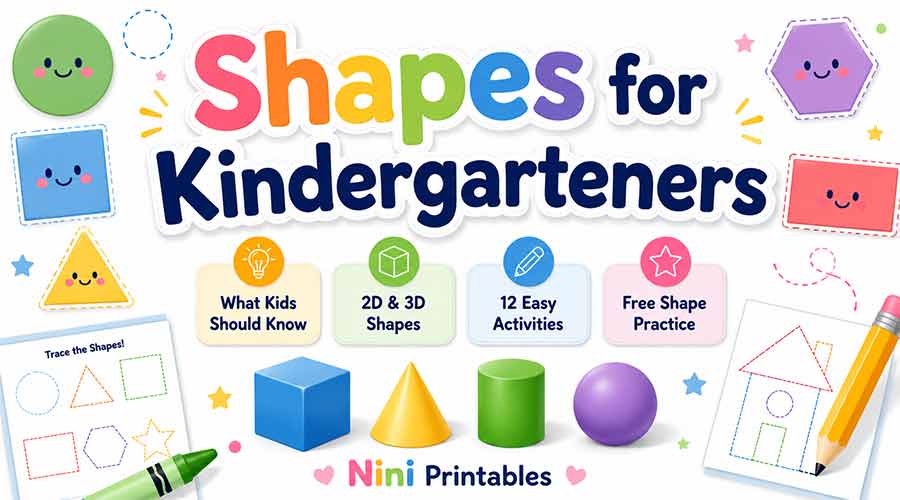
In the Common Core kindergarten geometry framework, children work with squares, circles, triangles, rectangles, hexagons, cubes, cones, cylinders, and spheres. More importantly, they learn to name shapes in different sizes and orientations, compare their features, build or draw them, and use simple shapes to make larger ones.
When you search for shapes for kindergarteners, a list of shape names is only part of the answer. A child may point to a triangle correctly but still struggle when the triangle is turned sideways, stretched, or mixed into a group of other shapes. That is why useful shape practice should include recognizing, describing, comparing, building, and drawing—not memorizing labels alone.
At Nini Printables, activities are designed to stay low-prep and focused on one clear skill at a time. For shapes, a simple sequence works well: find it → name it → describe it → make it → trace or draw it. You can use the whole sequence in one lesson or spread it across several short practice sessions. You can also learn more about Nini Printables and how the site approaches simple early-learning activities.
What Shapes Should Kindergarteners Know?
There is no single checklist used by every school, so it is better to think in terms of a learning progression than a race to memorize as many shape names as possible. In the U.S. Common Core framework, kindergarten geometry specifically includes squares, circles, triangles, rectangles, hexagons, cubes, cones, cylinders, and spheres.
For everyday practice, start with the shapes a child is most likely to see and handle. Then add new shapes as recognition becomes easier.
| Shape | Simple feature to notice | Everyday example |
|---|---|---|
| Circle | Curved edge, no corners | Plate, clock face |
| Triangle | 3 straight sides and 3 corners | Yield sign, pennant |
| Square | 4 equal straight sides | Sticky note, square tile |
| Rectangle | 4 straight sides | Book, door |
| Hexagon | 6 straight sides | Some floor tiles, pattern blocks |
| Sphere | Round solid shape | Ball, orange |
| Cube | Solid shape with square faces | Block, die |
| Cylinder | Solid shape with circular ends | Can, paper-towel roll |
| Cone | Solid shape with a point and circular base | Party hat, traffic cone |
Useful teaching detail: a shape does not become a different shape just because it is turned. A square tilted on a corner is still a square. The National Association for the Education of Young Children (NAEYC) recommends showing shapes in different sizes and orientations so children learn their defining features rather than one familiar picture.
What Does It Mean to “Know” a Shape?
Shape recognition is a good starting point, but kindergarten geometry goes further. The Common Core kindergarten geometry standards ask children to name shapes regardless of size or orientation, distinguish flat and solid shapes, compare attributes, build or draw shapes, and compose simple shapes into larger ones.
1. Recognize it
A child can find the requested shape in a mixed group. Try changing its size, color, or direction so the answer does not depend on one memorized example.
2. Name it
The child can say the shape name without needing a choice of answers. However, naming should stay connected to what the child sees.
3. Describe it
Ask questions such as, “How many sides do you see?” or “Does it have corners?” Simple observations help children compare shapes instead of treating each name as an isolated fact.
4. Find it in everyday life
A shape hunt makes geometry useful. Look for rectangles in doors and books, circles in plates and clocks, or cylinders in cans. NAEYC also recommends using ordinary routines and objects to help children identify, create, name, and compare shapes.
5. Make, trace, or draw it
Building a triangle with craft sticks, forming a circle with playdough, tracing a rectangle, or drawing a shape from memory adds a hands-on step. It also gives you a better picture of what the child understands.
2D vs. 3D Shapes for Kindergarteners
You do not need a long geometry lesson to introduce the difference. Start with a simple contrast: 2D shapes are flat, while 3D shapes are solid objects you can hold and turn.
Put a paper circle next to a ball, or a paper rectangle next to a small box. Then ask what looks similar and what is different. This is more meaningful than memorizing “circle equals 2D” and “sphere equals 3D” without seeing the connection.
NAEYC’s guidance on discovering shapes and space also encourages children to compare two- and three-dimensional shapes and use real objects as part of the learning process.
12 Easy Shape Activities for Kindergarteners
These shape activities for kindergarten use common supplies and short instructions. Choose one or two at a time rather than trying to turn shape practice into a large project.
1. Go on a Shape Hunt
Pick two or three shapes and look for them around the room, on a walk, or at the store. Ask the child to explain the choice: “What makes that window a rectangle?”
Make it harder: look for the same shape in a different size or direction.
2. Trace Shapes with a Finger First
Before using a pencil, let the child trace a large shape with a finger. Say the shape name and notice its edges or corners together. Then move to a crayon or pencil when the motion feels comfortable.
3. Build Shapes with Craft Sticks
Use craft sticks or straws to make triangles, squares, rectangles, and other straight-sided shapes. Count the pieces as you build. Then ask what needs to change to turn one shape into another.
4. Make Shapes with Playdough
Roll playdough into long “snakes” and bend them into simple shapes. For solid shapes, roll a ball to introduce a sphere or build a simple cube-like form together.
5. Sort Household Objects by Shape
Gather a few safe objects such as lids, blocks, small boxes, or cards. Let the child sort them by shape, then ask how the objects in each group are alike.
6. Draw Shapes in Salt, Sand, or Flour
Spread a thin layer in a tray and draw shapes with one finger. This keeps the activity tactile while adding early drawing and fine-motor practice.
Ready for a Quiet Printable Activity?
The free Preschool Shapes Tracing pack includes 16 US Letter pages with shape tracing, coloring, matching, picture activities, and a final review page. No account is required.
View the Free Shapes Tracing Pack Browse the Shape Printables Collection7. Play a Shape Matching Game
Match one shape to another, then try matching a shape to a real object or picture. For example, a circle can match a plate, while a rectangle can match a book.
8. Make a Shape Collage
Cut or provide simple paper shapes and let the child combine them into a picture. Two triangles might become part of a larger design, while circles and rectangles can become a vehicle or robot.
9. Try a Shape Drawing Challenge
Give one playful prompt: “Can you draw a picture using three circles?” or “Can you make a house from rectangles and triangles?” There is no single correct picture.
10. Count Sides and Corners
Put two shapes side by side and compare them. Count sides and corners, then ask what is the same and what is different. This moves the conversation from shape names to shape attributes.
11. Find the Shape That Does Not Belong
Place three similar shapes and one different shape together. Ask which one does not belong and, more importantly, why. Accept a reasonable explanation rather than looking only for a fast answer.
12. Trace, Color, Match, and Review
Finish with a short printable page when you want focused table practice. Tracing can support pencil control, while coloring and matching add another way to notice and identify shapes.
You can use the free Preschool Shapes Tracing printable as a follow-up to a hands-on activity rather than making worksheets the entire lesson.
Optional supplies: crayons, washable markers, playdough, craft sticks or straws, child-safe scissors, scrap paper, and a shallow tray for sensory drawing.
You do not need every item. Use what is already easy to reach.
A Simple 5-Day Shape Learning Routine
If you are wondering how to teach shapes without repeating the same worksheet every day, use one short focus at a time. Ten or fifteen minutes can be enough for a simple practice session.
Repeat the routine with new shapes or mix familiar shapes in different sizes and orientations. The goal is not to finish a list quickly. Instead, give the child enough variety to recognize the same defining features in new examples.
4 Common Shape-Learning Mistakes to Avoid
Showing only one “perfect” version of a shape
If every triangle points up and looks exactly the same, a child may learn the picture rather than the idea. Rotate shapes and vary their size and proportions.
Focusing only on names
Naming is useful, but follow it with a question: “How do you know?” NAEYC notes that adults can deepen shape learning by talking about properties, parts, sizes, and orientations rather than labeling alone.
Introducing too many shapes at once
Start with a small set. Once a child can comfortably find and compare those shapes, add another. A short successful activity is usually more useful than a crowded lesson.
Using worksheets as the only practice
Printable pages are useful for calm, focused practice, especially for tracing and review. However, shape learning becomes richer when children also handle objects, build shapes, look around the room, and talk about what they notice.
How to Tell When a Child Understands a Shape
You do not need a formal test. Use a few simple prompts over several activities. A child is building stronger shape understanding when they can do several of the following:
- Find the shape in a mixed group.
- Name it without needing a multiple-choice answer.
- Recognize it when it is larger, smaller, or rotated.
- Describe a simple feature such as sides or corners.
- Find a related shape in an everyday object.
- Build, trace, or draw the shape.
- Compare it with another shape.
- Use simple shapes to make a larger picture or design.
If one step is difficult, go back to a hands-on version. For example, build a triangle with sticks before asking the child to draw one. That keeps practice concrete and gives the learner another way into the idea.
Keep the Practice Simple
Need an easy next step? Start with one free printable, a pencil or crayon, and a few minutes of guided practice.
Get the Free Shapes Tracing Printable Explore All Free PrintablesFrequently Asked Questions About Shapes for Kindergarteners
What shapes should a kindergartener know?
In the Common Core kindergarten framework, geometry includes squares, circles, triangles, rectangles, hexagons, cubes, cones, cylinders, and spheres. Children also work on naming, comparing, building, drawing, and composing shapes—not just memorizing a list.
Should kindergarteners learn 2D or 3D shapes?
Both can be introduced. Start with familiar flat shapes such as circles, triangles, squares, and rectangles, then connect them to solid shapes such as spheres, cubes, cylinders, and cones using real objects.
How can I teach shapes at home?
Use ordinary objects and short activities. Look for shapes in the room, build them with sticks or playdough, sort objects, count sides and corners, and finish with tracing or drawing when the child is ready.
How do you make learning shapes fun?
Keep the task active and small. A shape hunt, playdough challenge, collage, sensory tray, matching game, or “which one does not belong?” question gives the child something to do rather than only something to memorize.
Are tracing activities useful for learning shapes?
Tracing can be one useful part of shape practice because it combines visual attention with pencil movement. It works best alongside naming, comparing, building, sorting, and finding shapes in real objects.
Start with One Shape, Then Build from There
Shape learning does not need a complicated lesson plan. Start with two or three familiar shapes, look for them in everyday objects, talk about their features, and let the child build or draw them. Then use a short printable activity when you want extra tracing, matching, or review practice.
For a ready-to-print option, visit the Preschool Shapes Tracing pack, or browse the growing shape printables collection.
About This Guide
Nini Printables creates low-prep printable activities for preschool and kindergarten learners. This guide was reviewed against the Common Core Kindergarten Geometry standards and early-childhood learning guidance from NAEYC. It is intended as practical educational guidance for parents, caregivers, homeschool families, and educators—not as a formal assessment or a substitute for a child’s school curriculum.
Learn more about Nini Printables.
Teaching References
This guide was prepared using Nini Printables’ low-prep activity approach together with established early-childhood geometry guidance. Learning expectations can vary by school, state, and child.
Source note: this article does not directly rely on a peer-reviewed research paper or quote study findings that require DOI citation. The references below are standards and professional early-childhood guidance.
Nini Printables keeps its learning resources simple and easy to access. If this guide helped your family or classroom, sharing it with another parent or educator is a simple way to support the site.