
Fine Motor Activities for Preschoolers: 20 Easy Ways to Build Hand Strength and Control
These simple preschool fine motor activities use everyday materials to practise squeezing, pinching, transferring, threading, cutting, drawing, and early pencil control without turning practice into a long lesson.
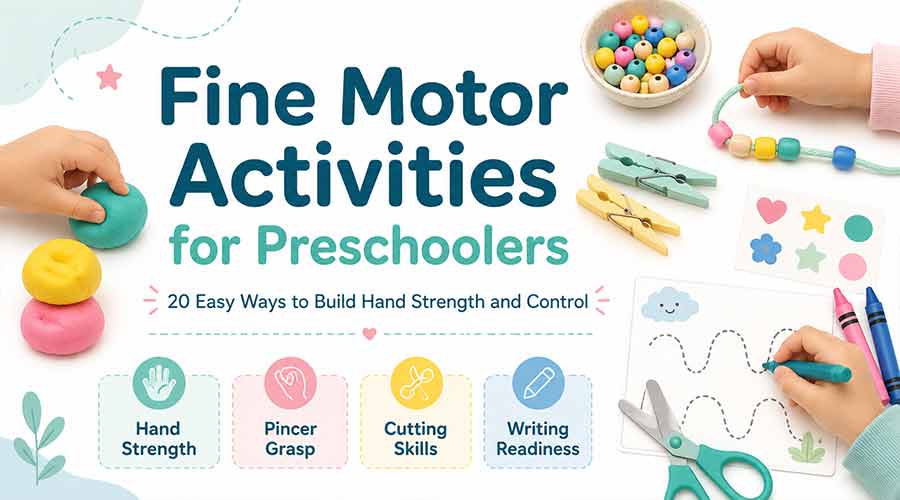
Good fine motor activities for preschoolers include playdough, clothespins, tongs, stickers, bead threading, paper tearing, simple cutting, drawing, and tracing. The most useful activity is the one that matches the skill a child is ready to practise, such as hand strength, pincer grasp, two-hand coordination, or pencil control.
Preschoolers use their hands all day: opening containers, turning pages, building with blocks, pulling on clothing, drawing, and helping with simple routines. Those everyday actions give children repeated opportunities to coordinate their fingers, hands, wrists, and eyes.
Fine motor practice does not need special equipment or a complicated setup. In fact, many of the most useful fine motor skills activities for preschoolers can be done with playdough, paper, clothespins, tongs, crayons, or stickers. A short activity is often easier to repeat than a large craft project. The goal is not to rush children toward handwriting. Instead, it is to give them varied, playful chances to control small movements.
What Are Fine Motor Skills?
Fine motor skills involve controlled movements of smaller muscles, especially in the hands and fingers. In preschool, that control shows up when children grasp and manipulate objects, use tools such as crayons and scissors, string beads, draw details, or coordinate both hands during a task.
The U.S. Head Start Early Childhood Learning & Knowledge Center describes fine motor development in terms of increasing control, strength, coordination, grasping, tool use, and hand-eye coordination. That is why useful preschool fine motor activities are more varied than pencil-and-paper work alone.
Fine motor skills vs. gross motor skills
Gross motor skills use larger body movements, such as running, climbing, jumping, and balancing. Fine motor skills use smaller, more precise movements. Both matter, and they often work together during real activities. For example, a child may sit upright at a table while one hand holds paper and the other hand controls scissors.
Keep expectations flexible. Children develop at different rates and may approach the same task in different ways. Use the ideas below as practice opportunities, not as a test or developmental diagnosis.
Fine Motor Activities for Hand and Finger Strength
Squeezing, pressing, pinching, and pulling give little hands resistance to work against. These activities are easy to repeat at home, in a preschool center, or during a short learning break.
Playdough Squeezing and Pinching
Invite children to roll, squeeze, flatten, pinch, and pull playdough. Then make small balls, snakes, pretend food, or simple shapes.
Practises: finger strength, hand strength, thumb-and-finger control.
Simple variation: Hide a few large beads in the dough and let the child find and pull them out.
Clothespin Pick-Up
Place several clothespins around the edge of a sturdy container or piece of cardboard. Children squeeze each pin to remove it and clip it back on.
Practises: squeezing strength, finger isolation, controlled release.
Keep it playful: Add color dots and ask children to clip a pin beside the matching color.
Sponge Squeezing
Give children a clean sponge and two shallow bowls. They can soak the sponge in one bowl, squeeze the water into the other, and repeat.
Practises: whole-hand squeezing and wrist control.
Less mess: Put the bowls on a tray or use the activity outside.
Paper Crumpling
Tear scrap paper into manageable pieces and let children crumple each piece into a ball using one hand or both hands.
Practises: finger flexion, palm strength, coordinated pressure.
Use the result: Toss the paper balls into a basket or glue them into a simple collage.
Hole Punching
With a child-friendly single-hole punch and adult supervision, let children punch along the edge of paper or around a simple drawn shape.
Practises: hand strength, bilateral coordination, controlled placement.
Start easy: Use thinner paper before moving to cardstock.
Activities for Pincer Grasp and Precision
Picking up small objects between the thumb and fingers asks for more precision than whole-hand grasping. Choose items that are large enough to be safe for the child and supervise activities that use small loose parts.
Pom-Pom Transfer with Tongs
Place pom-poms in one bowl and invite children to move them into another bowl with child-sized tongs or large tweezers.
Practises: grasp-and-release control, hand-eye coordination, precision.
Add learning: Sort by color or move a set number of pom-poms into each cup.
Sticker Peel and Place
Peel one edge of a sticker to get started if needed, then let the child pinch, lift, and place the sticker on paper.
Practises: fingertip control, visual placement, bilateral coordination.
Easy setup: Draw circles, lines, or simple shapes and invite children to cover them with stickers.
Coin or Button Drop
Cut a slot in the lid of a reusable container and let children pick up large tokens or buttons one at a time and push them through the opening.
Practises: pincer grasp, wrist positioning, controlled release.
Safety first: Use only objects appropriate for the child’s age and supervise closely around small parts.
Bead Threading
Use large beads and a thick lace, shoelace, or pipe cleaner. Start with only a few beads so the task feels achievable.
Practises: two-hand coordination, visual targeting, finger control.
Make it easier: A pipe cleaner stays firm and can be simpler than soft string for beginners.
Small Object Sorting
Sort safe manipulatives into a muffin tin, ice-cube tray, or several small bowls. Children can use their fingers first and tongs later.
Practises: precise pickup, release, visual discrimination, hand-eye coordination.
Keep the task clear: Sort by one feature at a time, such as color, size, or type.
Need a simple fine motor activity you can print?
Nini Printables has free preschool activities that combine fine motor practice with tracing and pre-writing paths. They can work as a short tabletop activity, a learning center, or an extra option after hands-on play.
Cutting and Two-Hand Coordination Activities
Many preschool tasks ask both hands to do different jobs at the same time. One hand may hold, turn, or stabilize while the other hand cuts, threads, tears, or places.
Snipping Paper Strips
Cut paper into narrow strips and let children make short snips from one edge. This keeps the first cutting task small and predictable.
Practises: opening and closing scissors, helper-hand use, visual attention.
Adult role: Model safe scissor handling and provide age-appropriate child scissors.
Cutting Along Straight Lines
Draw thick, short lines on paper. Invite the child to cut from one end toward the other rather than starting with complicated pictures.
Practises: scissor control, visual tracking, paper stabilization.
Progress slowly: Move from short straight lines to longer lines, then gentle curves.
Cutting Simple Shapes
Once straight cutting feels comfortable, use large circles, squares, or simple pictures with thick outlines.
Practises: turning paper with the helper hand, direction changes, sustained control.
Avoid perfection: The goal is controlled practice, not a perfectly cut shape.
Lacing Cards
Thread a lace through large holes around a card. Children can work around the edge or simply move the lace from one hole to another.
Practises: two-hand coordination, visual planning, controlled pulling.
DIY option: Punch holes around sturdy cardboard and tape the end of a shoelace if it begins to fray.
Tear-and-Paste Collage
Let children tear paper into pieces, pick up each piece, add a small amount of glue, and place it on a larger sheet.
Practises: bilateral coordination, fingertip control, hand strength.
Low-pressure art: Use scrap paper and let the collage stay open-ended.
Fine Motor Activities That Support Writing Readiness
Writing readiness is only one part of fine motor development. Before asking for repeated letter practice, children can spend time controlling lines, following paths, drawing simple forms, and making marks with crayons or pencils.
This is also where fine motor practice overlaps with pre-writing activities for preschoolers. To avoid turning every activity into tracing, use the ideas below as one part of a broader mix that also includes squeezing, building, cutting, threading, and everyday self-help tasks.
Trace Simple Paths
Start with wide, short paths and invite children to follow them with a finger, crayon, or pencil.
Practises: visual tracking, controlled movement, staying within a path.
Try first: Finger tracing can make a new path easier to understand before using a writing tool.
Draw Lines and Shapes
Draw a line, circle, cross, square, or simple picture and invite the child to copy it in their own way.
Practises: visual-motor imitation, direction changes, pencil or crayon control.
Keep it open: Mix copying with free drawing so the activity does not feel like a test.
Follow Road or Animal Paths
Use a road, trail, or animal-themed path and let children move a finger, toy, crayon, or pencil from start to finish.
Practises: direction, visual attention, controlled path following.
Printable option: The Vehicles Pre-Writing Paths pack uses roads and routes for this kind of practice.
Connect Simple Pictures
Place two related pictures or marks on a page and ask the child to draw a line from one to the other.
Practises: purposeful line movement, visual targeting, start-and-stop control.
Keep spacing manageable: Begin with large targets and short distances.
Color Small Areas
Offer a picture with a few clearly defined areas and let children color at their own pace using crayons or washable markers.
Practises: tool control, visual attention, repeated small hand movements.
Change the tool: Short crayons can encourage children to use their fingertips rather than gripping a long tool with the whole hand.
Choose a Fine Motor Activity by the Skill Your Child Is Practising
When there are dozens of preschool fine motor activities to choose from, it helps to start with the skill rather than the activity list. The chart below gives a quick way to match practice to a current need.
| Skill | Try | What to notice |
|---|---|---|
| Hand strength | Playdough, sponge squeezing, clothespins | Can the child squeeze, release, and repeat without becoming frustrated? |
| Pincer grasp | Stickers, pom-poms, large beads, sorting | Does the child increasingly use fingertips for smaller objects? |
| Two-hand coordination | Lacing, tearing paper, cutting | Can one hand stabilize while the other hand works? |
| Scissor control | Snipping, straight lines, simple shapes | Can the child open and close scissors while guiding the paper? |
| Pencil control | Drawing, paths, tracing, coloring | Is movement becoming more intentional and controlled? |
| Hand-eye coordination | Threading, transfers, sorting, simple paths | Can the child visually guide the hands toward a target? |
Fine Motor Activities for 3–4 Year Olds and Older Preschoolers
Age can help with activity selection, but it should not become a rigid checklist. Parents and teachers looking for fine motor activities for 3–4 year olds can start with larger materials and simpler actions, then add more precision as the child becomes comfortable. A child may find one activity easy and another challenging on the same day, so adjust the size, resistance, distance, or precision rather than treating age as a pass-or-fail standard.
Ages 3–4: Keep Materials Large and Actions Simple
- Squeeze and pinch playdough.
- Peel and place large stickers.
- Transfer larger objects with tongs.
- Thread large beads on a firm lace or pipe cleaner.
- Make short snips in paper.
- Draw freely with crayons and washable markers.
Ages 4–5+: Add More Control and Precision
- Sort smaller safe manipulatives.
- Cut along short straight lines, then simple curves.
- Use lacing cards with more holes.
- Copy simple lines and shapes.
- Follow roads, trails, and tracing paths.
- Combine drawing, cutting, and pasting in one activity.
Easy Fine Motor Activities With Almost No Prep
Some days, the best activity is the one that can start in two minutes. These low-prep ideas use items many families and classrooms already have:
- Tear scrap paper into small pieces.
- Peel stickers and place them along a drawn line.
- Clip clothespins around a cardboard edge.
- Stack blocks or small cups.
- Open and close reusable food containers.
- Fold paper in half and press the crease.
- Sort crayons or craft items by color.
- Draw roads, circles, or zigzags on scrap paper.
- Move cotton balls or pom-poms with kitchen tongs.
- Roll small pieces of playdough between the fingers.
Repetition is useful, so there is no need to introduce a new activity every day. A familiar task can become more challenging by changing the tool, using smaller safe materials, increasing the distance between containers, or adding a simple sorting rule.
Optional Supplies for Fine Motor Practice
A small reusable activity basket is enough
You do not need to buy a large fine motor kit. A few versatile supplies can support many of the activities above:
- Playdough
- Child-safe scissors
- Large tweezers or kid tongs
- Clothespins
- Large beads and laces
- Stickers
- Crayons or washable markers
- Sorting bowls or a muffin tin
When Are Fine Motor Printables Helpful?
Hands-on play should remain a large part of preschool fine motor practice. However, a simple printable can add focused practice when a child is ready to follow lines, trace paths, color defined spaces, or control a crayon or pencil across a page.
Printables are especially useful when adults need a clear, low-prep activity for a learning center, quiet table time, a short homeschool session, or an extra activity after more active play. The most helpful pages have a clear purpose and enough visual space for the child to understand what to do.
Try a free printable after hands-on practice
The Nini Printables fine motor library includes simple tracing and pre-writing activities that can follow playdough, tongs, threading, or cutting practice.
A Simple 5-Day Fine Motor Routine for Preschoolers
A routine can remove the pressure to invent a new activity every day. Five to ten minutes of focused practice is enough for a simple learning moment, especially when children are still interested and comfortable.
Squeeze, roll, pinch, and make small shapes.
Transfer and sort safe objects between bowls.
Snip paper strips or follow short straight lines.
Work on fingertip control and two-hand coordination.
Finish with free drawing, tracing, or a printable path.
If an activity is frustrating, simplify it rather than pushing for completion. Larger materials, shorter tasks, fewer pieces, or an adult demonstration can make the same idea more accessible.
Frequently Asked Questions About Preschool Fine Motor Activities
What are good fine motor activities for preschoolers?
Good choices include playdough, clothespins, tongs, stickers, threading, sorting, paper tearing, cutting, drawing, coloring, and simple tracing. Choose a mix of activities so children practise strength, precision, coordination, and tool control rather than repeating only pencil work.
What fine motor skills should preschoolers practise?
Preschool fine motor practice can include grasping and releasing, pinching, squeezing, using both hands together, coordinating the hands with the eyes, manipulating small safe objects, using scissors, and controlling crayons, markers, or pencils. Individual development varies, so these are practice areas rather than a pass-or-fail checklist.
How can I help a preschooler build hand strength?
Offer activities that provide gentle resistance, such as squeezing playdough or a sponge, opening clothespins, tearing paper, and pushing or pulling simple manipulatives. Keep sessions short and playful, and stop if the child is uncomfortable.
Does playdough help with fine motor practice?
Yes. Rolling, squeezing, pinching, flattening, and pulling playdough give children repeated opportunities to use the hands and fingers in different ways. It is also easy to adjust the activity without turning it into formal worksheet practice.
Are tracing activities good for fine motor skills?
Tracing can be one useful form of fine motor and pre-writing practice because it asks children to guide a writing tool along a path. However, it should sit alongside other activities such as playdough, threading, cutting, sorting, building, and everyday hand use.
Start With One Activity That Fits Today
Fine motor practice works best when it feels like something a child can do, not another task to finish. Start with one simple action: squeeze playdough, move objects with tongs, peel stickers, thread a few beads, snip paper, draw, or follow a short path.
Over time, those small opportunities give preschoolers more experience controlling their hands during everyday play and early learning. When pencil-and-paper practice makes sense, keep it simple and pair it with plenty of hands-on activity.
Looking for the next simple activity?
Browse free preschool and kindergarten printables for fine motor, pre-writing, tracing, counting, matching, and shape practice.
Enjoying the free resources? Sharing Nini Printables with another parent, teacher, or homeschool family is a simple way to support the growing library.