
Preschool Writing & Early Literacy
Pre-K Writing Center Ideas: How to Set Up a Simple Preschool Writing Space
Create a low-prep writing space children can actually use. These Pre-K writing center ideas cover simple setup, useful supplies, playful activities, small-space options, and free printable practice.
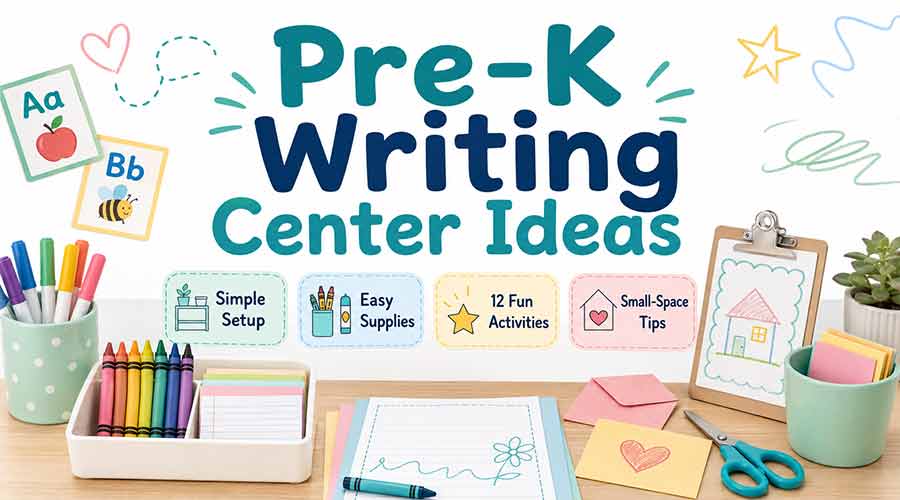
A preschool writing center does not need a special desk or a large collection of worksheets. In fact, the most useful setup is often a small table, shelf, basket, or portable caddy that makes drawing and writing materials easy to reach. Children can use the space to scribble, draw, make lists, create signs, copy familiar words, and experiment with letters.
That broad approach matches established early-childhood guidance. Head Start describes early writing as developing from marks and scribbling toward drawing, letter-like forms, and letters.[1] NAEYC also encourages families to make writing materials easy to access and to connect writing with everyday purposes such as lists, notes, and play.[2] The goal, therefore, is not perfect handwriting. It is to make writing available, useful, and inviting.
What Is a Pre-K Writing Center?
A Pre-K writing center is a small, accessible place where children can explore drawing, mark-making, and early writing. In a classroom, it may be a learning center. At home, it can be a basket that comes out at the kitchen table. Illinois Early Learning describes drawing and writing centers as spaces where children can use accessible materials to create pictures, messages, signs, and other meaningful forms of print.[3]
For preschoolers, “writing” can include much more than forming letters. A child may draw a picture, make a row of marks, pretend to write a grocery list, copy the first letter of a name, or dictate a sentence for an adult to write underneath a drawing. Those attempts are part of early writing development rather than mistakes that need constant correction.
NAEYC recommends making pencils, markers, paper, envelopes, and book-making materials available and finding everyday reasons for children to use writing.[2] That is why a good preschool writing center includes both open-ended materials and simple prompts instead of relying only on worksheets.
How to Set Up a Simple Preschool Writing Center
Choose a small, easy-to-reach space
Start with a place the child can use without a complicated setup. A child-size table is useful, but it is not required. A low shelf beside a table, a writing basket on a homeschool cart, or a portable caddy can work just as well.
Keep the materials visible
Children are more likely to use materials they can see and reach. Keep everyday tools together, and place less frequently used materials in a separate container. This also makes cleanup easier because each item has a clear home.
Start with less than you think you need
Too many supplies can make the center harder to use. Begin with a few reliable choices. Once children know where things belong and how to use them, add one or two new materials at a time.
- One reachable work surface
- Crayons or washable markers
- Blank and colored paper
- Index cards or sticky notes
- Name or alphabet reference cards
- A basket, tray, or caddy for storage
What to Put in a Preschool Writing Center
The best supplies are the ones children can use in several ways. Instead of buying a long list of specialty materials, build the center around basic tools, paper, and a few visual supports.
Writing tools
Offer a small choice such as crayons, washable markers, colored pencils, or pencils. Children do not need every tool at the same time. Rotating two or three choices can keep the area manageable.
Paper children can use for real purposes
Blank paper works for drawing and invented writing. Index cards can become labels or signs. Envelopes make letter writing feel purposeful. Small folded sheets can become mini books. Sticky notes work well for quick marks, names, or pretend reminders.
Simple writing supports
Name cards, alphabet cards, picture-word cards, and a few familiar labels can give children something useful to look at without turning the center into a copying drill. Keep these supports optional so children can still invent their own marks and drawings.
12 Easy Pre-K Writing Center Ideas
These preschool writing activities give children a simple reason to draw, make marks, communicate, or experiment with letters. Pick one or two at a time rather than turning the list into a required sequence.
Draw and Label
Invite the child to draw a favorite animal, food, person, or place. Then ask whether they would like to add a name, first letter, mark, or label. Adults can write the child’s dictated words nearby when needed.
Make a Name Card
Write the child’s name clearly on a card and let them decorate around it, trace it with a finger, copy any letters they notice, or simply use it as a reference while they draw.
Write a Postcard
Give the child a small card and ask who should receive it. They can draw on one side and make marks, letters, or dictated words on the other. The activity gives early writing a clear purpose: sending a message to someone.
Make a Grocery List
During pretend play, ask what the kitchen or store needs. A child can draw apples, make tally-like marks, copy the first letter of “milk,” or dictate the list while an adult writes it down.
Create a Sticker Story
Let the child choose two or three stickers and place them on paper. Ask what is happening in the picture. They can add drawings, marks, speech bubbles, or letters to turn the stickers into a simple story.
Stamp and Write
Put out a few alphabet stamps rather than the whole set. A child can stamp a letter, notice its shape, and then try drawing around it or making a similar mark with a crayon. There is no need to demand correct letter formation.
Try a Clipboard Writing Hunt
Give the child a clipboard and look for letters, shapes, colors, or familiar objects around the room. They can draw what they find, make a mark for each item, or copy a letter that catches their attention.
Make a Pretend Restaurant Menu
Ask the child what their restaurant serves. They can draw the food, add pretend prices, copy a few letters, or dictate item names. Later, use the menu during pretend restaurant play.
Make a Sign
Children see signs everywhere, so let them create one. It might say “OPEN,” “STOP,” “DOG,” “SHOP,” or simply use a child-created symbol. Put the finished sign into block play, a pretend shop, or a bedroom door.
Create a Family or Classroom Message Board
Put a small sheet, clipboard, or pocket chart in the writing area for simple messages. A child can draw a picture for a family member or friend, add marks or familiar letters, or dictate a short message for an adult to write underneath.
Make Invitations or Pretend Tickets
Invite the child to make a birthday invitation, zoo ticket, pretend show ticket, or pass for a dramatic-play area. They can draw symbols, add names, copy one familiar word, or decide what information the ticket needs.
Make a Mini Book
Fold a few sheets of paper and let the child create a cover and one picture per page. They can add marks, letter-like forms, copied letters, or dictated sentences. A simple book often keeps children engaged longer because the pages belong to one idea.
How to Keep a Preschool Writing Center Interesting
A writing center does not need a complete makeover every week. Instead, keep the basic paper and writing tools familiar, then change only one or two small elements. This gives children something new to notice without requiring a teacher or parent to rebuild the entire space.
Watch what children actually use. If the envelopes are popular, keep them longer. If a stamp set is ignored, put it away and try it again another time. Rotation should respond to interest rather than follow a rigid calendar.
Pre-K Writing Center Ideas for Small Spaces
A separate classroom center is helpful, but it is not necessary. Small homes, shared classrooms, and homeschool spaces can still make writing materials easy to access.
Portable writing caddy
Keep crayons, markers, paper, sticky notes, and a few cards in one handled caddy. Bring it to a table when needed, then store it on a shelf afterward.
One-shelf writing center
Use one low shelf for a paper tray, a cup of writing tools, and a small basket of prompts. The child can carry the materials to a nearby table or floor workspace.
Kitchen-table writing basket
At home, a single basket can turn an ordinary table into a preschool writing space. Keep the basket small enough that setup and cleanup each take less than a minute.
Printable Activities to Add to a Writing Center
Printables can be useful when you want one ready-to-use tabletop activity, but they work best as one option inside a broader writing space. Children should still have opportunities to draw, invent marks, make signs, and use writing during play.
Dinosaur Pre-Writing & Fine Motor Activity Pack
This free 16-page pack uses dinosaur-themed paths for pre-writing and fine motor practice. It is a good option when a child enjoys themed routes or needs a calm activity that can be finger-traced before using a crayon or pencil.
Vehicles Pre-Writing Paths
This free 16-page printable uses roads and routes with straight, curved, wavy, zigzag, roundabout, and spiral-style paths. Children can finger-trace a route first, then repeat it with a writing tool.
Common Preschool Writing Center Mistakes
Putting out too many supplies
More materials do not automatically create more learning. Too many choices can make the area harder to use and harder to clean up. Start small, then add variety gradually.
Turning the center into worksheet time
A writing center should include reasons to communicate, create, and play. Tracing sheets can be useful, but they should not replace drawing, pretend lists, signs, cards, and child-created writing.
Correcting every mark
Young children may scribble, use letter-like forms, reverse letters, or mix drawings and writing. Early attempts can show that a child is beginning to understand that marks carry meaning. Respond to the message first instead of correcting every form.
Making every activity too difficult
If a child avoids the center, simplify it. Offer a thicker crayon, larger paper, fewer choices, or a drawing activity before asking for more controlled marks.
Never changing the materials
Familiarity helps children work independently, but one small change can renew interest. Rotate a prompt, paper type, theme, or tool rather than replacing everything.
Using small materials without appropriate supervision
Stickers, stamps, clips, and other small pieces may not suit every child or setting. Choose materials that are appropriate for the children using the center and follow the product’s age and safety guidance.
Frequently Asked Questions About Pre-K Writing Centers
What should be in a preschool writing center?
Start with paper, crayons or washable markers, a few reference cards, and a simple storage basket or caddy. Then add optional materials such as envelopes, sticky notes, stickers, stamps, or clipboards as children become comfortable using the space.
What age should children start using a writing center?
There is no single starting age for every child. Preschool writing centers can support children who are drawing and scribbling as well as children who are beginning to copy letters or write familiar words. Match the materials to the child’s current interests and abilities.
How long should preschoolers spend at a writing center?
There is no required amount of time. A child may use the center briefly for one drawing or stay longer to make a book or pretend menu. Engagement and comfort are more useful guides than forcing a fixed number of minutes.
What if my preschooler only scribbles?
Scribbling is part of early writing development. Invite the child to tell you about the marks, add a drawing, or dictate a message. You can model writing nearby without requiring the child to copy you.
Should preschoolers use pencils or crayons?
They can use different age-appropriate writing tools. Crayons and washable markers are often easy choices for open-ended drawing and mark-making, while pencils can be available when a child is interested. Variety is more important than insisting on one tool.
Can I make a preschool writing center at home?
Yes. A home writing center can be as simple as a basket with paper and a few writing tools that comes out at a kitchen or child-size table. A permanent desk is not required.
Keep the Writing Center Simple and Useful
The best preschool writing center is not the one with the most supplies. It is the one children can understand, reach, and return to. Begin with a few basic materials, give children real reasons to draw and write, and rotate one small element when the space needs fresh interest.
Some days that may mean making a grocery list. Other days it may mean drawing a road, writing a postcard, or creating a mini book. The important part is that writing feels like something children can use—not a test they have to pass.
Enjoying the free resources? Sharing a useful Nini Printables activity with another parent, teacher, or homeschool family is a simple way to support the site while helping more families find free learning ideas.