
15 Pre-Writing Activities for Preschoolers to Build Pencil Control
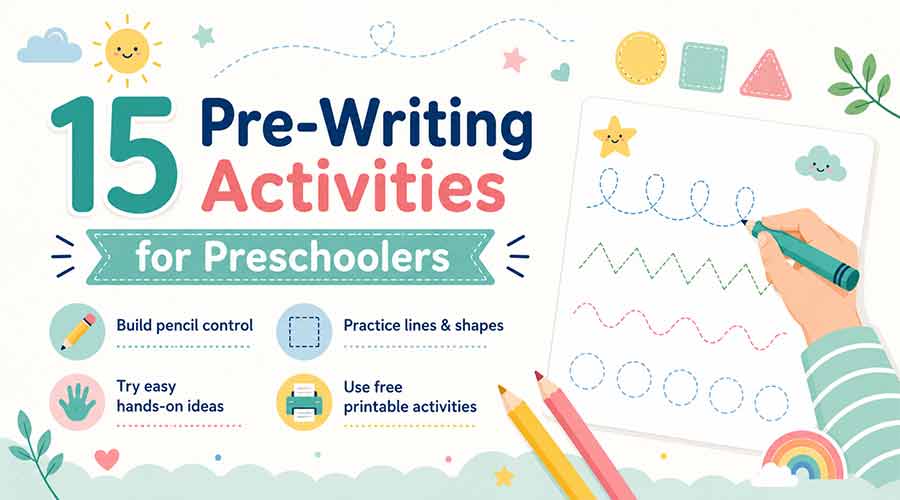
Pre-writing activities for preschoolers do not need to begin with letter worksheets. Simple lines, finger paths, playdough, drawing, tracing, and playful routes can help children practise the controlled movements they will later use for writing. The goal is not perfect handwriting. Instead, it is to give little hands short, successful chances to make marks, follow paths, and enjoy using writing tools.
What Counts as a Pre-Writing Activity?
A pre-writing activity is any age-appropriate activity that helps a child practise movements and control used before conventional handwriting. That can include scribbling, drawing, making lines, tracing simple paths, copying shapes, or manipulating materials with the hands.
Head Start describes preschool writing development as progressing through drawing, scribbling, letter-like forms, and letters. In other words, early writing grows over time rather than starting with perfectly formed letters. See Head Start’s preschool literacy guidance.
This guide gives parents, homeschoolers, and preschool teachers 15 low-prep ideas, a simple practice order, and two free printable options when a ready-to-use activity is helpful.
What Skills Do Pre-Writing Activities Practice?
Pre-writing practice combines several small skills. Children need opportunities to control crayons and pencils, coordinate what they see with how their hands move, and follow a direction or visual path. They also benefit from varied hand use outside pencil-and-paper work.
- Pencil and crayon control: stopping, starting, changing direction, and staying near a path.
- Hand-eye coordination: matching hand movement to what the child sees on the page or table.
- Visual tracking: following a road, line, curve, or sequence from one point to another.
- Basic mark-making: drawing lines, curves, circles, and simple shapes.
NAEYC notes that everyday fine-motor experiences help build hand strength and coordination for later tasks such as writing. That is why this article mixes hands-on play with tracing instead of treating worksheets as the only form of practice. Read NAEYC’s fine-motor guidance.
Start With Simple Lines, Then Add Curves and Shapes
There is no need to rush through a fixed sequence. However, a simple progression makes it easier to choose an activity that feels manageable. Start with large, easy movements. Then add changes in direction as the child becomes more comfortable.
| Start With | Then Try | Later Challenge |
|---|---|---|
| Straight lines | Curved lines | Zigzags |
| Horizontal paths | Circles | Spirals |
| Vertical paths | Simple shapes | Letter-like paths |
Start WithStraight lines
Then TryCurved lines
Later ChallengeZigzags
Start WithHorizontal paths
Then TryCircles
Later ChallengeSpirals
Start WithVertical paths
Then TrySimple shapes
Later ChallengeLetter-like paths
Tip: A child does not need to “master” one row before trying another. Use the progression as a planning guide, not a test.
15 Easy Pre-Writing Activities for Preschoolers
Choose one or two ideas at a time. Short practice usually works better than turning all 15 into a checklist. Most activities also work with crayons, washable markers, chalk, or fingers, so you can change the tool without changing the learning goal.
Hands-On Pre-Writing Activities Without a Pencil
Finger-Trace Simple Paths
Draw a wide straight, curved, or zigzag path on paper. Ask the child to move one finger from the start to the finish. Make the route large enough that accuracy is not the main challenge.
Make it easier: trace the path together once before the child tries independently.
Build Lines With Playdough
Roll playdough into short “snakes.” Arrange them as horizontal lines, vertical lines, curves, circles, or simple shapes. Children can copy a model or invent their own pattern.
Why it works: the child practises shape and direction without needing pencil control at the same time.
Draw in Salt, Sand, or Shaving Foam
Spread a thin layer of a safe sensory material on a tray. Show one simple line or circle, then let the child copy it with a finger. Smooth the surface and start again.
Keep it simple: one movement at a time is enough.
Make a Sticker Path
Place round stickers along a curved or zigzag route. The child can follow the path with a finger, toy, or crayon. Alternatively, draw the route first and let the child add stickers along it.
Variation: use two sticker colors to create a repeating pattern.
Drive a Toy Car Along a Road
Draw a wide road on paper or cardboard. Add turns, a bridge, or a finish point. Let the child drive a toy vehicle along the route before tracing a similar road with a crayon later.
Good transition: move from large toy-car motion to smaller finger motion, then to a writing tool.
Crayon and Pencil-Control Activities
Trace Straight Lines
Start with short horizontal or vertical lines. Use a thick path rather than a very thin one, especially for a child who is new to tracing lines in preschool.
Try saying: “Start here and stop here,” rather than correcting every wobble.
Follow Curved Paths
Draw a road that bends gently from one picture to another. The child can trace the route with a crayon. Curves add direction changes while keeping the task playful.
Theme idea: help a fish swim to the reef or a dinosaur reach its nest.
Try Zigzag Lines
Use wide zigzags first. Encourage the child to pause at each corner and change direction. The aim is controlled movement, not speed.
Variation: turn the zigzag into a mountain trail or lightning path.
Connect Simple Dots
Place three to five large dots in a simple line, curve, or shape. Ask the child to connect them in order. Fewer dots keep the activity focused on movement rather than counting.
Next step: let the child choose where the final dot should go.
Trace Basic Shapes
Once simple lines feel comfortable, try circles, squares, and triangles. Shapes combine several pre-writing movements in one familiar picture.
For more shape-focused learning, see Shapes for Kindergarteners.
Turn Pre-Writing Practice Into Play
Help an Animal Reach Its Home
Put an animal at one side of the page and its home at the other. Draw one clear path between them. Story-based routes give the line a purpose beyond “trace this.”
Drive a Vehicle Along a Printed Road
Use roads and routes when the child enjoys cars, trucks, boats, or planes. Finger-trace first, then repeat the route with a crayon or pencil.
The free Vehicles Pre-Writing Paths pack contains 16 printable pages with different road and route styles.
Finish a Simple Picture
Draw half of a sun, balloon string, fence, rain cloud, or road. Invite the child to add the missing lines. This combines early drawing with controlled mark-making.
Copy an Easy Pattern
Make a short pattern such as line-line-circle or curve-zigzag-curve. The child can copy it underneath. Keep the pattern short enough to remember at a glance.
Create Your Own Path
Give the child two pictures and ask, “How should we get from here to there?” Let the child draw the road. Their route can be straight, loopy, bumpy, or silly.
Why finish here: the child moves from following someone else’s path to planning one independently.
A Simple 5–10 Minute Pre-Writing Routine
Preschool writing practice does not need a long lesson. A short routine can combine movement, play, and a little pencil or crayon time.
Stop while the activity is still going well. Some children will happily continue; others may be finished after a few minutes. The routine is a flexible example, not a minimum requirement.
Printable or Hands-On Activities: Which Is Better?
Use both when they are helpful. Hands-on activities add variety and let children practise with larger movements or sensory materials. Printables provide a clear visual route and are convenient when you need a calm tabletop activity, classroom center, or repeatable practice page.
NAEYC recommends giving young children varied opportunities to develop finger dexterity and to use different writing tools. That supports a mixed approach rather than relying on one format. Read NAEYC’s guidance on emergent writing.
What If My Preschooler Does Not Want to Write?
Do not turn pre-writing into a battle. A child can practise many of the same movements before using a pencil. Start with a finger, toy car, chalk, paintbrush, playdough, or large crayon. You can also make the path shorter or let the child choose the theme.
- Use larger movements before smaller ones.
- Offer crayons or markers instead of insisting on a pencil.
- Let the child choose between two activities.
- Keep the session short.
- Praise effort and participation rather than perfect lines.
Children develop hand skills at different rates. The CDC lists holding a crayon or pencil between the fingers and thumb as one movement milestone by age 4, but milestones should not be used as a handwriting test. If you have concerns about a child’s development, discuss them with the child’s health professional rather than trying to diagnose the issue from a worksheet. See the CDC’s 4-year milestones.
Free Pre-Writing Printables to Try
These free Nini Printables resources are designed to make the next practice session easier to set up. Both can be used at home, in homeschool settings, or as classroom activities under the site’s terms of use.
Dinosaur Pre-Writing & Fine Motor Activity Pack
A 16-page dinosaur-themed printable pack with line paths and shape-based tracing practice. It works well when a child responds to story-like routes and familiar themes.
Vehicles Pre-Writing Paths
A 16-page PDF with roads, routes, and tracing paths, including straight, curved, wavy, zigzag, roundabout, and spiral-style routes.
For more low-prep activities, visit the Preschool & Kindergarten Printables library. If school readiness is also on your mind, the Kindergarten Readiness Checklist puts pre-writing into a broader set of everyday skills.
Frequently Asked Questions About Pre-Writing Activities
What are pre-writing activities for preschoolers?
They are simple activities that help children practise early mark-making and hand control before conventional handwriting. Examples include drawing, scribbling, finger tracing, line tracing, simple shapes, playdough paths, and following roads or routes.
At what age can children start pre-writing activities?
There is no single age when every child should begin formal pre-writing practice. Children often explore drawing and scribbling well before they write letters. Choose activities that match the child’s current interest and control, and keep the experience playful.
Should preschoolers trace letters?
Letter tracing can be one activity for a child who is interested and ready, but it does not need to be the starting point. Lines, curves, shapes, drawing, and playful paths can build useful control without expecting correct letter formation too early.
Are pre-writing worksheets enough?
Worksheets can provide convenient tracing practice, but they work best as one part of a broader mix. Children can also build hand control through drawing, playdough, stickers, blocks, art materials, self-care tasks, and other everyday play.
How long should a pre-writing activity last?
Keep it short enough that the child can stay engaged. Five to ten minutes can be a useful planning range for a small activity, but some children will prefer less time and others will continue longer. Interest and comfort matter more than completing a set number of minutes.
Teaching References
Development-related statements in this guide were checked against the following government and professional early-childhood sources:
Keep Pre-Writing Simple and Playful
Early writing practice does not have to look like a handwriting lesson. A child can build useful control by following a road with a finger, rolling a playdough line, drawing a circle, tracing a curve, or inventing a silly path across a page. Start with what feels manageable, vary the materials, and let interest guide the next step.
Ready for an Easy Activity?
Choose a free printable, print only the pages you need, and start with one short path today.