
Preschool Transportation & Hands-On Learning
15 Transportation Activities for Preschoolers: Easy Learning Ideas Through Play
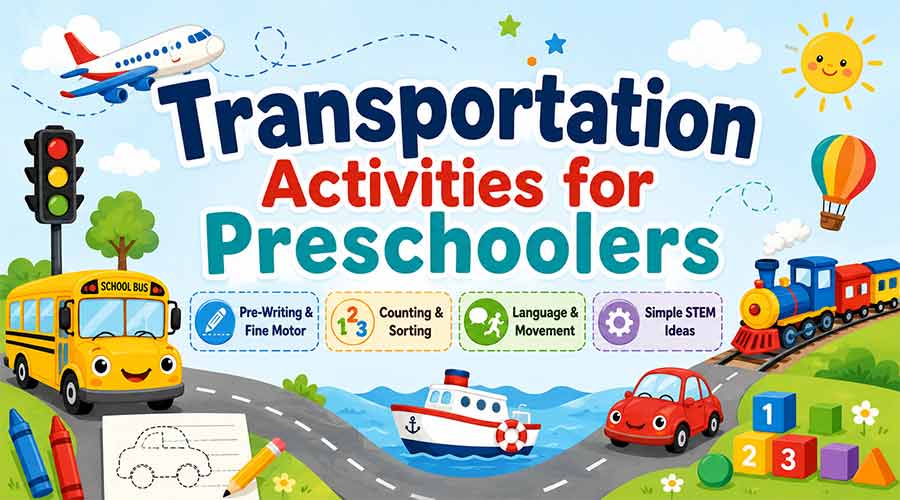
Transportation activities for preschoolers can turn familiar cars, buses, boats, trains, and airplanes into simple opportunities for counting, sorting, movement, language, fine motor practice, and early problem-solving. The ideas below are designed for homes, preschool classrooms, and Pre-K centers, with an emphasis on low-prep play and materials you may already have.
Choose a Transportation Activity by Skill
A long list of preschool transportation activities is only useful when you can quickly find the right one. Use this table to match an activity with the skill you want to practice.
| Skill | Activity | Basic Materials | Prep |
|---|---|---|---|
| Pre-writing | Drive or trace along a road | Toy car, tape, paper, crayon | Very low |
| Fine motor | Playdough tire tracks | Playdough, toy vehicles | Low |
| Counting | Parking lot counting | Toy vehicles, numbered spaces | Low |
| Sorting | Land, air, and water sort | Vehicle toys or picture cards | Low |
| Language | Guess the vehicle | No special materials | None |
| Gross motor | Red Light, Green Light | Open space | None |
| STEM | Build and test a car ramp | Cardboard, books, toy car | Low |
What Can Preschoolers Learn From Transportation Activities?
Transportation is a useful preschool theme because children can connect it with things they already see: a family car, a school bus, a delivery truck, a bicycle, a train, or an airplane overhead. That familiarity makes it easier to add new vocabulary and simple learning goals without turning play into a worksheet-only lesson.
During guided play, an adult can introduce a small goal—such as counting cars, comparing ramps, naming vehicle parts, or sorting by where a vehicle travels—while the child still has room to make choices. The National Association for the Education of Young Children describes play as an important context for joyful learning across language, cognitive, social, and other areas of development.
For preschool-age children, keep the emphasis on exploration rather than perfect answers. The CDC’s guidance for ages 3–5 also encourages age-appropriate play, interaction, movement, and hands-on activities.
Fine Motor and Pre-Writing Transportation Activities
1. Drive a Toy Car Along a Road
Make a road with painter’s tape on a table or floor. Add straight sections first, then curves and turns. Ask the child to keep the car on the road while you use simple words such as forward, turn, around, and stop.
For a younger preschooler, use one wide road. For an older preschooler, add intersections, a garage, or a simple route such as “drive to the bridge, then park beside the house.”
2. Make Playdough Tire Tracks
Flatten playdough and roll different toy vehicles across it. Then compare the marks. Which wheels make wide tracks? Which make narrow tracks? Do two vehicles leave the same pattern?
This activity works well as a small-group or quiet-table choice because the setup is simple and children can repeat it independently after a quick demonstration.
3. Paint With Toy Car Wheels
Put a small amount of washable paint on a tray, roll the wheels through it, and drive the vehicle across a large sheet of paper. Try two colors or compare the tracks made by different vehicles.
Keep this activity process-focused. The goal is not to make a perfect picture; it is to notice what happens when children push, turn, press, and change direction.
4. Follow Vehicle Paths With a Pencil or Crayon
After children have physically driven cars along roads, move the same idea onto paper. Start with straight and gently curved paths. Later, try wavy, zigzag, spiral, or roundabout-style routes.
This sequence keeps the printable connected to play rather than using tracing as an isolated task. For more ideas that build the same early pencil skills, see Pre-Writing Activities for Preschoolers and Fine Motor Activities for Preschoolers.
Transportation Math and Sorting Activities
5. Make a Parking Lot Counting Game
Draw or tape several parking spaces and give each space a number. Ask the child to park one vehicle in each space while counting aloud. Another option is to place a numeral beside a garage and ask the child to park that many cars inside it.
Keep the number range appropriate for the child. Five cars may be enough for a beginner, while another child may be ready for 1–10. For a broader set of number ideas, link this activity with Counting Activities for Preschoolers.
6. Sort Vehicles by Land, Air, and Water
Gather toy vehicles or simple vehicle pictures. Make three areas labeled land, air, and water. Children place each vehicle where they think it belongs.
Instead of correcting every answer immediately, ask a short question: “What makes you think the boat goes there?” Explaining a choice often gives you more useful information than the final sort.
7. Make a Vehicle Pattern
Arrange vehicles in a simple repeating pattern such as car–bus–car–bus. Pause and ask what comes next. Once that is easy, try car–car–truck or use colors instead of vehicle types.
8. Count Passengers on a Bus
Use a toy bus, a block “bus,” or a quick paper drawing. Add small figures or counters one at a time. Ask, “How many passengers are on the bus now?” Then let one passenger get off and count again.
Keep the focus on concrete objects. Preschoolers do not need formal equations to explore the idea that a group changes when something is added or taken away.
Transportation Language and Thinking Activities
9. Guess the Vehicle From Clues
Give two or three clues: “I have two wheels. I travel on land. You can pedal me.” Let the child guess the vehicle. Then switch roles and let the child give the clues.
You can also use sounds—such as a horn, engine, bell, or siren—but keep the clues specific enough that the game stays fun rather than frustrating.
10. Talk About How We Travel
Ask simple questions connected to everyday experiences: “How do we get to the store?” “Which vehicle can travel on water?” “Which one might carry many people?” “What vehicle would you choose for a very long trip?”
There may be more than one reasonable answer. The goal is to encourage children to explain what they know.
11. Tell a Transportation Story
Pick three vehicles and build a tiny story around them. For example: “A bus stopped near a bridge. A boat passed underneath. Then an airplane flew overhead.” Ask the child what happened first, next, and last—or let the child invent a new ending.
Movement and Pretend-Play Transportation Activities
12. Play Red Light, Green Light
Children move on “green light” and stop on “red light.” Add “yellow light” for slow movement once the basic rules are familiar. In a small indoor space, children can walk instead of run.
13. Move Like Different Vehicles
Call out a vehicle and invite children to show how it might move. They can stretch out their arms like an airplane, chug like a train, pedal an imaginary bicycle, or sway like a boat.
Then let children choose the next vehicle. Giving them that choice keeps the activity playful and encourages them to connect words with actions.
Simple Transportation STEM Activities for Preschoolers
14. Build and Test a Car Ramp
Lean a piece of cardboard against a stack of books and roll a toy car down the ramp. Ask the child to predict what might happen before each test. Then make one small change: raise the ramp, lower it, or change the surface.
Use everyday comparison words such as faster, slower, farther, higher, and lower. You do not need to turn the activity into a formal science lesson for it to encourage observation and problem-solving.
15. Build a Road, Bridge, or Garage
Offer blocks, cardboard, paper tubes, or magnetic building pieces and a few toy vehicles. Ask a simple challenge: “Can you build a bridge the truck can fit under?” or “Can you make a garage with room for three cars?”
Let children rebuild when a structure falls or a vehicle does not fit. The redesign is part of the activity.
Make the Activities Easier or Harder
Preschool classrooms and families include children with different interests, attention spans, and skill levels. Rather than choosing a new activity every time, adjust the same idea.
| Make It Easier | Add a Challenge |
|---|---|
| Use fewer vehicle choices. | Ask the child to explain how items were sorted. |
| Count within 1–5. | Count within 1–10 or beyond when ready. |
| Use wide, short tracing paths. | Add curves, zigzags, or child-drawn roads. |
| Model the first turn. | Let the child teach the activity back to you. |
| Offer two possible answers. | Ask open questions such as “How do you know?” |
A Simple 5-Day Preschool Transportation Theme Plan
You can also spread these preschool transportation theme activities across a week instead of setting up several centers at once.
| Day | Main Activity | Skill Focus |
|---|---|---|
| Monday | Land, air, and water sort | Vocabulary and classification |
| Tuesday | Toy-car wheel painting | Art and fine motor |
| Wednesday | Parking lot counting | Early math |
| Thursday | Build and test a ramp | STEM and comparison |
| Friday | Vehicle path tracing | Pre-writing and pencil control |
This plan is flexible. Swap activities based on available materials, weather, classroom routines, or the child’s interest that day.
Try a Vehicle Pre-Writing Printable After Hands-On Play
Hands-on play does not need to disappear when you introduce a printable. A useful sequence is to let children first move a toy vehicle along a real road or taped path, then offer a pencil or crayon version of the same idea.
The free Vehicles Pre-Writing Paths pack includes 16 pages of vehicle-themed line paths. It can work as a quiet-table activity, a preschool center, or a short at-home practice after a more active transportation game.
Helpful Materials for Transportation Play
Most of these activities do not require a special kit. A small reusable supply box can cover several ideas at once:
- a few toy cars, trucks, buses, trains, or other vehicles;
- painter’s tape or masking tape;
- washable paint and large paper;
- playdough;
- blocks, cardboard, or magnetic building pieces;
- crayons or pencils for tracing paths.
Start with materials you already own. A small set of reusable supplies can support several transportation activities across the week without requiring a separate purchase for every idea.
A Quick Safety Note
Choose materials that are appropriate for the child’s age and development. Supervise activities that use small toy parts, counters, paint, scissors, or building pieces, and follow the manufacturer’s age guidance for purchased materials.
Frequently Asked Questions
What are easy transportation activities for preschoolers?
Easy options include driving toy cars along taped roads, sorting vehicles into land/air/water groups, parking lot counting, Red Light Green Light, toy-car painting, and building a simple cardboard ramp. Choose activities with short directions and familiar materials.
How do you teach transportation to preschoolers?
Begin with vehicles children already recognize. Talk about what each vehicle does and where it travels, then add hands-on play such as sorting, counting, building, movement, or pretend play. A short printable can follow the activity when you want quieter pre-writing practice.
What can preschoolers learn from a transportation theme?
A transportation theme can provide practice with vocabulary, classification, counting, patterns, fine motor control, pre-writing strokes, movement, storytelling, prediction, and simple problem-solving. The exact goal depends on how the activity is set up.
What transportation activities require very little prep?
Red Light Green Light, moving like different vehicles, guessing vehicles from clues, talking about how people travel, and making a simple toy-car pattern can all be started with little or no preparation.
Keep Transportation Learning Playful
The best transportation activities for preschoolers do not need complicated supplies or a full themed classroom. Pick one clear skill, use a familiar vehicle idea, and give children enough room to explore. When they are ready for a quieter table activity, add tracing, matching, or counting without replacing the play that made the theme interesting in the first place.
About This Guide
Nini Printables creates low-prep printable activities and practical learning ideas for preschool and kindergarten children. This guide is designed to help parents, caregivers, homeschool families, and educators choose transportation activities by skill, preparation level, and the child’s readiness.
The activity suggestions are intentionally flexible: adults can simplify the number of choices, shorten a task, or add a challenge without changing the whole activity. Learn more about Nini Printables.
Teaching References
- National Association for the Education of Young Children (NAEYC): Principles of Child Development and Learning — used to support the article’s play-based learning guidance.
- U.S. Centers for Disease Control and Prevention (CDC): Positive Parenting Tips for Preschoolers Ages 3–5 — used for age-appropriate play, interaction, and activity guidance.
These are professional and government early-childhood guidance resources, not peer-reviewed research papers. DOI citations are therefore not applicable to this article.