
15 Pattern Activities for Preschoolers: From Simple AB Patterns to Making Their Own
These low-prep pattern activities for preschoolers move beyond guessing “what comes next.” Start with simple AB patterns, then help children copy, extend, find the repeating part, fix mistakes, use the same rule with new materials, and create patterns of their own.
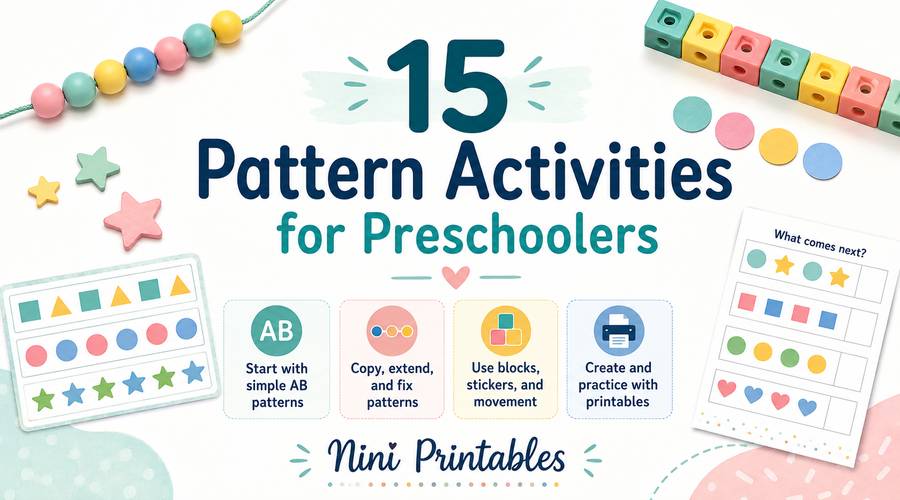
Quick Answer
Start with a simple AB repeating pattern using two clearly different objects, such as red-blue-red-blue. Help the child notice what repeats, copy the pattern, extend it, and say the repeating part aloud. When that feels easy, try AAB, ABB, or ABC patterns and invite the child to make a pattern of their own.
These pattern activities for preschoolers treat patterning as an early math skill without turning practice into a worksheet lesson. A child can explore the same repeating idea with blocks, movements, sounds, toys, snack pieces, or objects found outside.
The important shift is to move from seeing a pattern to understanding the part that repeats. Head Start’s preschool math progression includes recognizing simple patterns, filling missing elements, duplicating and extending patterns, using patterns in different forms, and identifying the core repeating unit. See Head Start’s preschool math guidance.
NAEYC also gives examples of children exploring repeating rules through sounds, pictures, movement, and different objects. That is why the activities below are organized as a learning progression rather than a random list of crafts. See NAEYC’s pattern-learning examples.
How Do You Teach Patterns to Preschoolers?
Use one simple repeating rule and make it easy to see. Model a short pattern, say it aloud, and give the child several chances to work with the same rule before increasing the difficulty.
Why this progression? A large Australian study of preschool children found that children ages 3.5–4.5 in the study could copy, extend, insert missing elements, fix, and create repeating patterns (Larkin, Resnick, & Lowrie, 2024). A 2026 study of 4–7-year-olds found that completing a pattern was easier than explicitly identifying its repeating unit (Msall et al., 2026). That is why this guide starts with concrete copying and extending, then adds missing pieces, error-fixing, explaining the repeating unit, translating the rule, and independent creation.
A useful teaching question is not only “What comes next?” Also ask “What part keeps repeating?” A child who can explain or rebuild the repeating part is showing more than a lucky guess.
If you want a broader view of early math skills, see our preschool math activities guide. That article keeps patterns as one small math section; this page is the deeper pattern-specific resource.
What Is a Pattern for Preschoolers?
A repeating pattern is a sequence with a part that repeats in the same order. Preschoolers can make patterns with color, shape, objects, sounds, movements, textures, or pictures.
The letters are simply a convenient way for adults to describe the rule. A preschooler does not need to memorize “AAB” as a label before enjoying or understanding the pattern.
Which Pattern Should Preschoolers Learn First?
Start with AB patterns
AB patterns alternate two items: red-blue-red-blue or clap-stomp-clap-stomp. The difference between the two parts is easy to see and hear, which makes AB a practical starting point.
Move to AAB and ABB when AB feels easy
Once a child can copy and extend AB patterns reliably, try a slightly longer repeating unit such as red-red-blue or red-blue-blue. Keep the materials familiar so the new challenge is the pattern rule, not the objects.
Try ABC patterns later
ABC uses three different parts before repeating. Some preschoolers will enjoy this quickly, while others benefit from more AB practice first. Use readiness rather than a strict birthday cutoff.
15 Pattern Activities for Preschoolers
Use the stages in order when you are introducing patterning, or jump to the stage that matches what the child can already do. Choose age-appropriate materials and supervise any activity that uses small objects or food.
Copy an AB Block Pattern
Build a short red-blue-red-blue row with blocks or connecting cubes. Ask the child to make the same pattern beside yours rather than continuing your row.
What it practices: noticing order, copying a repeating sequence, and comparing two patterns.
Copy a Toy Pattern
Arrange familiar toys in a repeating rule such as car-animal-car-animal. Let the child build the same sequence with another small set of toys.
What it practices: understanding that a pattern can be based on object type, not only color.
Clap and Stomp a Pattern
Make an AB movement pattern: clap-stomp-clap-stomp. Repeat it slowly together, then pause and let the child lead the sequence.
What it practices: listening, sequencing, rhythm, and recognizing the same repeating idea in a non-visual form.
Finish a Sticker Pattern
Place two types or colors of stickers in an AB row and stop after four or six stickers. Give the child the same two choices and ask them to continue the row.
What it practices: extending a visible pattern and making a choice based on the rule.
Finish a Snack Pattern
Use two safe snack foods to make a short pattern, such as cracker-grape-cracker-grape. Ask what should come next, then let the child add it before eating.
What it practices: predicting and extending a repeating sequence with real objects.
Build a Nature Pattern
Collect a few safe, easy-to-handle nature items such as leaves and stones. Make leaf-stone-leaf-stone, then let the child continue or copy the pattern.
What it practices: transferring patterning to an outdoor setting and noticing similarities and differences.
Circle the Repeating Unit
Make a pattern on paper or with cards, then visually separate the smallest chunk that repeats: red-blue | red-blue | red-blue. Ask, “Which part keeps happening again?”
What it practices: identifying the core unit instead of only guessing the final item.
Say the Pattern Out Loud
Point to each item while saying the full sequence: “red-blue, red-blue, red-blue.” Then ask the child to say the repeating part without pointing.
What it practices: connecting visual information with language and making the rule easier to hear.
Go on a Pattern Detective Hunt
Look for repetition on clothing, rugs, book illustrations, tiles, playground structures, fences, or natural objects. Ask what repeats and whether the pattern is color, shape, line, movement, or something else.
What it practices: seeing pattern structure outside a prepared lesson.
Fix the Broken Pattern
Make an almost-correct pattern with one mistake, such as red-blue-red-green-red-blue. Ask, “Something changed. Can you find the part that does not follow the rule?”
What it practices: checking a whole sequence against a repeating rule.
Fill in a Missing Middle
Instead of always leaving the last space empty, remove an item from the middle: red-blue-___-blue-red-blue. Give the child two possible pieces and ask which one makes the pattern work.
What it practices: using the pattern structure rather than relying only on the final position.
Make the Same Pattern With New Objects
Show red-blue-red-blue, then ask the child to make the same rule with cars and toy animals: car-animal-car-animal. The objects changed, but the AB structure stayed the same.
What it practices: recognizing that a pattern rule can stay constant even when the materials change.
Make a Playdough Pattern
Roll two colors of playdough into large balls or simple shapes and invite the child to arrange them in a repeating pattern. Ask the child to explain the repeating part when finished.
What it practices: planning a rule, fine-motor work, and explaining a self-created pattern.
Create a Movement Pattern for Someone Else
Let the child become the teacher. They might choose jump-clap-jump-clap or tap-tap-stomp. Copy their pattern exactly, then ask them to check whether you followed the rule.
What it practices: creating, communicating, and checking a pattern.
Create Your Own Pattern Challenge
Offer a small set of blocks, stickers, colored shapes, picture cards, or other familiar materials without giving a model. Ask, “Can you make a repeating pattern and show me the part that repeats?”
What it practices: independent pattern creation and explaining the rule.
Make Pattern Activities for Preschoolers Easier or Harder
Children may understand one part of patterning before another. Adjust the same activity instead of immediately replacing it with a new one.
| If the child… | Try this next |
|---|---|
| Does not notice the pattern | Use only two very different objects and shorten the row. |
| Can copy but cannot extend | Say the repeating part aloud together before adding another item. |
| Keeps guessing | Ask “What part repeats?” before asking “What comes next?” |
| Easily completes AB | Introduce AAB or ABB with the same familiar materials. |
| Easily completes AAB or ABB | Use a new material but keep the same rule. |
| Creates patterns independently | Ask them to explain, fix, or translate the rule for someone else. |
Hands-On First, Printable Practice Second
A printable can be useful, but it works best when the child already has a concrete pattern idea to connect to the page. For these pattern activities for preschoolers, a simple sequence is:
- Build: make the pattern with real objects or movement.
- Say: name the repeating part aloud.
- Extend: add or fill in one part of the sequence.
- Reinforce: use a short printable for quieter practice.
This approach keeps pattern worksheets from becoming a guessing exercise. If the child can first build red-blue-red-blue with blocks, the same repeating rule on paper has something meaningful to connect to.
Pattern work also connects naturally with classification and visual discrimination. For related practice, continue with sorting activities for preschoolers, color activities for preschool, or matching activities for preschoolers.
Choose a Pattern Activity by Setting
If you need a quick activity rather than a full lesson, use this table to match the setup to your day.
| Need | Try | Why it works |
|---|---|---|
| 5-minute activity | Clap and stomp | No materials and easy repetition. |
| Quiet table work | Sticker pattern | Simple choices and clear visual order. |
| Math center | Block patterns | Easy to copy, extend, and rebuild. |
| Outdoor activity | Nature pattern hunt | Connects patterning to the real world. |
| No-prep movement | Child-led movement pattern | Adds leadership and oral explanation. |
| Independent follow-up | Short printable practice | Reinforces a rule after hands-on learning. |
Optional Supplies for Preschool Pattern Activities
Use what you already have first
Most pattern activities for preschoolers can be done with ordinary home or classroom materials. A small reusable supply box can make repeated practice easier, but none of these items is required.
- Connecting cubes or blocks
- Large stickers or dot stickers
- Washable markers or crayons
- Playdough
- Craft sticks
- Reusable dry-erase sleeves
- Laminating supplies, if you already laminate classroom materials
Frequently Asked Questions
What pattern should I teach preschoolers first?
Start with a simple AB repeating pattern using two clearly different items, such as red-blue-red-blue or clap-stomp-clap-stomp. When the child can copy and extend AB patterns reliably, try AAB, ABB, and then ABC patterns.
What are AB, AAB, ABB, and ABC patterns?
The letters describe the repeating rule. AB alternates two parts. AAB repeats two of one part and one of another. ABB repeats one part followed by two of another. ABC repeats three different parts in the same order.
At what age do children understand patterns?
Pattern understanding develops across the preschool years, and children progress at different rates. Head Start describes growing pattern skills across ages 3–5, from recognizing and completing simple patterns to creating, extending, translating, and identifying the repeating unit. Use those progressions as guidance rather than a pass-or-fail age checklist.
Why are patterns important for preschoolers?
Patterns give children practice noticing regularity, predicting, sequencing, comparing, and explaining a rule. Patterning can also connect math with music, movement, art, building, language, and everyday routines.
What if my preschooler cannot complete a pattern?
Reduce the difficulty. Use a short AB pattern with two very different objects, say the repeating part aloud, and let the child copy before asking them to extend it. If “what comes next?” leads to guessing, ask “what part keeps repeating?” instead.
Are pattern worksheets good for preschoolers?
They can be a useful follow-up after hands-on practice. Build or act out the pattern first, then use a short printable to reinforce the same rule. A worksheet should not be the only way a preschooler experiences patterns.
Keep Pattern Practice Simple
The best pattern activities for preschoolers stay simple enough for a child to notice the rule. You do not need to complete all 15 activities: start with one clear AB pattern and stay with that level until copying and extending feel comfortable.
Then increase one challenge at a time: make the repeating unit longer, remove a middle piece, change the materials while keeping the same rule, or let the child create and explain a pattern for you.
Enjoying the free resources? Sharing this guide with another parent, preschool teacher, kindergarten teacher, homeschool family, or caregiver helps more families discover Nini Printables and supports continued free-resource creation.