
20 Math Activities for Preschoolers: Easy Hands-On Games by Skill
Make preschool math feel like play with 20 low-prep activities for counting, number recognition, sorting, patterns, shapes, measurement, comparing, and early addition. Most use materials already at home or in the classroom.
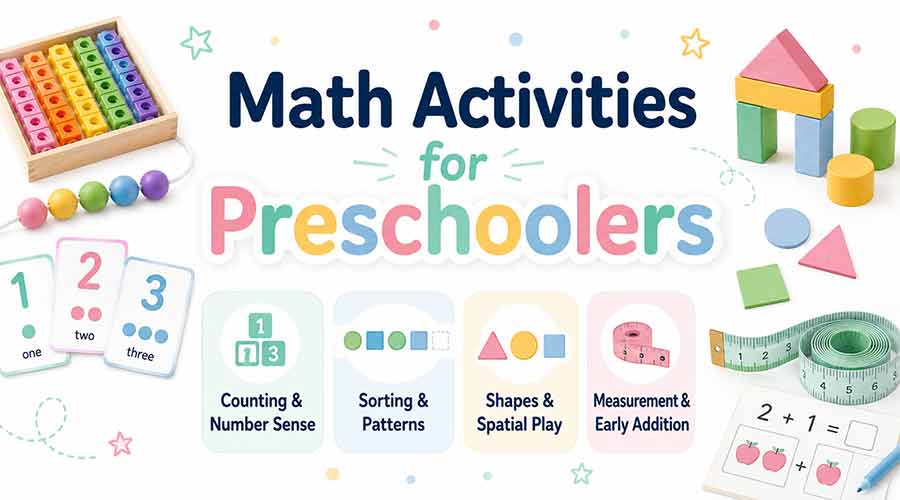
Preschool math is much more than memorizing numbers. When children sort socks, build a block tower, compare two cups, notice a pattern, or count snacks, they are using early mathematical thinking in a meaningful way.
That everyday approach also matches early-childhood guidance. The National Association for the Education of Young Children (NAEYC) encourages families to explore math through sorting, counting, measuring, building, and conversation. Stanford’s DREME Family Math resources likewise emphasize playful, research-based early math using ordinary materials and daily routines.
You do not need to complete all 20 activities. These math activities for preschoolers are organized by skill so you can choose one idea that matches what your child is ready to practice. Keep the activity short and follow the child’s engagement; a few focused minutes may be enough, while an interested child may choose to continue longer.
What Math Skills Do Preschoolers Practice?
Early math grows through several connected skills. Counting is important, but a useful preschool math routine also gives children chances to compare, sort, measure, notice patterns, work with shapes, and explain what they see.
| Math skill | What it can look like in preschool |
|---|---|
| Counting | Saying number words in order and counting small groups of real objects. |
| Number recognition | Recognizing written numerals such as 1, 2, 3, and 4. |
| One-to-one correspondence | Touching or moving one object for each number word while counting. |
| Sorting | Grouping objects by color, size, shape, type, or another visible feature. |
| Patterns | Noticing and continuing repeated sequences such as red-blue-red-blue. |
| Shapes & spatial thinking | Naming shapes, building them, comparing positions, and noticing how pieces fit together. |
| Measurement | Comparing longer/shorter, taller/shorter, heavier/lighter, or more/less. |
| Early operations | Joining or removing small groups with toys, snacks, or fingers before formal equations. |
Keep expectations flexible. Preschoolers develop at different rates. These activities are practice ideas, not a test or a checklist a child must complete by a particular birthday.
Choose a Preschool Math Activity by Skill
Not sure where to start? Use the table below as a quick shortcut. Pick one skill that needs practice and begin with the matching activity instead of searching through a long list.
| If you want to practice… | Start with… | Why it helps |
|---|---|---|
| Counting objects | Count Snacks | Children can touch or move each object as they count. |
| Number recognition | Number Hunt | Written numerals become part of everyday surroundings. |
| One-to-one counting | Roll and Build | One block is added for each count. |
| Sorting | Toy Sorting | Children choose a rule and explain why objects belong together. |
| Patterns | Block Patterns | A repeated sequence is easy to see and continue. |
| Shapes | Shape Hunt | Children connect shape names to real objects. |
| Measurement | Measure with Blocks | Nonstandard units make length concrete. |
| Comparing quantities | More, Less, or Same? | Children compare groups instead of only reciting numbers. |
| Early addition | Snack Addition | Joining two small groups makes “adding” visible. |
| Spatial thinking | Copy a Block Build | Children notice position, size, orientation, and structure. |
Counting and Number Sense Activities
These first four preschool math activities build number sense without turning the session into a worksheet lesson. If counting is already a major focus, use these as quick starters and then move to the more detailed counting resources linked below.
Safety note: Choose age-appropriate materials and supervise activities involving small objects, food, or water.
Count Snacks
Place 3–10 small snack pieces on a plate. Have the child touch or move each piece while counting aloud. Then ask, “How many are there altogether?”
Practice: counting, one-to-one correspondence, cardinality.
Roll and Build
Roll one die, count the dots, and add that many blocks to a tower. Repeat for several turns. Younger children can use a die with 1–3 dots drawn on cards instead.
Practice: subitizing, counting, matching quantity to action.
Go on a Number Hunt
Look for numerals on calendars, clocks, mailboxes, books, signs, or toy pieces. Pick just a few target numbers at a time and ask the child to name each one.
Practice: numeral recognition in real contexts.
Build a Number Tower
Show a numeral card from 1–10. The child builds a tower with the matching number of blocks, then checks by touching each block while recounting.
Practice: connecting written numerals with quantities.
For deeper practice, continue with Counting Activities for Preschoolers, Number Recognition Activities for Preschoolers, or One-to-One Correspondence Activities for Preschoolers. Those guides focus on the individual skills rather than repeating them here.
Sorting and Classifying Math Activities
Sorting helps children notice attributes and decide what belongs together. The useful part is not only making piles; it is talking about the sorting rule.
Sort Toys by Color
Choose a small basket of blocks, cars, pom-poms, or other safe objects. Sort them into color groups. Ask, “How did you decide where this one belongs?”
Variation: sort the same objects a second way.
Sort by Size
Collect objects that clearly differ in size. Make “small” and “large” groups first. Later, add “medium” if the child can compare confidently.
Practice: comparing, classifying, math vocabulary.
Match and Sort Socks
Use clean laundry to match pairs, then sort socks by person, color, length, or pattern. This turns a familiar routine into a low-prep preschool math game.
Practice: matching, sorting, noticing similarities and differences.
If matching is the skill you want to strengthen, see Matching Activities for Preschoolers for more focused ideas.
Pattern Activities for Preschoolers
Start with very simple repeating patterns. AB patterns are usually easier to see than longer sequences, so begin with two alternating items before adding more complexity.
Build an AB Block Pattern
Make a short pattern such as red-blue-red-blue. Pause and ask, “What comes next?” Let the child continue the sequence with the next block.
Make it harder: try red-red-blue or an ABC pattern.
Make a Movement Pattern
Create a movement sequence such as clap-stomp-clap-stomp. Repeat it together, then let the child invent a new pattern for you to copy.
Practice: sequencing, prediction, memory.
Make a Snack Pattern
Alternate two safe snack foods on a plate, such as cracker-grape-cracker-grape. Ask the child to finish the row before eating it.
Practice: identifying and extending repeating patterns.
Shape and Spatial Math Activities
Geometry for preschoolers is not limited to naming circles and squares. Building, rotating, comparing, and copying shapes also help children notice position and how objects fit together.
Go on a Shape Hunt
Choose two or three shapes and look for matching objects around the room. Instead of only asking for the name, ask what the child notices about the shape.
Example: “How do you know this window is a rectangle?”
Build Shapes with Craft Sticks
Use craft sticks or straws to build triangles, squares, and rectangles. Count the sides as you build, then change one part and notice what happens.
Practice: shape attributes, composing shapes, counting sides.
Copy a Block Build
Make a small structure with 3–6 blocks and ask the child to copy it. Keep the model visible so the task is about observing position, not memorizing.
Practice: spatial language, orientation, visual comparison.
For a fuller set of geometry ideas, continue with Shape Activities for Preschoolers. For quieter follow-up practice, the Preschool Shapes Tracing printable adds tracing, matching, and review without replacing hands-on exploration.
Measurement and Comparing Activities
Young children can explore measurement before they understand standard units. Start with visible comparisons such as longer, shorter, taller, heavier, lighter, more, and less.
Measure with Blocks
Line up same-size blocks beside a book, shoe, or toy. Count how many blocks long the object is. Compare two objects using the same blocks.
Practice: nonstandard measurement and consistent units.
Longer or Shorter?
Place two safe household objects side by side. Ask which is longer and how the child knows. Then switch to two objects with a smaller difference.
Practice: comparing length and explaining observations.
Which Container Holds More?
During water play, compare two cups or containers. Let the child predict which holds more, test the idea, and describe what happened.
Safety: supervise water play closely.
More, Less, or Same?
Make two small groups of blocks or counters. Ask which group has more, which has fewer, or whether the groups are equal. Let the child pair the objects if the answer is not obvious.
Practice: comparing quantities and one-to-one matching.
Simple Addition and Subtraction Through Play
Formal equations can wait. Preschoolers can first explore the idea of adding and taking away by watching small groups change.
Snack Addition
Place two crackers on a plate, then add one more. Ask, “There were two. We added one. How many are there now?” Let the child recount the full group.
Practice: joining small quantities.
Toy Take Away
Start with five toy cars. Move one away and ask how many remain. Keep the quantities small enough that the child can check by counting.
Practice: taking away and noticing quantity change.
Find Math During the Day
Choose one everyday routine and notice the math already inside it: count stairs, set out one spoon per person, sort laundry, compare cups, find shapes, or build towers.
Practice: connecting math ideas to real life.
A useful question: instead of asking only “What is the answer?”, try “How did you figure that out?” The child’s explanation can show more about their thinking than a correct answer alone.
Hands-On Math First, Printable Practice Second
For preschoolers, a printable works best as one part of the learning sequence—not the entire lesson. Strong math activities for preschoolers usually begin with real objects that make quantities, shapes, patterns, and comparisons easier to see and touch.
- Explore: use real objects, movement, or building.
- Talk: name the math idea and ask simple questions.
- Repeat: play the same successful game again.
- Reinforce: use a short printable for focused review.
This sequence also keeps worksheets from becoming busywork. A child who has already counted real objects or matched real shapes has a clearer idea to connect to the printed page.
Optional Supplies for Preschool Math
The best math activities for preschoolers do not require expensive materials. Most of these ideas work with things already around the house or classroom; if you are building a reusable math shelf, a few simple materials can make repeated practice easier.
Useful, but not required
- Large dice
- Counting bears or counters
- Building cubes or blocks
- Pattern blocks
- Craft sticks
- Child-safe measuring tape
- Simple balance scale
- Reusable dry-erase sleeves
Use what you already have first. Preschool math does not require a special kit, and ordinary household materials often make the activity feel more natural.
Frequently Asked Questions
What math should a 4-year-old know?
Many 4-year-olds are developing skills such as counting small groups, recognizing some numerals, comparing quantities, sorting objects, making simple patterns, identifying common shapes, and using words such as more, less, longer, and shorter. Development varies, so treat these as areas to explore rather than a checklist.
How do I make math fun for preschoolers?
Use movement, toys, food, blocks, water play, songs, and everyday routines. Let the child make choices and repeat games they enjoy. Preschool math is often more engaging when there is something to move, build, sort, or compare.
How long should preschool math activities last?
There is no required length. Keep the activity short and follow the child’s engagement. A few focused minutes may be enough, while an interested child may continue longer. Stop on a positive note when attention fades.
Are worksheets good for preschoolers?
Short, age-appropriate printables can reinforce a skill after a child has explored the idea with real objects or play. They should not replace conversation, movement, building, sorting, counting, and other hands-on experiences.
How can I teach preschool math at home?
Start with routines you already have. Count fruit while making a snack, compare shoes by size, sort laundry, find shapes on a walk, build block towers, or measure objects with blocks. Everyday math talk can provide meaningful practice without creating a separate lesson.
What should I teach first: counting or number recognition?
They can develop together, but they are different skills. Counting connects number words to quantities, while number recognition connects a written symbol to a number name. If a child names numerals but struggles to count objects accurately, add more hands-on counting and one-to-one correspondence practice.
Keep Preschool Math Simple
The best preschool math activity is not the one with the most supplies or the longest instructions. It is the one a child can understand, enjoy, and repeat.
Keep math activities for preschoolers simple and connected to everyday play. Start with one skill, use familiar objects, ask a few open questions, and revisit the idea later—at snack time, during cleanup, outside, or with a printable. Over time, those small experiences help children see that math is part of everyday life.
Enjoying the free resources? Sharing Nini Printables with another parent or teacher helps more families find the activities and helps support the continued creation of free resources.