
15 Shape Activities for Preschoolers: Easy Hands-On Ideas for Ages 3–5
These low-prep shape activities for preschoolers help children find, match, sort, build, move, and trace basic shapes without turning practice into a long lesson. Choose one activity that fits what your child or class needs today.
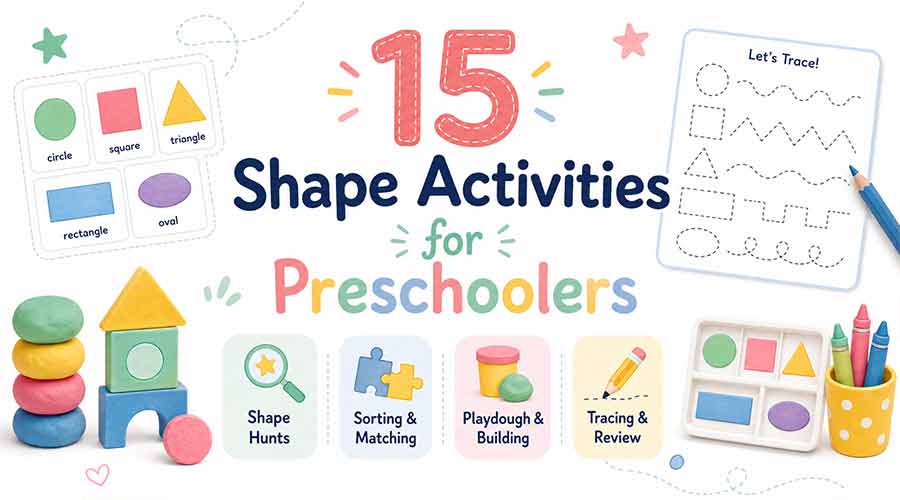
A preschooler does not need to memorize a long list of shape names all at once. A more useful goal is to help the child notice what makes a shape the same even when its color, size, or direction changes.
The Head Start preschool math framework describes a progression from recognizing familiar circles, squares, and sometimes triangles toward comparing shapes in different sizes and orientations, noticing sides and angles, sorting shapes, and building shapes from parts. NAEYC guidance on shapes and space in preschool also recommends varied sizes and orientations rather than showing only one familiar example.
What Shapes Should Preschoolers Practice First?
For most preschool activities, a small starting set works better than a crowded worksheet. Begin with circles, squares, triangles, and rectangles. Add ovals and other shapes once the child can comfortably find and compare the first group.
The important part is variation. Show a small triangle and a wide triangle. Turn one sideways. Use a red square and a blue square. This helps children focus on shape features instead of memorizing one “perfect” picture.
NAEYC’s guidance on discovering shapes and space in preschool specifically encourages teachers to expose children to circles, triangles, squares, rectangles, and ovals in different sizes and orientations.
Choose a Shape Activity Based on What the Child Needs
You do not need to work through all 15 ideas in order. Start with the difficulty you are seeing and choose the simplest activity that practices that skill.
15 Easy Shape Activities for Preschoolers
These preschool shape activities use simple materials and short instructions. Most work at home, in a preschool center, or during homeschool time. Keep the activity brief enough that the child can finish while still interested.
1. Go on a One-Shape Hunt
Choose just one target shape, such as a circle, and look for it around the room. This simple shape hunt for preschoolers works well at home or in a classroom because children can focus on one shape at a time. A plate, clock face, lid, or round coaster can all become examples. Ask, “What did you notice that made you choose it?”
2. Make a Painter’s-Tape Shape Walk
Use painter’s tape to make a large square, triangle, rectangle, or simple path on the floor. Invite the child to walk along the lines, stop at the corners, or move around the curved edge of a large circle made from paper or string.
3. Match the Same Shape in Different Sizes
Cut or draw several circles, squares, and triangles in different sizes. Mix them up and ask the child to match by shape rather than by size or color. Rotate a few pieces so the child sees that direction does not change the shape.
4. Sort Safe Household Objects by Shape
Gather a few easy-to-handle objects, such as large lids, blocks, cards, or small boxes. Make two or three shape groups and let the child decide where each object belongs. Then compare the groups together.
5. Play Shape Parking
Draw large “parking spaces” in different shapes on paper or cardboard. Give a toy vehicle a simple direction such as, “Park on the triangle,” or let the child choose a space and name it.
6. Try a Mystery Shape Bag
Place a few large foam, cardboard, or wooden shapes in a bag. Without looking, let the child feel one and describe what they notice: “Is it curved?” “Can you feel corners?” Then pull it out and check.
7. Stamp and Compare Shape Prints
Use washable paint with large shape stamps or the flat ends of safe household objects. Make a few prints, then ask which ones look alike and which ones look different. This can also introduce the idea that everyday objects can leave familiar flat shapes.
8. Build a Shape Picture
Provide a small set of paper shapes and invite the child to make a picture. A square and triangle might become a house, while a rectangle and circles might become a vehicle. Name the shapes while building rather than waiting until the end.
9. Feed the Shape Sorter
Draw two or three simple “shape monsters” on boxes, bowls, or sheets of paper. Give each one a target shape and let the child feed it matching paper pieces. Keep colors mixed so the child must pay attention to shape.
10. Make Shapes with Playdough
Roll playdough into long pieces and bend them into shapes. Compare a triangle with a square, or make a circle and notice how it has no corners. This combines shape practice with hand-strength and fine-motor work.
11. Build Straight-Sided Shapes with Craft Sticks
Use craft sticks or paper strips to build triangles, squares, and rectangles. Count the pieces and corners together. Then change one part and ask what happens to the shape.
12. Play “Hop to the Shape”
Place large paper shapes on the floor. Call out one shape and let the child hop, tiptoe, or march to it. After a few turns, reverse roles and let the child call the shape for you.
13. Finish the Missing Shape
Draw most of a familiar shape but leave one section unfinished. Ask the child to complete it with a crayon or finger. Start with a large shape and only one missing part.
14. Trace Shapes in Sand, Salt, or a Sensory Tray
Spread a thin layer of sand, salt, or another suitable sensory material in a shallow tray. Draw one large shape with a finger, smooth the surface, and try again. This is a useful bridge between whole-hand movement and pencil tracing.
15. Practice with a Short Shape Tracing Printable
Once the child has handled, found, and built shapes, use a short printable page for focused review. Finger-trace first when needed, then move to a crayon or pencil. The goal is a small successful practice session, not finishing many pages at once.
How to Teach Shapes to Preschoolers
When you are deciding how to teach shapes to preschoolers, keep the sequence concrete. Children usually benefit from seeing and handling shapes before they are asked to reproduce them on paper.
NAEYC also encourages adults to use regular routines and familiar objects to help children identify, create, name, and take apart shapes in everyday life. That is why a plate, window, box, sign, or block can be as useful as a formal lesson.
Common Shape-Learning Problems
“My child only recognizes one kind of triangle.”
Show triangles that are wider, narrower, larger, smaller, and turned in different directions. The Head Start preschool geometry progression specifically includes recognizing shapes in different sizes and orientations. Varied examples are more useful here than repeating the same triangle picture.
“My child mixes up squares and rectangles.”
Place one square and one obvious rectangle side by side. Trace the edges with a finger and compare what looks the same and different. Avoid long definitions; preschool practice should stay visual and concrete.
“My child can name a shape but cannot match it.”
Return to real objects and large shape pieces. Match a paper circle to a round lid or a rectangle to a book. Once the match is easy, vary the size, color, and direction.
“My child gets bored with worksheets.”
Move the learning off the page for a while. Try a floor game, playdough, a shape hunt, or a building activity. Come back to a short printable only when you want calm review or tracing practice.
Hands-On Shape Activities vs. Worksheets
You do not need to choose one or the other. Hands-on play and printable practice do different jobs.
Hands-on activities are useful for
- finding shapes in real life;
- handling and turning shapes;
- sorting and comparing;
- building shapes from parts;
- adding movement and conversation.
Simple printables are useful for
- focused shape recognition;
- finger or pencil tracing;
- fine-motor and pencil-control practice;
- matching and quiet review;
- an easy classroom or home-learning station.
A practical routine is to start with a real object or movement activity, then use one short printable page as a follow-up. This keeps the concept concrete while still giving the child focused table practice.
Try a Free Preschool Shape Printable
The Nini Printables Preschool Shapes Tracing activity pack includes 16 pages of shape tracing, coloring, matching, picture activities, and review. It is formatted for US Letter paper and can be used for personal, homeschool, or classroom practice under the site’s terms of use.
For an older learner who is ready to compare 2D and 3D shapes and work more directly with kindergarten geometry, continue with Shapes for Kindergarteners: What Kids Should Know + 12 Easy Activities. Keeping the preschool and kindergarten stages separate makes it easier to choose practice that matches the learner.
Frequently Asked Questions About Shape Activities for Preschoolers
What shapes should preschoolers know?
Start with circles, squares, triangles, and rectangles. The Head Start preschool math framework treats shape learning as a progression toward recognizing varied examples, comparing, sorting, and building shapes—not a pass-or-fail checklist.
How do you teach shapes to preschoolers?
Start with real objects and movement, then progress to matching, comparing, building, and finally tracing or drawing when the child is ready.
What are easy shape activities for 3-year-olds?
Try one-shape hunts, large floor shapes, simple matching, shape parking, playdough, or sorting two familiar shapes. Keep the choices small and the activity short.
How can preschoolers practice shapes without worksheets?
Look for shapes, sort real objects, build with sticks or blocks, use playdough, play movement games, or create pictures from paper shapes. Save worksheets for focused tracing and review.
Are shape tracing worksheets good for preschoolers?
Yes. Tracing can support shape recognition and early pencil control when it follows hands-on finding, matching, sorting, or building.
Keep Shape Practice Simple and Playful
Keep preschool shape practice simple: use one or two familiar shapes, move from hands-on finding and matching into comparing or building, and finish with a short tracing page when quiet review makes sense. The goal is flexible recognition, not memorizing one “perfect” picture.