
15 Ocean Activities for Preschoolers: Easy Learning Ideas by Skill
Use an ocean theme to practise counting, language, matching, fine motor skills, sensory exploration, movement, and early science. These simple activities are easy to adjust for ages 3–5.
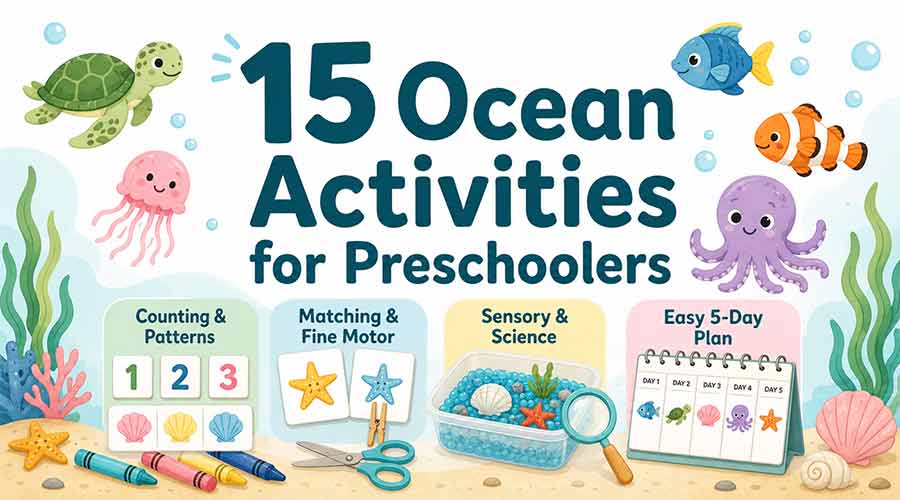
Easy ocean activities for preschoolers include counting sea animals, making fish patterns, matching ocean animals, and sorting by habitat or size. Children can also cut jellyfish tentacles, build with playdough, test sink-or-float objects, move like sea creatures, or create a simple ocean habitat. The best choice is one that matches the skill a child is ready to practise and uses materials that are easy to set up.
An ocean theme gives parents and teachers a practical way to connect several preschool skills without turning the day into a formal lesson. One child may be ready to count fish, another may want to build an octopus from playdough, and another may learn more through movement or matching.
That flexible, play-based approach fits early-childhood guidance from the National Association for the Education of Young Children (NAEYC). Its guidance emphasizes joyful, engaged learning that responds to individual children. The Head Start Early Learning Outcomes Framework also organizes preschool development across areas such as language and literacy, cognition, and perceptual, motor, and physical development. In other words, an ocean unit does not need to stay in one “subject.”
Choose an Ocean Activity by the Skill Your Preschooler Is Practising
When there are dozens of ocean preschool activities to choose from, start with the learning goal rather than the longest list. This quick chart helps narrow the options.
| Activity | Main skill | Prep | Mess level |
|---|---|---|---|
| Count the Sea Animals | Counting & one-to-one correspondence | Low | None |
| Fish Patterns | Patterns & early math | Low | None |
| Ocean Animals Matching | Visual discrimination & vocabulary | Print only | None |
| Jellyfish Tentacle Cutting | Scissor control | Low | Low |
| Ocean Sensory Bin | Sensory exploration & language | Medium | Medium |
| Sink or Float | Prediction & observation | Low | Low |
| Move Like a Sea Animal | Gross motor & listening | None | None |
What Can Preschoolers Learn From an Ocean Theme?
Ocean theme activities for preschool can support several early-learning areas at the same time. For example, a child can count shells, describe a whale, compare the size of sea animals, cut paper tentacles, or predict whether an object will sink or float.
- Language: name sea animals and use describing words.
- Math: count, compare, sort, and continue simple patterns.
- Fine motor: cut, pinch, press, place, connect, and manipulate.
- Thinking: classify objects and make simple predictions.
- Science: notice habitats, movement, water, and animal features.
- Movement: copy animal motions and follow simple directions.
For families and educators who want a broader ocean-science framework, NOAA’s Ocean and Climate Literacy resources explain how ocean learning connects across disciplines. Preschool activities do not need to cover formal K–12 concepts; instead, the ocean theme can simply invite observation, vocabulary, questions, and playful exploration.
Ocean Math and Thinking Activities for Preschoolers
These first four ideas keep the ocean theme playful while reinforcing several early math skills. For deeper practice, use Nini Printables’ math activities for preschoolers, preschool counting activities, and one-to-one correspondence activities.
1Count the Sea Animals
Place 3–10 sea animals in a row or loose group. Ask the child to touch or move one animal at a time while saying each number. Then ask, “How many are there altogether?”
2Make Fish Patterns
Make a simple pattern such as blue-yellow-blue-yellow and ask what should come next. Once that feels easy, try ABB or ABC patterns.
3Sort Land and Ocean Animals
Make two spaces labeled “land” and “ocean.” Let the child decide where each animal belongs. Then invite a short explanation: “Why did you put the dolphin in the ocean group?”
4Compare Ocean Animal Sizes
Ask the child to find the smallest and largest animal, then line the set up from smallest to largest. Use words such as smaller, larger, shortest, and longest as they make comparisons.
Ocean Literacy and Language Activities
Preschool ocean activities can build vocabulary without needing a worksheet for every word. Keep language practice conversational, short, and connected to pictures, objects, stories, or movement.
5Ocean Animal Vocabulary Hunt
Choose 5–8 familiar animals such as fish, whale, crab, octopus, turtle, shark, and seahorse. Name one animal and ask the child to find it. Then switch roles so the child gives the clue.
6Clap Ocean Animal Syllables
Say a word slowly, then clap its beats together: fish, tur-tle, oc-to-pus. Sort words into groups with one, two, or three claps if the child enjoys the challenge.
7Go Fishing for Letters
Write one familiar letter on each paper fish. Children can “catch” a fish, name the letter if they know it, or match it to the same letter on a simple reference card.
Ocean Fine Motor and Visual Skills Activities
Fine motor work fits naturally into an ocean theme because children can cut tentacles, pinch playdough, place pieces, and connect matching pictures. For a fuller progression, see fine motor activities for preschoolers and preschool cutting activities.
8Try an Ocean Animals Matching Activity
Start with one matching page rather than the full pack. Ask the child to look closely at each picture, find the partner, and connect the pair. The cut-and-match pages can be introduced later with adult support where needed.
9Cut Jellyfish Tentacles
Draw or print a simple jellyfish body with wide vertical lines underneath. Children can make short snips first, then work toward cutting along longer tentacle lines.
10Make Ocean Animals With Playdough
Roll, pinch, flatten, and join playdough to make a fish, turtle, octopus, shell, or completely imaginary sea creature. Ask the child to describe what the animal can do or where it lives.
11Add Eight Tentacles to an Octopus
Invite the child to attach one tentacle at a time while counting to eight. Clothespins add squeezing practice; paper strips can be glued or taped if that is more appropriate.
Ocean Sensory, Science, and Movement Activities
Not every preschooler wants to sit at a table for long. The next ideas bring the ocean theme into sensory play, simple observation, and whole-body movement. For more setup choices, see the full guide to sensory activities for preschoolers.
12Build a Simple Ocean Sensory Bin
Keep the setup simple: a shallow container, a blue base, and a few large ocean animals are enough. Children can hide, find, sort, move, and describe the animals.
13Try a Sink-or-Float Ocean Experiment
Choose a few safe objects and ask the child to predict whether each one will sink or float. Test one object at a time, then talk about what happened. Preschool science can begin with noticing and describing rather than explaining every physical principle.
14Move Like an Ocean Animal
Call out an ocean animal and invent a movement together. Swim like a fish, crawl sideways like a crab, stretch arms like an octopus, or move slowly like a sea turtle.
15Build a Mini Ocean Habitat
Invite the child to create a place for ocean animals to live. They might add rocks, seaweed, sand-colored paper, caves, or open water. The model does not need to be scientifically perfect. Use it as a reason to talk about what animals need and where they might be found.
A Simple 5-Day Ocean Theme Plan for Preschool
You do not need to use all 15 activities at once. A short weekly rhythm makes the theme easier to repeat at home, in a classroom center, or during homeschool preschool.
Five to fifteen minutes can be enough for one focused preschool activity. If interest is still high, continue. If the child is frustrated or done, simplify the task or save it for another day.
Optional Supplies for Ocean Preschool Activities
Most of these ideas work with materials already found at home or in a classroom. If you keep a small reusable activity basket, choose supplies that can serve many themes rather than buying ocean-specific materials for every lesson.
A small reusable supply basket is enough
- Child-safe scissors
- Washable crayons or markers
- Playdough
- Clothespins or large kid tongs
- Reusable dry-erase sleeves
- A few large ocean animal figures
- Paper, cardstock, glue, and tape
Frequently Asked Questions About Ocean Activities for Preschoolers
What do preschoolers learn from an ocean theme?
An ocean theme can support vocabulary, counting, sorting, patterns, matching, fine motor control, movement, observation, and simple science thinking. The theme is most useful when activities stay playful and are adjusted to the individual child’s current skills.
What are easy ocean activities for 3–5 year olds?
Low-prep choices include counting sea animal toys, making two-color fish patterns, matching ocean pictures, and clapping animal syllables. Cutting paper tentacles, making sea creatures with playdough, and moving like ocean animals are also simple options. Start with a short activity and add complexity only when the child is ready.
How do you teach ocean animals to preschoolers?
Use a small set of familiar animals and combine pictures, books, toys, movement, and conversation. Name the animal and notice one or two features. Compare it with another animal, then invite the child to use the new word during play instead of expecting memorization.
What ocean activities require almost no prep?
Try moving like sea animals, drawing fish patterns, counting ocean figures, sorting animal pictures, clapping syllables, or using a ready-to-print matching page. These options need little more than paper, a few toys or pictures, or open floor space.
Are there free printable ocean activities for preschoolers?
Yes. Nini Printables offers a free 16-page Ocean Animals Matching PDF with picture, shadow, detail, food, home, body-shape, size, and cut-and-match activities. No account is required.
Enjoying the free resources? Sharing Nini Printables with another parent, preschool teacher, kindergarten teacher, homeschool family, or caregiver is a simple way to support the growing library.