
Preschool Playdough: 15 Easy Learning Activities for Ages 3–5
Looking for easy playdough activities for preschoolers that do more than fill time? These 15 low-prep ideas turn playdough for preschoolers into playful practice with counting, shapes, early writing, hand control, and pretend play.
Quick Answer
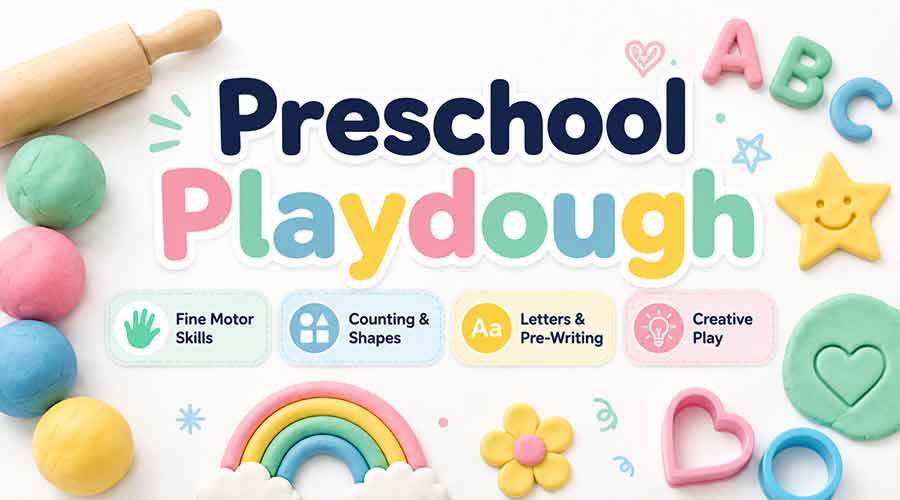
Preschool playdough can support several early-learning goals without turning playtime into a worksheet. Children can roll and pinch dough for hand control, count small dough balls, build simple shapes and letters, copy lines and curves, or create pretend-play scenes. For ages 3–5, start with one simple goal and keep the activity short enough that the child still wants to play.
Playdough is useful because the same material can change with the lesson. A child who is practicing counting can make five balls; a child working on shapes can build a triangle; another child can turn the dough into a bakery, dinosaur habitat, or ocean scene.
The National Association for the Education of Young Children notes that making and kneading playdough can introduce measuring and provide fine-motor practice. The CDC’s 4-year guidance includes pretend play and holding a crayon or pencil between the fingers and thumb among common milestones, and recommends counting simple everyday objects as an activity families can practice. These are helpful developmental reference points, not a test or checklist for what every child must do at the same time.
What Can Preschoolers Learn With Playdough?
Playdough is most useful when adults give it a clear but flexible purpose. Instead of directing every movement, offer a simple invitation such as “Can you make four balls?” or “Can you build a triangle?” Then let the child decide how to get there.
If hand strength and coordination are the main goal, use the dedicated fine motor activities for preschoolers guide. If the goal is preparing for pencil-and-paper work, see these pre-writing activities for preschoolers. This page stays focused on what to do when playdough itself is the activity material.
Simple Preschool Playdough Setup
You do not need a large activity table. One tray, one or two colors of dough, and a few tools are enough for most preschool playdough activities.
- Playdough or a homemade dough recipe
- Small rolling pin or smooth cylindrical tool
- Child-safe dough cutter
- Large shape cutters
- Reusable activity mat, tray, or wipe-clean surface
- Large counters or other age-appropriate loose parts, only with close supervision
Keep it small: Two or three tools are usually enough. Too many accessories can distract from the learning goal and create more cleanup than the activity needs.
Fine Motor Playdough Activities
These three ideas use the natural resistance of dough without turning this article into another full fine-motor guide.
1. Roll, Pinch, and Squeeze
Invite the child to make one ball, one flat “pancake,” and one long roll. The goal is simply to use different hand and finger movements.
2. Hide and Find
Hide a few large, age-appropriate objects partly inside the dough. Let the child pull them out, then press them back in.
3. Make Playdough Snakes
Roll dough back and forth with the palm to make long “snakes.” Compare short and long rolls, or curve them into simple paths.
For more activities that target hand strength, finger isolation, cutting, and coordination, continue with 20 easy fine motor activities for preschoolers.
Preschool Math Activities With Playdough
Playdough makes early math visible and touchable. Keep the numbers small enough that the child can focus on the idea rather than managing too many pieces.
4. Count Playdough Balls
Make a group of dough balls and count them slowly together. Start with 1–5, then move toward 1–10 when that feels comfortable.
5. Make Numbers With Playdough
Roll a thin strip and shape it into a familiar numeral. Focus on one or two numbers at a time rather than making the whole number set.
6. Bigger or Smaller?
Make two balls or shapes and compare them. Use simple words such as bigger, smaller, longer, shorter, same, and different.
7. Make a Simple Pattern
Use two colors to create an AB pattern, such as green-yellow-green-yellow. Let the child predict which color comes next.
8. Count the Toppings
Flatten dough into a pretend pizza or cupcake. Ask the child to add a specific number of large dough “toppings,” such as four circles or six dots.
For more number practice without playdough, explore these counting activities for preschoolers.
Want a Print-and-Go Counting Follow-Up?
After hands-on counting, a simple printable can give the child another way to practice one-to-one counting and number recognition without changing the skill completely.
Shape Activities With Playdough
Shape play works best when children build and compare shapes instead of only naming them. Let the child touch the edges, corners, and curves as the shape takes form.
9. Make Basic Shapes
Use rolled strips to build a circle, triangle, square, or rectangle. Start with shapes the child already recognizes.
10. Build Pictures From Shapes
Combine simple pieces into a picture: a circle and triangle can become an ice cream cone, while a square and triangle can become a house.
11. Press Shape Cutters Into Playdough
Press large cutters into flattened dough, then sort the results by shape or size. The goal is recognition and comparison, not perfect edges.
For a broader shape lesson, visit shape activities for preschoolers. For a quiet follow-up, the preschool shapes tracing printable adds pencil control after hands-on shape play.
Early Literacy and Pre-Writing Playdough Activities
Playdough is a useful bridge before pencil work because children can build a line or letter, change it, and try again. Keep the emphasis on recognition and movement rather than perfect letter formation.
12. Build Letters With Playdough
Roll a few short strips and use them to make one familiar letter. Letters in the child’s name are a practical place to start.
13. Make Your Child’s Name
Begin with the first letter. Later, build two letters or the full first name if the child enjoys the challenge.
14. Copy Lines and Curves
Make a straight line, a curved line, a circle, or a simple zigzag from rolled dough. These same movement ideas appear in early pre-writing practice.
When the child is ready to move from dough to paper, use these pre-writing activities for preschoolers, the Vehicles Pre-Writing Paths, or the Dinosaur Pre-Writing & Fine Motor Activity Pack.
Creative Playdough Idea
15. Create a Pretend Play Scene
Turn the dough into a bakery, farm, pizza shop, dinosaur habitat, or ocean world. Ask open-ended questions such as “What happens next?” or “Who lives here?” rather than giving the child a finished model to copy.
Dinosaur fans can continue with these dinosaur activities for preschoolers. For an under-the-sea theme, try the ocean activities for preschoolers guide.
Choose a Playdough Activity by Skill
If you only have a few minutes, choose one activity based on what the child is already practicing.
| Skill | Try This | Simple Prompt |
|---|---|---|
| Hand control | Roll, pinch, and squeeze | “Can you make a ball and a long snake?” |
| Counting | Count dough balls | “Can you make four?” |
| Number recognition | Make a numeral | “Can we build the number 3?” |
| Shapes | Build basic shapes | “Which one has three sides?” |
| Patterns | Two-color pattern | “What comes next?” |
| Pre-writing | Copy lines and curves | “Can you make a curve like mine?” |
| Letters | Build a name letter | “Which letter starts your name?” |
| Imagination | Pretend-play scene | “What are you making today?” |
A Simple 5-Day Preschool Playdough Routine
You do not need a new setup every day. Reuse the same dough and change only the prompt. Five to ten minutes is enough for a short learning invitation; stop sooner if interest fades.
Store-Bought or Homemade Playdough?
Either can work. Store-bought dough is convenient and consistent. Homemade dough can turn preparation into an extra measuring and mixing activity when an adult handles any heat and closely supervises the process.
There is no need to turn this page into a recipe guide. If you want to make a batch, the NAEYC Preschool Play Plans: Playdough resource includes cooked and uncooked recipe options along with play ideas.
When Playdough Mats Are Useful
Open-ended play is valuable, but a simple mat can help when a child needs a clear starting point. A playdough mat can provide a number to fill, a shape to build, a line to follow, or an object to decorate.
Use mats as invitations rather than tests. The child does not need to copy every part exactly. If the mat says “5,” for example, the useful learning action is making and counting five pieces—not creating five perfectly identical balls.
Keep the Learning Going
A dedicated playdough mat set is not part of the current library yet. For now, continue the same skills with the existing free printable library for counting, shapes, matching, and pre-writing.
Frequently Asked Questions
What can preschoolers do with playdough?
Preschoolers can roll, pinch, flatten, cut, count, compare, build shapes, form letters, copy simple lines, and create pretend-play scenes with playdough. Choose one goal at a time so the activity stays easy to understand.
Is playdough good for preschool learning?
It can be. Playdough gives children a hands-on way to practice movements and concepts such as counting, shape building, early letter formation, and pretend play. NAEYC also highlights measuring during playdough making and fine-motor practice during kneading.
What can children learn from playdough?
Depending on the activity, children can practice hand control, early math language, counting, shapes, patterns, letter recognition, pre-writing movements, vocabulary, and imaginative storytelling.
What tools can preschoolers use with playdough?
A small rolling pin, child-safe dough cutter, large shape cutters, tray, and wipe-clean mat are usually enough. Keep the setup simple and choose tools that match the child’s age and supervision needs.
How do you make playdough activities educational?
Add one clear prompt instead of a long lesson. Ask for a number of balls, a familiar shape, a repeating pattern, a name letter, or a pretend scene. The learning comes from the action and conversation, not from making the playdough look perfect.
Start With One Simple Playdough Activity
Pick one skill, one tub of playdough, and one short activity. When the child is ready for a different format, continue with a related printable instead of adding more steps to the same play session.
About This Guide
This guide is designed for parents, preschool teachers, kindergarten teachers, homeschool families, and caregivers looking for practical playdough activities for ages 3–5. Activities are intentionally low-prep and are organized by learning goal so adults can choose an idea without turning open-ended play into a formal assessment.
Development varies from child to child. The activities on this page are educational play ideas, not developmental screening or medical advice. Learn more about the approach behind the site on the About Nini Printables page.
Teaching References
- National Association for the Education of Young Children (NAEYC): Preschool Play Plans — Playdough. Supports the use of playdough preparation and kneading for measuring, math conversation, and fine-motor practice.
- CDC: Milestones by 4 Years. Used as developmental context for pretend play and crayon/pencil control, plus the CDC’s family activity suggestion to count simple everyday objects; milestones are not treated as a test in this article.