
Preschool Sensory Play
15 Sensory Activities for Preschoolers: Easy, Low-Prep Ideas by Mess Level & Skill
Sensory activities for preschoolers do not need expensive bins, complicated recipes, or a huge cleanup. A bowl of water, a sealed mystery bag, playdough, large household objects, or a simple texture hunt can give children meaningful opportunities to describe, compare, count, predict, and use their hands.
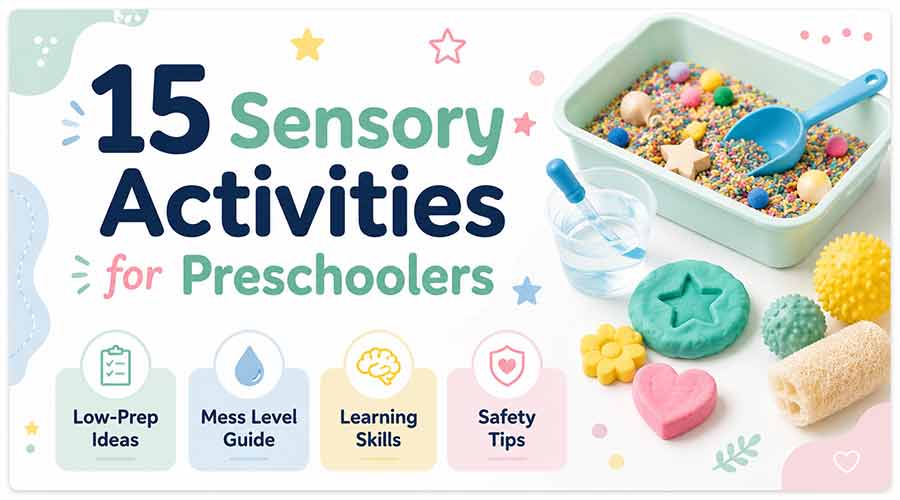
Sensory activities for preschoolers can be simple and low-prep: try a mystery touch bag, sealed paint-in-a-bag play, a texture hunt, water pouring, playdough, or scoop-and-count games. Choose an activity by setup time, mess level, the skill you want to practice, and what your child is comfortable touching or hearing.
This guide is designed for families, preschool teachers, and homeschoolers who want practical ideas for children around ages 3–5. Use the quick table below to choose an activity by setup time, mess level, sensory focus, and learning skill. Then adapt it to the child in front of you rather than trying to complete every activity.
Quick Guide: Choose a Sensory Activity
If time or cleanup is the deciding factor, start here. Mess ratings are relative: one star is usually easy to contain, while three stars may need a tray, towel, or washable surface.
| Activity | Setup | Mess | Main Skill | Sensory Focus |
|---|---|---|---|---|
| Mystery Touch Bag | 2 min | ★ | Vocabulary | Touch |
| Texture Treasure Basket | 3 min | ★ | Comparing | Touch + sight |
| Paint in a Bag | 3 min | ★ | Fine motor | Touch + sight |
| Sound Matching Containers | 5 min | ★ | Matching | Hearing |
| Nature Texture Hunt | 2 min | ★ | Observation | Touch + sight |
| Water Pour and Measure | 5 min | ★★★ | More/less, full/empty | Touch + sight |
| Sponge Squeeze Transfer | 5 min | ★★ | Hand strength | Touch |
| Playdough Roll, Press and Cut | 5 min | ★★ | Fine motor | Touch |
| Ice Rescue | 5 min | ★★ | Cause and effect | Temperature + touch |
| Vehicle Wash Station | 5 min | ★★★ | Sequencing | Touch + sight |
| Dinosaur Sensory Dig | 5 min | ★★ | Describing + pretend play | Touch + sight |
| Farm or Ocean Habitat Play | 5 min | ★★ | Sorting + vocabulary | Touch + sight |
| Make and Find Playdough Shapes | 5 min | ★★ | Shape recognition | Touch + sight |
| Scoop and Count | 5 min | ★★ | Counting | Touch + sight |
| Sink or Float Investigation | 5 min | ★★ | Prediction | Touch + sight |
What Do Preschoolers Learn Through Sensory Play?
Good sensory play is not about keeping children busy with a container of interesting materials. It is an opportunity to notice, describe, compare, test an idea, repeat an action, and talk about what happened.
The U.S. Head Start program notes that children learn through doing and that play can support language, math, science, problem solving, physical development, and other areas of learning. That makes simple preschool sensory activities useful when the adult adds a little conversation without taking over the play.
- Language: smooth, rough, cold, squishy, heavy, empty, louder, softer.
- Early math: counting, matching, sorting, comparing amounts, full and empty.
- Early science: predicting, observing changes, testing what sinks or floats.
- Fine motor practice: squeezing, scooping, pinching, rolling, pouring, and using tools.
- Attention and flexible thinking: trying a plan, noticing the result, and changing what to do next.
For more on learning through play, see Head Start’s Learning Experiences resources.
15 Easy Sensory Activities for Preschoolers
1. Texture Treasure Basket
You need: A basket and several large, age-appropriate objects with different surfaces, such as a washcloth, wooden spoon, silicone spatula, sponge, soft scarf, and smooth plastic cup.
How to play: Let the child explore one object at a time. Ask, “How does this feel?” and “Which one feels smoother?” Then sort two or three objects into simple groups such as soft/hard or smooth/bumpy.
What they practice: Descriptive vocabulary, comparison, sorting, and careful observation.
Make it easier: Compare only two very different textures. Make it harder: Ask the child to explain how two objects are alike and different.
Mess level: ★
2. Mystery Touch Bag
You need: A cloth bag or pillowcase and three to five large familiar objects that are safe for the child to handle.
How to play: Hide one object in the bag. The child reaches in without looking, feels it, and describes clues before guessing. Try questions such as, “Is it hard or soft?” and “Does it have corners?”
What they practice: Vocabulary, memory, using clues, and describing properties.
Make it easier: Show the possible objects first. Make it harder: Add objects with similar shapes.
Mess level: ★
3. Paint in a Bag
You need: A sturdy resealable bag, washable paint, and strong tape.
How to play: Add a small amount of paint, remove excess air, seal the bag, and tape every opening securely. Place it flat on a table. Children can press, swipe, make lines, and mix colors through the sealed bag.
What they practice: Finger control, visual tracking, color mixing, and cause and effect.
Make it easier: Use one color. Make it harder: Ask the child to trace lines, circles, or simple shapes.
Mess level: ★ when the bag remains securely sealed.
4. Sound Matching Containers
You need: Pairs of opaque containers that can be closed securely, plus different fillers for the adult to prepare.
How to play: Create matching pairs that make noticeably different sounds. Keep every container fully sealed. The child shakes one, listens, and searches for its matching sound.
What they practice: Listening, matching, concentration, and words such as loud, quiet, fast, and soft.
Make it easier: Use two pairs. Make it harder: Add another pair with a more similar sound.
Mess level: ★
5. Nature Texture Hunt
You need: A safe outdoor space and an adult-led list of texture words.
How to play: Look for things that appear rough, smooth, soft, bumpy, hard, or bendy. Children can point, describe, or gently touch safe objects instead of collecting them.
What they practice: Observation, vocabulary, comparing, and noticing details in the environment.
Make it easier: Hunt for one texture. Make it harder: Find two objects that share one property but differ in another.
Mess level: ★
6. Water Pour and Measure
You need: A shallow tub, a small amount of water, two or three cups, and a towel.
How to play: Pour water between containers and compare what happens. Use simple math words: more, less, full, empty, almost full, and same.
What they practice: Hand-eye coordination, measurement language, volume comparison, and controlled pouring.
Make it easier: Use two wide containers. Make it harder: Predict which container will hold more before pouring.
Mess level: ★★★. Use close adult supervision around water.
7. Sponge Squeeze Transfer
You need: Two bowls, a clean sponge, and a small amount of water.
How to play: Place water in one bowl. The child soaks the sponge, carries it to the empty bowl, and squeezes the water out. Repeat until most of the water has moved.
What they practice: Hand strength, bilateral coordination, sequencing, and persistence.
If strengthening hands is the main goal, continue with these fine motor activities for preschoolers.
Mess level: ★★
8. Playdough Roll, Press and Cut
You need: Child-safe playdough and simple age-appropriate tools such as a roller, blunt cutter, or plastic shape tool.
How to play: Roll a ball, flatten it, press patterns, make long snakes, and cut the dough into pieces. Rather than directing every step, demonstrate one action and let the child experiment.
What they practice: Fine motor control, hand strength, planning, and shape language.
Make it easier: Use soft dough and hands only. Make it harder: Copy a simple pattern or build a familiar object.
Mess level: ★★
After hands-on play, switch to a simple printable while the same theme is still fresh.
Browse Free Printables9. Ice Rescue
You need: A shallow container with one or two large washable toys frozen partly into a block of ice, plus cool or slightly warm water and a spoon or dropper.
How to play: Ask, “What could help the ice melt?” Let the child add small amounts of water and watch the changes. Avoid hot water.
What they practice: Prediction, cause and effect, temperature words, and patient observation.
Make it easier: Use a thin layer of ice. Make it harder: Compare two methods and decide which worked faster.
Mess level: ★★
10. Vehicle Wash Station
You need: Washable toy vehicles, a shallow tray, a little soapy water, a sponge or brush, and a towel.
How to play: Wash, rinse, and dry the vehicles in order. Use sequence words such as first, next, then, and last.
What they practice: Sequencing, pretend play, fine motor control, and practical vocabulary.
For another vehicle-themed follow-up, use the free Vehicles Pre-Writing Paths printable.
Mess level: ★★★
11. Dinosaur Sensory Dig
You need: A tray, a safe filler that is appropriate for the child’s age and mouthing habits, large dinosaur toys, and a scoop or brush.
How to play: Hide part of each dinosaur, then let the child uncover it using tools. Talk about what is visible before the whole dinosaur appears: “I can see a tail. What do you think is underneath?”
What they practice: Prediction, descriptive language, pretend play, and hand control.
Continue the theme with dinosaur activities for preschoolers or the free Dinosaur Pre-Writing & Fine Motor Activity Pack.
Mess level: ★★, depending on the filler.
12. Farm or Ocean Habitat Play
You need: Large age-appropriate animal toys, a tray, and a few simple materials that suggest a habitat.
How to play: Build a small pretend farm or ocean scene. Ask the child to group animals, name them, describe where they might go, and make up a short story.
What they practice: Sorting, vocabulary, classification, and imaginative play.
Pair the activity with the free Farm Animals Matching printable or Ocean Animals Matching printable.
Mess level: ★★
13. Make and Find Playdough Shapes
You need: Playdough and a few simple shape examples.
How to play: Roll and press the dough into circles, squares, triangles, and rectangles. Then compare: Which has corners? Which has straight sides? Which shape can roll?
What they practice: Shape recognition, geometry vocabulary, and fine motor control.
For more practice, see shape activities for preschoolers and the free Preschool Shapes Tracing printable.
Mess level: ★★
14. Scoop and Count
You need: A tray, a scoop, small bowls, and age-appropriate counting objects that are too large to be a choking concern for the child using them.
How to play: Scoop a small group, place the objects in a bowl, and count each object once. Start with small quantities so the focus stays on one-to-one counting rather than speed.
What they practice: Counting, one-to-one correspondence, number language, and controlled scooping.
For focused number practice, continue with counting activities for preschoolers, number recognition activities, or the free Counting 1–10 Animals printable.
Mess level: ★★
15. Sink or Float Investigation
You need: A clear tub with a small amount of water and several large, safe household objects that can get wet.
How to play: Choose one object. Ask the child to predict “sink” or “float,” test it, and describe the result. Then try another object.
What they practice: Prediction, observation, comparing results, and early science language.
Make it easier: Test two very different objects. Make it harder: Group the objects by prediction first, then check the whole group.
Mess level: ★★. Stay within arm’s reach and supervise water play closely.
How to Turn Sensory Play Into Learning
The easiest way to add learning is not to quiz the child. Instead, describe what is happening and ask an occasional open question. Then give the child time to respond or keep playing.
- What does it feel like?
- Which one feels different?
- What do you notice?
- Which container holds more?
- What do you think will happen next?
- Can you find two that match?
- How many did you scoop?
That small amount of adult guidance keeps the activity playful while helping children connect sensations with useful words and ideas. If a child is deeply focused, however, it is fine to talk less and let the exploration continue.
Sensory Play Safety for Preschoolers
Sensory play should be chosen for the individual child, not just for the age printed in an activity list. Consider whether the child still mouths objects, whether siblings younger than 3 can access the materials, and whether any ingredients may cause an allergic reaction.
- Provide active adult supervision, especially during water activities.
- Use age-appropriate materials and follow safety or age guidance on purchased products.
- Keep small parts away from younger children and from any child who may put objects in the mouth.
- Avoid magnets, button batteries, sharp objects, hot water, and unsafe household chemicals.
- Check food-based materials for allergies before use.
- Secure sealed-bag and sealed-container activities before handing them to a child.
- Do not use water beads for preschool sensory play.
The U.S. Consumer Product Safety Commission warns that water beads can be dangerous if swallowed and advises parents, caregivers, child-care centers, camps, and schools to keep them out of environments where children are present. See the CPSC Water Beads Information Center. CPSC also provides guidance on toy safety and small parts.
This article provides general educational activity ideas, not medical, developmental, or occupational-therapy advice.
What If My Child Doesn’t Like Messy Textures?
A preschool sensory activity does not need to involve wet hands, slime, or messy fillers. Some children prefer to watch first, use a tool, or keep their hands clean. That is still valid sensory play.
- Use tongs, scoops, brushes, or spoons instead of fingers.
- Try sealed-bag activities.
- Start with dry textures or familiar household materials.
- Keep one “clean hand” available if the child prefers it.
- Let the child observe before joining.
- Offer a different activity if the texture is uncomfortable.
There is no need to force a child to touch a material simply because it appears on a sensory-play list. The goal is useful, enjoyable exploration.
Optional Sensory Play Supplies
You can do most of these activities with household materials. However, a few reusable tools can make setup faster if sensory play is part of your regular preschool routine.
- Shallow washable tray or bin
- Child-size tongs
- Measuring cups and scoops
- Funnels
- Washable activity mat
- Playdough tools
- Clear storage containers with secure lids
Extend the Play With Free Printables
Hands-on play and printable learning do different jobs. Sensory play gives children room to explore, while a short printable can provide a calmer follow-up for matching, tracing, counting, or pencil-control practice.
Try pairing one hands-on activity with one related printable instead of turning the whole session into worksheets:
- Dinosaur dig → Dinosaur Pre-Writing & Fine Motor Activity Pack
- Vehicle wash → Vehicles Pre-Writing Paths
- Playdough shapes → Preschool Shapes Tracing
- Farm habitat → Farm Animals Matching
- Ocean habitat → Ocean Animals Matching
- Scoop and count → Counting 1–10 Animals
Browse all free preschool and kindergarten printables and choose one that matches the skill your child is already practicing.
Explore Free PrintablesFrequently Asked Questions
What are sensory activities for preschoolers?
Sensory activities give preschoolers safe ways to explore information through touch, sight, sound, movement, temperature, and other everyday sensations. The strongest activities also connect that exploration with language, comparing, sorting, counting, prediction, or fine motor practice.
What are some low-mess sensory activities?
Try a mystery touch bag, a texture basket, sealed paint-in-a-bag play, sound matching containers, or a nature texture hunt. These options offer sensory exploration without a large bin of loose material.
How long should sensory play last?
There is no required length. A focused 10-minute activity can be more useful than stretching play after a child has lost interest. Follow the child’s attention, the activity, and the time available.
Are sensory bins good for preschoolers?
They can be useful when materials are age-appropriate, safely contained, and supervised. However, a sensory bin is only one format. Water play, playdough, texture hunts, sealed bags, sound games, and simple household activities can provide the same kind of hands-on exploration.
What can I use instead of a sensory bin?
Use a baking tray, shallow tub, bowl, sealed bag, basket, outdoor space, or tabletop activity. The container matters much less than the child’s opportunity to explore and talk about what they notice.
What if my preschooler doesn’t like certain textures?
Offer tools, dry materials, sealed activities, or the option to watch first. Do not force contact with an uncomfortable texture. If a caregiver has ongoing concerns about a child’s responses to sensory experiences, those questions are better discussed with an appropriate qualified professional.
Keep Learning Through Play
The best sensory activities for preschoolers are usually the ones that are easy enough to repeat. Choose one activity, use materials that fit your child and your space, and add a few useful words or questions. Then stop while the activity is still enjoyable.
When you want a simple next step, explore Nini Printables’ free resources for counting, matching, pre-writing, shapes, animals, and more.
Browse Preschool & Kindergarten PrintablesAbout This Guide
Nini Printables creates simple preschool and kindergarten learning resources that can pair hands-on play with low-prep printable practice. This guide organizes sensory play ideas around setup time, mess level, learning skill, and child comfort, then cross-checks the education and safety guidance used in the article against U.S. Head Start and U.S. Consumer Product Safety Commission resources.
Teaching & Safety References
- U.S. Head Start — Learning Experiences
- U.S. Consumer Product Safety Commission — Water Beads Information Center
- U.S. Consumer Product Safety Commission — Toy Safety
Reference note: This article uses official government education and product-safety guidance. It does not cite a peer-reviewed journal paper, so DOI references do not apply.