
What Should Kindergarteners Know by the End of the Year? A Practical Guide Before First Grade
Wondering whether your child is ready to move on from kindergarten? This guide explains common end-of-kindergarten reading, writing, math, social, fine-motor, and independence skills—and what to practice next without turning home into another classroom.
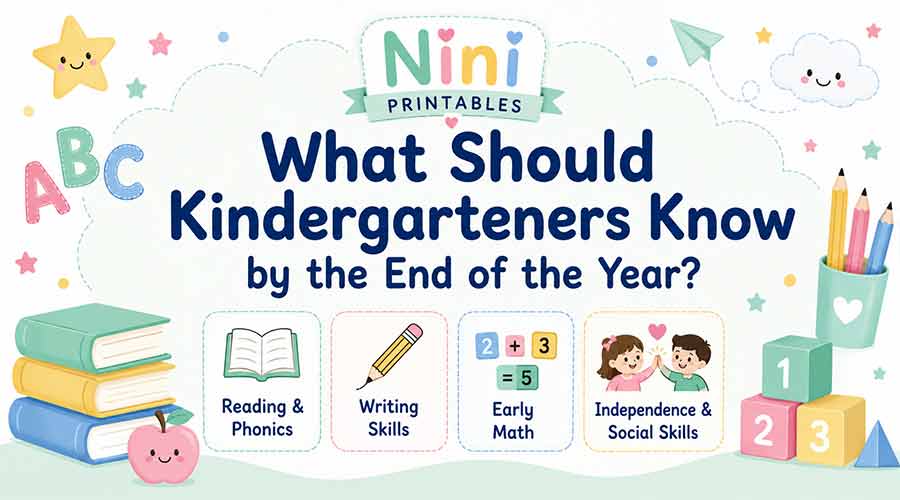
When parents search what should kindergarteners know by the end of the year, they are usually trying to answer two questions: “Is my child on track?” and “What should we work on before first grade?” A useful answer needs both a clear overview and realistic next steps.
The goal is not to check every skill in one sitting. Instead, look for patterns. A child may be confident in math but still developing writing stamina, or enjoy reading aloud while needing more practice with independent routines. Those differences are normal parts of learning.
First, End-of-Kindergarten Expectations Are Not Identical Everywhere
There is no single online checklist that functions as a universal graduation test for every U.S. kindergartener. States and school systems use different standards, curricula, assessments, and pacing. Even where schools use similar academic standards, teachers still make decisions based on the children in front of them.
For example, the Common Core kindergarten reading foundational skills include print concepts, phonological awareness, phonics, word recognition, and emerging reading fluency. Kindergarten math standards emphasize counting, quantities, comparison, early operations, measurement, and geometry. These are useful reference points, but a child’s own school remains the best source for exact local expectations.
This strengths-first approach also fits the National Association for the Education of Young Children (NAEYC) view of developmentally appropriate practice, which considers common patterns in child development alongside each child’s individuality and context.
End-of-Kindergarten Skills Checklist at a Glance
If you are looking for an end-of-kindergarten checklist, use the six skill areas below as a starting point rather than a pass-or-fail test. The examples show common directions for learning, while your child’s teacher and school curriculum provide the best context for individual expectations.
| Area | Common skill direction | Simple example |
|---|---|---|
| Reading | Connect letters and sounds, hear parts of words, and begin reading simple text | Blend sounds in a simple word and talk about a short story |
| Writing | Use drawing, dictation, letters, and words to communicate an idea | Draw a picture and add a short sentence or label |
| Math | Count, connect numbers to quantities, compare groups, and model simple operations | Count objects accurately and solve a small “add one” or “take away” problem |
| Shapes | Name, describe, compare, build, and draw common shapes | Explain how a triangle and rectangle are different |
| Social | Participate in conversations and classroom routines | Take turns, listen, ask for help, and share an idea |
| Independence | Manage common school-day tasks with growing independence | Handle belongings, open common containers, and clean up materials |
Reading and Phonics Skills by the End of Kindergarten
End-of-kindergarten reading is best viewed as a collection of connected skills, not simply “Can my child read a book alone?” Some children are already reading simple books independently, while others are still strengthening the sound-by-sound foundation that makes later reading more accurate.
Recognizing letters and connecting them to sounds
Children are commonly expected to recognize upper- and lowercase letters and connect many letters with their usual sounds. More importantly, they begin understanding that printed letters represent spoken sounds.
Hearing and working with sounds in words
Kindergarten phonological awareness includes noticing rhymes, syllables, beginning sounds, ending sounds, and individual sounds in words. These listening skills support later decoding because children can hear the parts they are trying to connect to print.
Blending and reading simple words
Many children begin blending sounds to read simple words. Rather than memorizing every word by shape, they are learning to use letter-sound information and familiar spelling patterns.
Understanding a story
Reading development also includes comprehension. After a short story or read-aloud, a kindergartener may be able to talk about characters, important events, the main idea, or what happened first and next. Asking and answering questions about a story matters even when an adult did the reading.
What about sight words?
Parents often ask how many sight words a kindergartener “should” know. There is no useful universal number to treat as a pass-or-fail cutoff because curricula use different word lists and instructional approaches. A better question is whether the child is building a growing bank of familiar high-frequency words while also learning how print and sounds work together.
Writing Skills Kindergarteners Are Building
Kindergarten writing is not expected to look like adult writing. The Common Core kindergarten writing standards, for example, explicitly allow children to combine drawing, dictating, and writing to communicate ideas. That makes the message itself just as important as perfect spelling or handwriting.
Name and letter writing
By the end of the year, many children can write their first name and form many upper- and lowercase letters. Letter size, spacing, reversals, and consistency may still be developing.
Drawing and writing an idea
A child may draw a picture, label important parts, write a simple sentence, or tell an adult what they want to add. Invented spelling can be part of early writing because it shows the child is listening for sounds and trying to represent them.
Simple words and sentences
Children may begin leaving spaces between words, using a capital letter at the start, and experimenting with end punctuation. These conventions develop with repeated meaningful writing, not only handwriting worksheets.
Pencil control still matters
If forming letters feels physically tiring, it can be harder for a child to focus on the idea they want to write. Low-pressure line, curve, path, coloring, cutting, and tracing practice can support hand control.
For children who still need that foundation, see Pre-Writing Activities for Preschoolers and Fine Motor Activities for Preschoolers. Those pages focus on the hand control that comes before and alongside conventional handwriting.
Math Skills Kindergarteners Commonly Use Before First Grade
Kindergarten math is much more than reciting a long number sequence. A strong foundation includes understanding what numbers mean, counting objects accurately, comparing quantities, and using real objects or drawings to think through simple problems.
Counting and number sense
As a reference point, the Common Core kindergarten counting and cardinality standards include counting to 100 by ones and tens, writing numerals from 0 to 20, counting objects to answer “how many,” and comparing groups and numerals.
However, counting accurately matters more than racing through a memorized sequence. A child who can touch each object once, say one number word for each object, and understand that the final count tells “how many” is showing a key number-sense relationship.
If this is still developing, start with Counting Activities for Preschoolers, Number Recognition Activities for Preschoolers, or One-to-One Correspondence Activities for Preschoolers. Each page targets a different part of early number learning.
Comparing numbers and quantities
Children can practice deciding which group has more, fewer, or the same number of objects. They can also compare written numbers within a familiar range. Use buttons, blocks, snack pieces, toy animals, or anything easy to move and count.
Beginning addition and subtraction
Kindergarteners often represent joining and separating situations with fingers, objects, drawings, stories, or equations. The goal is to understand what addition and subtraction mean—not simply memorize facts without context.
Shapes and spatial thinking
Children may identify common two- and three-dimensional shapes, describe features, compare shapes, and build or draw them. Instead of only asking “What shape is this?”, try “How do you know?” or “What is the same and different about these two shapes?”
For extra practice, the Shapes for Kindergarteners guide and the free Preschool Shapes Tracing printable give children a simple path from noticing shapes to tracing and describing them.
Fine-Motor Skills and Everyday Independence Before First Grade
First grade usually asks children to manage more of their own materials and spend longer periods writing, drawing, cutting, and completing classroom tasks. That makes fine-motor control and everyday independence useful parts of end-of-kindergarten readiness.
- Use crayons, pencils, or markers with growing control
- Cut along simple lines with child-safe scissors
- Manipulate small classroom materials
- Open common lunch or snack containers
- Keep track of a backpack or folder with reminders
- Put away materials and complete familiar cleanup routines
If hand control is the main challenge, the free Dinosaur Pre-Writing & Fine Motor Activity Pack and Vehicles Pre-Writing Paths provide short, focused practice without requiring a long lesson.
Optional Supplies That Make Practice Easier
Most activities in this guide can be done with items already at home or in the classroom. Helpful extras can include child-safe scissors, crayons or washable markers, counting manipulatives, dry-erase sleeves, and simple early-reader books.
What If My Child Cannot Do Everything on This List?
First, do not turn the list into a single test. Children often develop unevenly. One child may read confidently but avoid writing; another may love number problems but need support joining group conversations.
Instead, look at what is happening across several weeks and settings. Teacher feedback, work samples, report cards, and everyday observation are more useful than testing a child on dozens of skills in one afternoon.
- Start with the teacher’s feedback. Ask which one or two areas would be most useful to practice.
- Choose a narrow skill. “Count objects accurately” is easier to work on than “get better at math.”
- Keep practice short. Ten focused minutes can be enough for a young child.
- Use familiar materials. Toys, books, snacks, drawings, and daily routines can all become practice.
- Recheck progress later. Look for increased confidence and independence, not instant perfection.
If a parent has a specific concern about learning, communication, behavior, or development, the child’s teacher or an appropriate qualified professional can help interpret what is happening in context.
How to Choose What to Practice Before First Grade
The easiest way to avoid random worksheets is to match the activity to the exact skill that needs practice. Use the table below as a starting point.
| If your child is working on… | Start with… | Nini resource |
|---|---|---|
| Counting objects | Touch-and-count small groups | Counting 1–10 Animals |
| Numeral recognition | Match numerals to quantities | Number Recognition Activities |
| One-to-one counting | Move one object for each number word | One-to-One Correspondence Activities |
| Shape knowledge | Find, name, compare, then trace | Preschool Shapes Tracing |
| Pencil control | Short lines, curves, and paths | Vehicles Pre-Writing Paths |
| Fine-motor control | Pinch, trace, color, cut, and manipulate | Dinosaur Fine Motor Pack |
| Visual matching | Match pictures and explain the pair | Farm Animals Matching |
For children who are still preparing to start kindergarten rather than finish it, use the separate Kindergarten Readiness Checklist. Keeping those two stages separate helps families find the right guide and prevents “before kindergarten” and “before first grade” advice from getting mixed together.
A Simple 5-Day First-Grade Bridge
If you want a short routine for the final weeks of kindergarten or the beginning of summer, try one 10- to 15-minute activity per day. Repeat the cycle rather than increasing the workload.
The routine is intentionally light. If your child is engaged, you can extend it. If frustration rises, stop and return another day.
Frequently Asked Questions
Do kindergarteners need to be reading by the end of the year?
Many kindergarteners are beginning to read simple words and short texts by the end of the year, but children develop at different rates and schools use different curricula. Look at the full reading foundation: letter-sound knowledge, phonological awareness, blending, familiar word recognition, and story comprehension. Teacher feedback is the best guide for your child’s specific classroom expectations.
How high should a kindergartener count?
Under the Common Core kindergarten counting standards, one benchmark is counting to 100 by ones and tens. Just as important, children work on counting objects accurately, connecting quantities to numerals, and comparing groups. A child who can recite numbers but loses track of objects may need more one-to-one counting practice.
How many sight words should a kindergartener know?
There is no single number that works as a universal pass-or-fail target because schools and reading programs use different high-frequency word lists. Focus on whether your child is becoming more automatic with familiar words while continuing to build phonics and decoding skills.
What math should kindergarteners know before first grade?
Common kindergarten math areas include counting and cardinality, comparing numbers and quantities, representing simple addition and subtraction, working with teen numbers, measurement and classification, and identifying and describing shapes. Exact expectations depend on the school or state.
What should a kindergartener be able to write?
Many kindergarteners can write their name, form many letters, label drawings, and use drawing, dictation, and emerging writing to communicate an idea. Simple sentences, spacing, capitalization, punctuation, and spelling are still developing and may not be consistent.
What if my child seems behind at the end of kindergarten?
Start by asking the teacher which specific skills need the most support and whether the concern is consistent across classroom tasks. Then practice one narrow skill at a time in short sessions. If there is a specific concern about learning or development, discuss it with the teacher and an appropriate qualified professional who can consider the child in context.
What should a child know before starting first grade?
A child entering first grade benefits from a foundation in early reading, writing, number sense, simple operations, shape knowledge, communication, fine-motor control, and classroom independence. The goal is not mastery of every first-grade skill before school starts; it is having enough foundation to keep learning.
Final Thoughts: Look for Progress, Not Perfection
So, what should kindergarteners know by the end of the year? They should be building a workable foundation for first grade across reading, writing, math, communication, fine-motor skills, and independence. The exact level will vary, and a checklist is most useful when it points to the next small step—not when it becomes a score.
Choose one skill that would make school feel easier, practice it in a short and familiar way, and notice improvement over time. When you need a ready-to-use activity, the Nini Printables library is designed to make that next step simple.
Social, Communication, and Classroom Skills Matter Too
Academic skills are only part of the kindergarten-to-first-grade transition. Children also use language and self-regulation to participate in a classroom: listening, taking turns, asking questions, following routines, joining group activities, and communicating when they need help.
The Common Core kindergarten speaking-and-listening standards also emphasize participating in conversations, following agreed-upon discussion rules, asking and answering questions, and expressing ideas clearly. In daily life, these abilities often show up during play, family conversations, read-alouds, and ordinary classroom routines.
These skills do not need to look perfect every day. Tiredness, unfamiliar situations, language background, temperament, and classroom context can all affect how confidently a child uses them.