
15 Kindergarten Readiness Activities to Prepare Your Preschooler for School
These low-prep kindergarten readiness activities help preschoolers practice early math, language, fine motor, listening, independence, and social skills through short, everyday play—not long lessons or piles of worksheets.
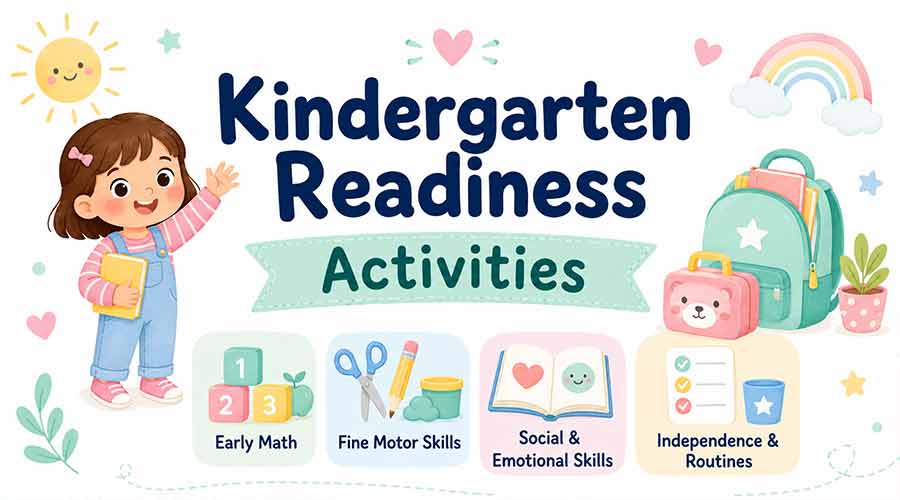
Getting ready for kindergarten does not require turning home into a classroom. School readiness includes early learning, communication, motor skills, independence, and social-emotional development—not academics alone.
Use these preschool readiness activities to practice one useful skill at a time through everyday play and routines. If you first want a skills overview, see the kindergarten readiness checklist.
What Do Kindergarten Readiness Activities Actually Build?
Kindergarten readiness is best treated as a combination of skills rather than one academic target. Head Start’s school-readiness framework includes development across learning behaviors, social-emotional development, language and literacy, cognition, and motor and physical development. That broad view is useful at home because it reminds adults to practice both learning skills and everyday independence.
- Social-emotional skills: taking turns, naming feelings, and recovering from small frustrations.
- Language and early literacy: listening, talking about stories, rhyming, and expressing ideas.
- Early math and thinking: counting objects, matching quantities, sorting, comparing, and noticing patterns.
- Fine motor and physical skills: drawing, cutting, pinching, rolling, opening containers, and handling tools.
- Independence: managing a backpack, lunch items, simple clothing, cleanup, and asking for help when needed.
- Learning habits: following short directions, staying with a task briefly, trying again, and moving through routines.
You do not need to practice every area every day. Instead, notice which part of the school day may feel hardest for your child and begin there.
15 Kindergarten Readiness Activities for Preschoolers
These getting-ready-for-kindergarten activities use ordinary routines and simple materials. Most can be done in 5–15 minutes. Keep the tone playful, stop before the child is worn out, and repeat familiar activities rather than constantly adding new ones.
1. Follow a Two-Step Direction
Give one simple direction with two connected actions: “Pick up the red block and put it in the basket,” or “Get your shoes and place them by the door.” Keep the wording short and let the child finish before adding another instruction.
This mirrors the kind of listening children use during cleanup, transitions, and small-group activities. Head Start’s preschool language guidance includes understanding and responding to increasingly complex communication, including multi-step directions.
Make it easier: begin with one step, then add the second step once the first feels comfortable.
2. Pack and Open a Practice Lunch
Put a few familiar snack items into the lunchbox or containers your child is likely to use. Practice opening the lunchbox, unscrewing a bottle, opening a container, putting leftovers away, and cleaning the eating space.
NAEYC specifically recommends building independence and self-help skills before kindergarten. Practicing lunch at home turns an everyday routine into useful preparation without making it feel like a lesson.
Useful check: if a container is consistently too difficult, choose a simpler one rather than making lunch a daily fine-motor test.
3. Play a Name-the-Feeling Game
Use a picture book, family photo, or simple pretend situation. Ask, “How might this person feel?” Then follow with, “What could they do next?” Keep the conversation open; the goal is not to find one perfect answer.
Talking about feelings gives children words they can later use when they are disappointed, nervous, excited, or frustrated at school.
4. Practice Taking Turns with a Tiny Game
Roll one die, pass a block back and forth, build a tower one piece at a time, or play a very short board game. Say whose turn it is, wait, and model what to do when someone else goes first.
NAEYC lists listening to others and taking appropriate turns as useful experiences for children entering kindergarten. A two-minute game can practice that skill more naturally than a long explanation.
5. Count and Move Real Objects
Set out 5–10 small objects such as toy animals, blocks, buttons, or large pom-poms. Ask your child to move one object into a bowl each time they say a number. Then ask, “How many are there altogether?”
Moving one object for each number word helps connect counting words with actual quantities. For more ideas, see counting activities for preschoolers and one-to-one correspondence activities.
Make it harder: mix in more objects or ask the child to give you an exact quantity, such as “Please give me seven bears.”
6. Match a Number to a Quantity
Write the numerals 1–5 on small cards. Put one card beside a group of objects, then let your child count and decide whether the numeral matches the quantity. Gradually move toward 1–10 as the smaller set becomes easy.
If numeral recognition is the harder part, use the ideas in number recognition activities for preschoolers before increasing the quantity.
7. Sort by Color, Shape, or Size
Gather a small group of safe objects and ask your child to sort them in one way. Afterward, mix them up and ask, “Can you find a different way to sort these?”
Sorting encourages children to notice similarities, differences, and simple rules. It also invites useful language such as same, different, bigger, smaller, round, and straight.
8. Find Shapes Around the House
Choose two or three shapes and look for them in everyday objects: a plate can suggest a circle, a book a rectangle, and a tile a square. Ask your child to explain what they notice instead of only naming the shape.
If this is a current learning goal, continue with shape activities for preschoolers or the free preschool shapes tracing printable.
9. Play a Rhyming Word Game
Say an easy word such as cat, sun, or log, then think of a rhyming word together. Silly made-up words are fine when the goal is hearing how words sound.
Keep this oral. Your preschooler does not need to read the words to hear that cat and hat sound alike.
10. Retell a Favorite Story
After reading a familiar book, ask three small questions: “What happened first?” “What happened next?” and “How did it end?” If needed, flip through the pictures and use them as clues.
This keeps reading interactive while practicing memory, sequencing, vocabulary, and speaking in complete ideas.
11. Draw a Picture and Explain It
Invite your child to draw something familiar—a trip to the park, a pet, a favorite meal, or an imaginary scene. When the picture is finished, ask them to tell you about it. You can write down one sentence they say if they enjoy seeing their words turned into print.
The goal is not perfect handwriting. Drawing gives small hands practice while the explanation builds language and confidence.
12. Cut Along Simple Lines
Start with short straight lines on sturdy paper. Once the opening-and-closing motion feels easier, try gentle curves and simple shapes. Always use age-appropriate scissors and supervise cutting practice.
The cutting activities for preschoolers guide shows an easy progression from snips to more controlled paths.
Keep it successful: a few controlled cuts are enough. Stop before hand fatigue turns the activity into frustration.
13. Pinch, Roll, and Shape Playdough
Roll playdough into balls and “snakes,” pinch small pieces, flatten them with the palm, and build simple shapes. These movements give fingers and hands varied practice without requiring a pencil.
Keep the task open-ended. A child can make pretend food, letters they already know, shapes, or anything else that keeps hands working.
14. Practice Getting Ready Independently
Choose two or three real tasks: putting on a backpack, zipping a jacket, using a water bottle, putting shoes in the right place, or tidying personal belongings. Give enough time for the child to try before stepping in.
NAEYC recommends opportunities for independence, responsibility, routines, and asking for help when needed. These practical skills can reduce the number of small tasks a child must learn all at once during the first weeks of school.
15. Play Pretend Kindergarten
Set up a short pretend school routine: arrive, hang up a backpack, sit for a tiny story, ask the “teacher” for help, eat a pretend lunch, clean up, and pack for home. Let your child switch roles and become the teacher too.
Pretend play makes an unfamiliar routine more predictable. It also gives a child a safe place to talk about worries, questions, or excitement before school begins.
Keep it light: the goal is familiarity, not perfect classroom behavior. Five playful minutes can be more useful than a long rehearsal.
Choose an Activity Based on What Your Child Needs
You do not need to complete all 15 kindergarten readiness activities in order. Use the table below to pick one useful starting point.
| If this feels hard… | Try this activity | Main skill |
|---|---|---|
| Counting objects accurately | Count and move real objects | One-to-one correspondence |
| Following directions | Two-step direction game | Listening and working memory |
| Using scissors | Cut simple lines | Fine motor control |
| Waiting for a turn | Tiny turn-taking game | Self-regulation |
| Opening lunch items | Practice lunch | Independence |
| Talking about feelings | Name-the-feeling game | Social-emotional language |
| Worrying about school routines | Pretend kindergarten | Familiarity and confidence |
A Simple 7-Day Kindergarten Readiness Routine
If you prefer a plan, use one short focus each day. Five to fifteen minutes is a practical range for many home activities, but stop sooner when interest fades. The routine is meant to make practice easier to remember, not to create a new daily requirement.
Repeat the same routine the following week if it is working. Familiar practice is often more useful than constantly searching for a new activity.
What You Do Not Need to Teach Before Kindergarten
School readiness should not become a race to make a preschooler look like an older student. NAEYC advises families to look at the whole child rather than worrying only about reading and writing. It also notes that children arrive with a wide range of experiences and developing skills.
- Your child does not need to read independently before kindergarten.
- They do not need perfect handwriting or perfectly formed letters.
- They do not need long daily worksheets to be “ready.”
- They do not need to master every skill on the same timetable as another child.
Instead, focus on useful foundations: curiosity, communication, early number sense, motor control, independence, listening, play, and the ability to ask for help.
When Are Kindergarten Readiness Printables Helpful?
Hands-on practice should do most of the work. However, a simple printable can be useful when a child is ready for a few minutes of focused table practice with counting, matching, tracing, shapes, or pre-writing movements.
A good rule is to connect the page to something the child has already done. Count toy animals first, then try a counting page. Find shapes around the house, then trace a few shapes. Build hand strength with playdough, then practice a short pencil path.
Optional supplies that can make practice easier
Crayons, washable markers, playdough, child-safe scissors, small counting objects, scrap paper, simple picture books, and reusable lunch containers can support many of the activities above. Use what you already have; there is no need to buy a special kindergarten-readiness kit.
Frequently Asked Questions About Kindergarten Readiness Activities
What are kindergarten readiness activities?
Kindergarten readiness activities are short, age-appropriate experiences that practice skills useful for school, including early math and language, motor control, listening, social skills, independence, and routines.
What should a 4-year-old practice before kindergarten?
Useful practice includes talking and listening, counting real objects, drawing, following short directions, taking turns, managing belongings, and using simple self-help skills. Treat these as practice areas rather than a pass/fail list.
How long should kindergarten readiness practice last?
Try roughly 5–15 minutes for a focused activity, or build the skill into an existing routine such as lunch, cleanup, story time, or getting dressed. Stop when interest fades.
Does my child need to read before kindergarten?
No. Kindergarten readiness is broader than reading and writing. Reading aloud, talking about stories, noticing sounds, and enjoying books build early-literacy experience without requiring independent reading.
Are kindergarten readiness worksheets necessary?
No. Worksheets are optional. Hands-on play, conversation, routines, drawing, sorting, counting real objects, and pretend play can all build readiness skills. Use a printable as a short follow-up when it matches the skill being practiced.
How can I prepare my child for kindergarten at home?
Start with ordinary routines: manage a backpack, open lunch containers, follow a two-step direction, take turns, count toys, retell a story, cut or draw, and ask for help. Add short printable practice when it is useful.
Start With One Small Activity Today
You do not need to work through a complete kindergarten-prep program. Pick one skill that matters in your child’s daily life, choose one activity from this guide, and repeat it until it feels familiar. Then move to another area when it makes sense.
If you want a ready-to-print next step, browse the free preschool and kindergarten printables. The goal is simple practice that fits around family life, classroom routines, or homeschool time—not more busywork.
Enjoying the free resources? Sharing Nini Printables with another parent, teacher, homeschool family, or caregiver is a simple way to support the growing free printable library.
About This Guide
Nini Printables creates low-prep printable activities for preschool and kindergarten learners. This guide reflects the same skill progression used across the site’s counting, shape, tracing, pre-writing, and fine-motor resources: begin with hands-on practice, then use short printable follow-up when it is helpful. The guidance was also checked against current school-readiness resources from Head Start and NAEYC. It is intended as general educational guidance for parents, caregivers, homeschool families, and educators—not as a formal developmental assessment or a substitute for guidance from a child’s school or qualified professional.
Learn more about Nini Printables.
Teaching References
The learning guidance in this article was checked against the following government and professional early-childhood resources: