
15 Sorting Activities for Preschoolers: Easy Ideas by Skill Level
These sorting activities for preschoolers use colors, shapes, toys, animals, and everyday objects to build early classification skills without a complicated setup. Start with one clear rule, then add a new challenge when the child is ready.
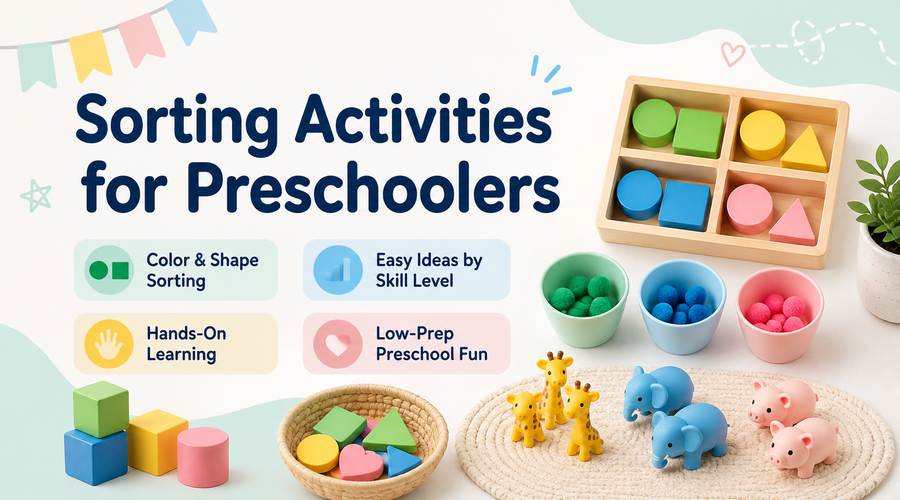
Good preschool sorting activities begin with obvious differences, such as red versus blue or animals versus vehicles. Once that feels easy, invite children to sort the same objects a different way, make their own rule, or explain why each item belongs in a group.
Sorting looks simple, but it asks children to notice details, compare objects, make a rule, and decide where each item belongs. The National Association for the Education of Young Children (NAEYC) explains that early sorting and classifying experiences help young children notice how things are alike and different.[1] That makes sorting a useful bridge between everyday play and early math thinking.
This guide is organized by skill level rather than by a random list of crafts. Parents, preschool teachers, homeschool families, and caregivers can begin with an easy activity, watch how the child responds, and then increase the challenge without turning the activity into a test.
Sorting Activities at a Glance
Choose an activity by the skill you want to practice. You do not need to complete all 15 ideas, and repeating a familiar sort with a slightly different rule can be more useful than setting up a brand-new activity every day.
| Activity | Main skill | Basic materials | Prep / level |
|---|---|---|---|
| 1. Sock Match & Sort | Same / different | Clean socks | None · Beginner |
| 2. Large Block Color Sort | Color | Blocks, bowls or mats | Very low · Beginner |
| 3. Simple Toy Groups | Category | Mixed familiar toys | None · Beginner |
| 4. Farm / Ocean Animal Sort | Category | Animal toys or cards | Low · Beginner |
| 5. Pom-Pom Color Sort | Color | Large pom-poms, cups | Low · Beginner |
| 6. Color Hunt and Sort | Color | Safe room objects | None · Beginner |
| 7. Large Counter or Block Sort | Color / rule switching | Large counters or blocks | Low · Developing |
| 8. Shape Sorting Tray | Shape | Paper, foam, or card shapes | Low · Developing |
| 9. Big and Small Toy Sort | Size | Toys or blocks | None · Developing |
| 10. Two-Way Re-Sort | Rule switching | Blocks with two attributes | Low · Challenge |
| 11. Mystery Sorting Rule | Reasoning | Mixed safe objects | None · Challenge |
| 12. Cooperative Sorting Race | Quick classification | Mixed safe objects, optional song | Low · Developing |
| 13. Sort During Clean-Up | Real-life categories | Everyday toys or supplies | None · Developing |
| 14. Land, Air, and Water Vehicles | Category | Vehicle toys or cards | Low · Developing |
| 15. Animals, Food, and Household Sort | Category + explanation | Objects, toys, or cards | Low · Challenge |
What Is Sorting for Preschoolers?
Sorting means grouping objects by a shared feature or rule. A child might put red counters in one cup and blue counters in another, group animals by where they live, or separate large blocks from small blocks.
NAEYC’s early math guidance notes that sorting experiences help children observe similarities and differences.[1] In everyday preschool play, those comparisons can involve color, shape, size, texture, use, or category. Read the NAEYC guidance on sorting and classifying.
Matching vs. sorting vs. classifying
Matching usually asks a child to find two items that are the same or that belong together. Sorting asks the child to organize several items into groups. Classifying adds the idea of a rule: the child decides or explains what the items in each group have in common.
If matching is still new, begin with the site’s matching activities for preschoolers. Once children can compare pairs comfortably, sorting gives them a natural next step.
How Preschool Sorting Skills Progress
There is no need to attach a rigid age to each step. Instead, use the child’s current response to decide what comes next. A useful progression moves from obvious sameness toward flexible rules and explanations.
The Center on the Developing Child at Harvard University specifically recommends asking 3- to 5-year-olds to sort by one rule and then switch to a different rule, such as moving from color to shape, as a way to challenge cognitive flexibility.[2] See Harvard’s executive-function activity guide.
Simple teaching rule: change only one part of the challenge at a time. Add more groups, a less obvious rule, or an explanation step—but not all three at once.
Easy Sorting Activities for Beginners
Beginner preschool sorting activities work best when the difference between groups is easy to see. Start with only a few objects and two groups.
Sort Matching Socks
Put three or four clean pairs of clearly different socks in a pile. Help the child make pairs first, then sort the pairs by color, pattern, person, or size.
Practices: visual comparison, same/different, simple grouping.
Sort Large Blocks by Color
Choose blocks in two colors and place two bowls or paper mats on the table. Model one block, then invite the child to continue.
Practices: color recognition, one-rule sorting, attention.
Sort Toys Into Simple Groups
Mix a few familiar toys, such as cars and animal figures. Ask, “Which ones are vehicles?” and “Which ones are animals?” Keep the first categories concrete and familiar.
Practices: vocabulary, category knowledge, reasoning.
Sort Farm and Ocean Animals
Use safe animal figures or picture cards. Put a “farm” area on one side and an “ocean” area on the other, then talk about where each animal belongs.
Practices: category sorting, language, background knowledge.
Color Sorting Activities for Preschoolers
Color is often an easy first sorting rule because the difference is visible without extra explanation. Use only two colors at first if a larger set feels distracting.
Pom-Pom Color Sort
Place two colored cups or paper circles beside a small set of large, age-appropriate pom-poms. The child moves each pom-pom to the matching color.
Practices: color sorting, visual scanning, controlled placement.
Color Hunt and Sort
Choose two colors and look around the room for safe objects that match. Bring the objects back to two mats or baskets and sort the collection together.
Practices: color recognition, movement, comparing real objects.
Large Counter or Block Color Sort
Use large, age-appropriate counters or blocks in several colors. First sort by color. Then mix the set and ask whether the same objects could be sorted another way.
Practices: classification, rule switching, flexible thinking.
Need a low-prep follow-up?
Hands-on sorting can come first, then a short matching, counting, or shape printable can give children a quieter way to practice noticing details and following a simple rule.
Shape and Size Sorting Activities
Once color sorting feels familiar, shape and size add useful comparison language. Children can notice corners, curved edges, longer pieces, shorter pieces, bigger objects, and smaller objects.
Shape Sorting Tray
Mix paper, foam, or sturdy card shapes and ask the child to group circles, triangles, squares, or other familiar shapes. Keep the colors mixed so shape—not color—becomes the rule.
Practices: shape recognition, visual comparison, rule focus.
Big and Small Toy Sort
Choose similar objects in two obvious sizes, such as large and small blocks or toy animals. Put a “big” example and a “small” example beside two containers before the child begins.
Practices: comparison language, size concepts, classification.
Sort the Same Objects Two Ways
Use a set that has two visible features, such as red and blue blocks in two sizes. Sort by color first. Next, mix them and sort by size.
Practices: rule switching, attention, flexible classification.
Sorting Games for Preschoolers
Sorting games add conversation and movement without requiring a winner. Keep directions short, and give the child time to explain a choice.
Guess the Mystery Sorting Rule
Make two small groups while the child watches. For example, place round objects on one side and objects with corners on the other. Ask the child to guess your rule.
Practices: reasoning, comparison, explaining evidence.
Cooperative Sorting Race
Put a small mixed collection in the middle and work together to sort it before a short song ends. The goal is cooperation and quick recognition, not beating another child.
Practices: visual scanning, decision making, shared attention.
Sort During Clean-Up
Turn an ordinary routine into a classification game: blocks in one bin, toy food in another, art tools in a cup, and books on the shelf.
Practices: real-life categorizing, independence, vocabulary.
Category Sorting Activities
Category sorting asks children to think beyond one visual feature. Two items may look different but still belong together because they share a use, habitat, or meaning.
Sort Vehicles by Land, Air, and Water
Use toy vehicles or picture cards and make three spaces for land, air, and water. Talk about where each vehicle usually travels before placing it.
Practices: category knowledge, transportation vocabulary, reasoning.
Sort Animals, Food, and Household Objects
Use safe real objects, toys, or picture cards from three familiar categories. Ask the child to sort first, then choose one group and explain what its items have in common.
Practices: classification, vocabulary, verbal reasoning.
How to Make a Sorting Activity Easier or Harder
The best adjustment is usually small. If a child is guessing, reduce the choices. If a child sorts quickly without thinking, change one feature of the task.
| Area | Make it easier | Add a challenge |
|---|---|---|
| Groups | Use two groups. | Use three or four groups. |
| Differences | Choose objects with obvious differences. | Use items with subtler differences. |
| Adult support | Model the first few choices. | Let the child invent the rule. |
| Rule | Sort by one visible feature. | Re-sort the same objects by a new rule. |
| Language | Ask “same or different?” | Ask “why do these belong together?” |
What If a Preschooler Has Trouble Sorting?
Treat difficulty as information about the activity, not as a pass-or-fail result. First, make the task clearer and smaller.
- Use fewer objects.
- Reduce the task to two groups.
- Choose items with obvious differences.
- Model one or two examples first.
- Use one sorting rule at a time.
- Return to matching before sorting.
A child may also understand the rule but lose interest in the materials. In that case, use a familiar topic such as cars, animals, snacks, or classroom supplies. Keep practice playful and flexible rather than using sorting as a developmental diagnosis.
Turn Sorting Into Fine Motor Practice
Once the sorting rule is familiar, change the way children move the objects. Fingers are the easiest starting point. Later, tongs, clothespins, or a muffin tin can add controlled grasp-and-release practice.
Optional reusable supplies
Use what you already have first. If you are building a reusable preschool activity basket, versatile options include child-sized tongs, sorting bowls, large counters, blocks, washable markers, and a muffin tin.
Choose age-appropriate materials and supervise loose parts. A special sorting kit is not necessary.
For more hand-strength and tool-control ideas, see Fine Motor Activities for Preschoolers. For a broader early-math routine, continue with Math Activities for Preschoolers.
What to Practice After Sorting
Sorting does not need to lead straight to worksheets. A useful next step is to reuse the same objects for a new kind of thinking.
- Matching: compare individual pairs when visual discrimination needs more practice.
- Patterns: arrange sorted objects in a repeating sequence such as red-blue-red-blue.
- Counting: count how many objects ended up in each group, then continue with Counting Activities for Preschoolers when you want a focused number-sense follow-up.
- Comparing: ask which group has more, fewer, bigger, or smaller items.
- Simple graphing: line up groups and compare their lengths visually.
This progression connects sorting with the site’s existing math content without making every activity cover every skill at once.
Keep the next activity simple
Choose one free printable that matches the skill your child or class is ready to practice. Nini Printables includes matching, counting, shape, animal, tracing, and pre-writing activities for short, focused follow-up.
Frequently Asked Questions About Sorting Activities for Preschoolers
What are examples of sorting activities for preschoolers?
Easy examples include sorting blocks by color, toys by type, shapes into groups, objects by big and small, animals by habitat, vehicles by land/air/water, or classroom materials during clean-up. Begin with two clear groups and one rule.
What skills do sorting activities teach?
Sorting activities can help children practice noticing similarities and differences, classification, vocabulary, early math reasoning, attention, and explaining a simple rule. When children re-sort the same objects a different way, the task also asks them to shift between rules.
What is the difference between matching and sorting?
Matching usually asks children to find two items that are the same or belong together. Sorting asks children to organize several items into groups based on a feature or category. Matching can be a helpful first step before sorting.
How do you teach a preschooler to sort?
Start with a small set of familiar objects and two obvious groups. Name the rule, model one or two examples, and let the child continue. When that feels easy, change the rule or ask the child to explain why the items belong together.
What household items can preschoolers sort?
Clean socks, large blocks, plastic cups, crayons, safe kitchen tools, toy animals, toy vehicles, and other large age-appropriate objects can work well. Avoid small loose parts when they are not appropriate for the child.
How can I make sorting activities more challenging?
Add a third group, use less obvious differences, ask the child to invent the sorting rule, or mix the objects and sort the same set a second way. You can also ask, “Why do these belong together?” instead of only asking where an item goes.
Keep Sorting Simple and Hands-On
Effective sorting activities for preschoolers do not require a full math kit or a long lesson. Start with a few familiar objects, use one clear rule, and let children move and compare the items themselves.
Next, increase only one part of the challenge: add another group, sort the same collection in a new way, or ask the child to explain the rule. That keeps the activity useful without making it unnecessarily complicated.
Enjoying the free ideas? Sharing this guide with another parent, preschool teacher, homeschool family, or caregiver is a simple way to support Nini Printables and helps more families discover the free resource library.