
15 Music Activities for Preschoolers: Easy Rhythm, Listening & Movement Ideas
These low-prep music activities for preschoolers help children explore rhythm, steady beat, listening, sound, movement, and simple musical patterns with clapping, household objects, and easy instruments.
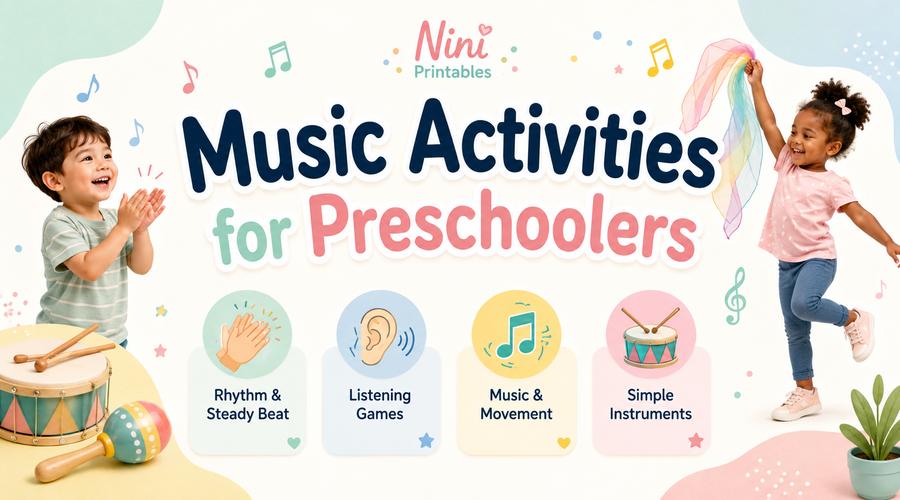
Quick answer: Good music activities for preschoolers include echo clapping, body percussion, fast-and-slow games, sound guessing, rhythm sticks, shakers, simple drumming, freeze dance, scarf movement, and drawing to music. Start with one clear idea—such as copying a beat or noticing loud and soft sounds—then keep the activity short enough that children finish while they are still engaged.
These music activities for preschoolers do not require a formal lesson. Young children can explore sound through play by copying a clap, moving to a beat, comparing fast and slow sounds, or creating a short rhythm for someone else to repeat. The National Association for the Education of Young Children (NAEYC) describes young children exploring music through singing, movement, beat, sound experiments, and repeated patterns.
Likewise, Head Start guidance on music and child development describes playful music experiences that include singing, clapping, dancing, playing instruments, and movement. For this guide, the practical sequence is simple: listen → copy → move → create.
Nini Printables uses a low-prep, skill-focused approach: each idea below gives the adult one clear task to model, one musical feature to notice, and a simple way to adjust the challenge. Use familiar music when possible, include songs or sounds that reflect the children and families in your setting, and stop or simplify when the activity is no longer comfortable or engaging.
Choose a Music Activity by Skill
Choose the activity by the skill you want children to notice, not by how many materials it uses. The same game can stay useful for several days when one small challenge changes.
| Focus | Try this activity | Simple materials |
|---|---|---|
| Steady beat | Echo Clapping | Hands only |
| Rhythm | Body Percussion Copycat | Hands, knees, feet |
| Listening | Mystery Sound Guessing | Safe household objects |
| Tempo | Fast or Slow? | Clapping or a drum |
| Loud / soft | Little Conductor | Hands or one instrument |
| Turn-taking | Drum and Stop | Drum or container |
| Fine motor | Egg Shaker Beat | Sealed shaker |
| Gross motor | Freeze Dance With Tempo | Music playback |
| Creativity | Draw What You Hear | Paper and crayons |
What Can Preschoolers Explore Through Music?
Music play gives children concrete things to notice and copy. Keep the language simple and connect it to what they can hear or do in the moment.
- Steady beat: keeping a regular pulse with claps, taps, or steps.
- Rhythm: copying short sound patterns with different pauses and beats.
- Listening: noticing where a sound comes from or how it changes.
- Tempo: comparing fast and slow music or movement.
- Dynamics: exploring louder and softer sounds without shouting.
- Turn-taking: waiting, listening, then responding to another person.
- Movement: matching steps, claps, sways, or stomps to a beat.
- Creativity: inventing a rhythm, movement, or picture inspired by sound.
5 No-Instrument Music Activities for Preschoolers
Start here when you need preschool music activities with almost no setup. These simple music games for preschoolers work well at home, during circle time, or as a short transition between other activities.
Echo Clapping
Clap one short pattern and ask the child to copy it. Begin with two or three beats, such as clap-clap-pause-clap. Repeat the same pattern before changing it.
Make it easier: use two identical claps. More challenge: let the child create the pattern for the adult to copy.
Body Percussion Copycat
Build a sound pattern with the body: clap hands, tap knees, then stomp once. Children copy the sequence after watching. When that becomes easy, change just one action.
Keep it manageable: use two actions first. Add a third only when children can remember the basic pattern.
Fast or Slow?
Clap a steady beat slowly, then repeat it faster. Ask, “Was that fast or slow?” Next, let the child move in a way that matches the tempo: slow steps for slow beats and quick steps for fast beats.
Loud or Soft Conductor
Choose one safe sound, such as clapping or tapping knees. The conductor raises both hands for louder sounds and lowers them for softer sounds. Take turns being the conductor.
Useful boundary: “loud” does not need to mean shouting. Keep the sound comfortable for the room.
Mystery Sound Guessing
Hide one familiar object behind your back and make a sound with it: rustle paper, tap two wooden spoons, shake a sealed container, or ring a bell. The child listens and guesses the sound source.
Safety: avoid loose small objects that could become choking hazards. Keep homemade sound containers securely sealed and supervise use. Head Start also recommends closing homemade shaker openings tightly and having adults complete safety-sensitive steps as needed.
Need a quiet follow-up after active music play?
Switching from movement to one simple tabletop activity can make planning easier. Browse Nini Printables for free tracing, matching, counting, shapes, pre-writing, and fine-motor practice.
5 Simple Instrument Music Activities
Simple instruments can make a beat easier to hear and give children a clear action to repeat. However, special equipment is optional. A sturdy container can become a drum, and a sealed homemade shaker can stand in for a classroom instrument.
Rhythm Stick Copycat
Tap two rhythm sticks together once, pause, then tap twice. The child copies the pattern. Keep the sticks below shoulder height and use clear rules about tapping sticks rather than people or furniture.
Egg Shaker Beat
Shake once on each beat while counting four steady beats: 1, 2, 3, 4. Pause, then repeat. Next, try shaking only on beats 1 and 3 so children have to listen before moving.
Drum and Stop
Tap a simple drum while the child moves. When the drum stops, the child freezes. After a few rounds, swap roles so the child controls when the sound starts and stops.
Instrument Sound Match
Place two or three instruments or safe sound-makers where children can see them. Make one sound without showing which item you used. The child points to the matching object, then checks the answer by playing it.
Make a Household Band
Choose three different safe sounds, such as tapping wooden spoons, drumming on a container, and shaking a sealed shaker. Give each person one sound and play a simple four-beat pattern together.
Keep it useful: begin with one leader and one repeated pattern. Too many different sounds at once can make the listening goal disappear.
3 Music and Movement Activities for Preschoolers
Music and movement activities for preschoolers work best here when the movement helps children notice something in the music. For a larger collection focused specifically on gross motor play, use the separate movement activities for preschoolers guide.
Freeze Dance With Tempo
Play a short piece of music and ask children to move. Pause the music for a freeze. Then change the challenge: use slow movement during a slow section and faster movement during a faster section.
Scarf Beat Movement
Give each child a lightweight play scarf or small piece of fabric. Move it up, down, side to side, or in a circle on a steady beat. Children copy the motion while listening for the beat.
Move Like the Music
Choose two clearly different sections of music. Ask children how each section makes them want to move: march, tiptoe, sway, stretch, or stomp. There is no need for one “correct” dance.
2 Music, Art and Imagination Activities
Draw What You Hear
Play a short piece of music while children draw lines, shapes, or colors that match what they notice. Afterward, ask one open question such as, “What part of the music made you draw that line?”
Song Picture Cube
Put six simple pictures on a paper cube, with each picture representing a familiar song. A child rolls the cube, identifies the picture, and chooses the matching song for the group to sing.
Keep it simple: use songs the group already knows. The activity is about recalling and choosing, not learning six new songs at once.
A Simple 5-Day Preschool Music Plan
You do not need five completely different lessons. Repeat familiar formats and change the listening focus. A short, predictable routine is often easier for adults to prepare and easier for children to understand.
For classroom use, keep one opening cue and one closing cue the same across the week. That leaves more attention for the musical idea you want children to notice.
Make the Activities Easier or Harder
The best preschool music activity is the one that gives the child a manageable next step. Age can be a useful clue, but current skill and interest are more helpful than forcing every child into the same level.
For beginners or younger preschoolers
- Use one-step directions.
- Keep patterns to two or three sounds.
- Model first, then invite the child to copy.
- Use clearly different contrasts such as very slow versus clearly faster.
When the basic activity is comfortable
- Use two-part patterns.
- Add a pause that children must remember.
- Let children take turns leading.
- Combine two ideas, such as fast/slow with loud/soft.
For more challenge
- Ask the child to create a short rhythm for someone else to copy.
- Hide the model briefly and repeat from memory.
- Compare two sound-makers and describe how they differ.
- Invite children to explain why a movement matches the music they heard.
Adapt for different ways of participating
Participation does not have to mean standing and dancing. A child can clap, nod, sway, tap, move their head, or use wheelchair movement to respond to a beat. Head Start recommends offering different movement options and easier-to-grasp instruments when children need them. The musical goal can stay the same even when the movement changes.
Want to extend the movement or hand-skill practice?
Keep the search intent clear: use the music ideas on this page for rhythm, listening, tempo, and sound. For activities where movement or hand control is the main goal, continue with the dedicated guides below.
Optional Supplies for Preschool Music
You do not need to buy special instruments for these preschool music activities. Still, a small reusable music basket can make setup faster when music play is part of your weekly routine.
- Rhythm sticks: useful for tapping and copying simple patterns.
- Egg shakers: easy to use for steady beats and start/stop games.
- Play scarves: useful for beat, direction, and movement activities.
- Small hand drum: helpful for start/stop, tempo, and turn-taking.
- Simple percussion set: useful when several children need different sound choices.
Use what you already have first. If you later build a reusable music basket, choose durable, age-appropriate items that are easy to hold and simple to put away.
Music Activities and Printables: Use Each for a Different Job
Music learning is most direct when children can listen, copy, move, and create. A printable can then work as a calm follow-up rather than replacing the hands-on activity.
For example, after a rhythm game, a child might switch to a short tracing or matching page. After a counting song, continue the number idea with a counting activity. If you want more number-and-music ideas specifically, see 15 counting songs for preschoolers.
Frequently Asked Questions
What are good music activities for preschoolers?
Good choices include echo clapping, body percussion, fast-and-slow games, mystery sounds, shaker beats, simple drumming, freeze dance, scarf movement, and drawing to music. Choose one clear listening or movement goal and keep the directions short.
How can I teach music to preschoolers without instruments?
Start with the body and voice. Clap a beat, tap knees, stomp, sing a familiar song, move fast or slow, or play a listening game with safe household sounds. Instruments can add variety, but they are not required for basic preschool music play.
How do you teach rhythm to preschoolers?
Use very short patterns that children can hear and copy. Begin with two or three claps or taps, repeat the same pattern, and then let the child lead. Once that is easy, add a pause or a second type of sound.
What are easy music and movement activities for preschoolers?
Freeze dance with fast and slow sections, scarf movements on the beat, marching to a drum, and “move like the music” are easy choices. If movement is the main goal rather than the music concept, use the dedicated preschool movement activities guide for more ideas.
How long should a preschool music activity last?
There is no single correct length. Start with a brief activity and watch the group. Stop or change the challenge when children are no longer listening, copying, or participating comfortably. A short activity that children want to repeat is usually more useful than stretching one game to fill a preset time.
Keep Preschool Music Playful
The goal is not to turn preschool music into a miniature formal lesson. Start with one sound idea, let children hear it, copy it, move with it, and eventually create their own version. Familiar games can be repeated with a small change instead of replacing them every day.
When children are ready for a quieter follow-up, choose a printable that supports a separate skill rather than forcing the music activity onto a worksheet.
Ready for another simple preschool activity?
Browse free preschool and kindergarten printables for tracing, counting, matching, pre-writing, shapes, and fine-motor practice. Choose one activity that fits the skill and the time you have today.
About This Guide
Nini Printables creates low-prep preschool and kindergarten activities designed to keep practice clear and easy to prepare. For this article, activities were selected around observable tasks—listen, copy, compare, move, or create—so an adult can see what the child is being asked to do without turning play into a formal assessment.
The listen → copy → move → create sequence is Nini Printables’ editorial structure for organizing this guide; it is not a developmental scale, diagnostic tool, or required preschool curriculum. The educational and safety guidance was checked against current resources from NAEYC and the U.S. Head Start program. Children develop at different rates, sensory preferences differ, and classroom expectations vary.
Learn more about the site’s approach on the About Nini Printables page.
Teaching References
- National Association for the Education of Young Children (NAEYC) — Playing with Music at Home. Family guidance on exploring music through singing, movement, beat, sound, and playful experimentation.
- U.S. Department of Health and Human Services, Head Start — Music in Child Development. Early-childhood guidance connecting music with movement and other areas of development.
- U.S. Department of Health and Human Services, Head Start — 1-2-3 Dance with Me. Practical guidance for adapting music and movement activities and offering instruments that are easier for children to grasp.
Source note: no peer-reviewed research paper was used as a direct evidence source for this article. The references above are professional and U.S. government early-childhood guidance, so there is no DOI to list.
If this guide helped your family or classroom, sharing it with another parent, teacher, or homeschool family—and exploring another free resource—is a simple way to support Nini Printables and help more families find the site.