
Counting Songs for Preschoolers: 15 Songs That Build Early Math Skills
Counting songs can make number practice feel playful, but the strongest learning happens when children also move, touch real objects, see numerals, and answer simple “how many?” questions. This guide shows parents and teachers how to turn familiar preschool counting songs into useful early-math practice.
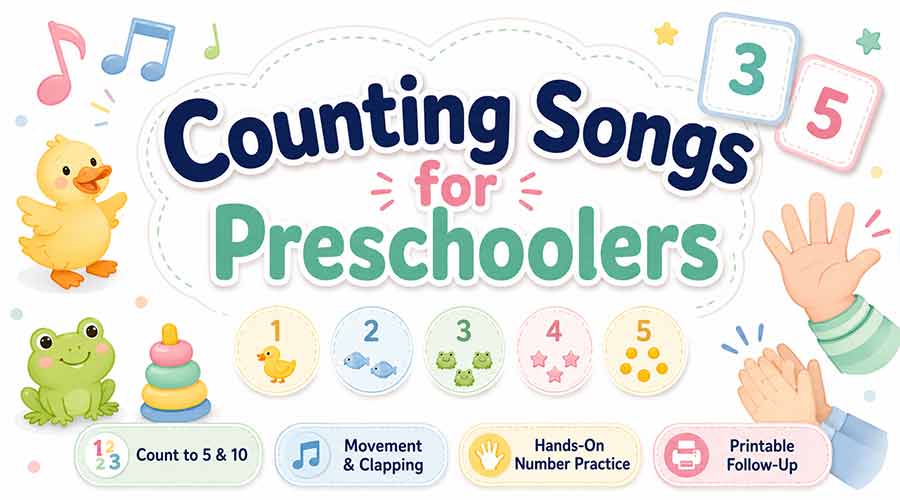
Good counting songs for preschoolers include Five Little Ducks, Five Little Speckled Frogs, One, Two, Buckle My Shoe, Ten in the Bed, and simple count-to-10 or count-to-20 movement songs. For more meaningful practice, pair the song with fingers, counters, toys, number cards, or claps so each number word connects to one action or object.
A child who can sing “one, two, three, four, five” is practicing the verbal number sequence. That is useful, but it is only one part of early counting. Children also need chances to match one number word to one object and understand that the last number counted tells how many objects are in the group.
That is why this guide uses a simple low-prep sequence: sing it → move to it → count real objects → show the numeral → ask “how many?” It works at home, during preschool circle time, in a homeschool routine, or as a short warm-up before a printable activity.
Why Counting Songs Work for Preschoolers
Counting songs give young children repeated exposure to number words through rhythm, movement, and predictable patterns. The National Association for the Education of Young Children (NAEYC) explains that steady beat and rhythm can support early mathematical ideas, including one-to-one correspondence and pattern awareness.[1]
Songs are most useful when children also connect each spoken number to something concrete. The Head Start preschool mathematics progression separates knowing the number-word sequence from coordinating one number word with one object and understanding that the last number counted tells the total.[2] The Institute of Education Sciences Teaching Math to Young Children Toolkit describes these same ideas as meaningful counting, one-to-one tagging, and cardinality.[3]
Singing numbers is not the same as counting objects
A child may be able to sing “one, two, three, four, five” while still learning to count a group accurately. Keep the follow-up simple: use a small set of toys, counters, or fingers; touch or move one item for each number; then ask, “How many?” This keeps the song playful while adding real quantity practice.
For more targeted practice, see one-to-one correspondence activities for preschoolers. For a wider range of non-song ideas, continue with counting activities for preschoolers.
Quick Guide: Which Counting Song Should You Choose?
Choose a song based on the math goal rather than trying to use every song at once. A preschooler who is still learning 1–5 usually benefits more from a short, repeatable song with fingers or objects than from a fast song that races to 20.
| Goal | Good song type | Simple way to use it |
|---|---|---|
| Count to 5 | Five Little Ducks or Five Little Speckled Frogs | Hold up five fingers or five small counters. |
| Count to 10 | One, Two, Buckle My Shoe or a simple count-to-10 song | Point to numeral cards 1–10 as you sing. |
| Count backward | Ten in the Bed or Five Little Ducks | Remove one object after each verse. |
| Practice one-to-one counting | Count-and-clap or finger-counting song | Make exactly one clap, tap, or touch per number. |
| Extend beyond 10 | Count-to-20 movement song | Add one movement per number and pause at 10. |
15 Counting Songs for Preschoolers
The goal is not to memorize fifteen songs. Pick two or three that fit the child’s current skill level and repeat them over several days. The short teaching ideas below help turn familiar preschool counting songs into active number practice without reproducing copyrighted lyrics.
1. Five Little Ducks
This familiar countdown song is useful for hearing a sequence become one smaller each time. Put out five toy ducks, counters, or fingers. After each part of the song, move one away and ask how many are left.
Listen / example: Five Little Ducks — Super Simple
2. Five Little Speckled Frogs
Use five green counters, frog pictures, or fingers. Move one “frog” away each time the group changes. At the end, count the remaining objects again rather than relying only on the song.
Listen / example: Five Little Speckled Frogs — Super Simple
3. One, Two, Buckle My Shoe
The rhyme gives children a predictable number sequence. Add a simple action for each pair of numbers, or place numeral cards 1–10 in a row and point to them as the numbers are sung.
4. Ten in the Bed
Line up ten small toys or paper counters and remove one at a time. For children who are still working on smaller quantities, start with five instead of ten. The math idea matters more than completing the traditional version exactly.
Listen / example: Ten In The Bed — Super Simple
5. The Ants Go Marching
Marching gives each count a physical beat. Keep the movement steady and slow enough that the child can match one movement to each number. This can work well as a preschool transition or circle-time activity.
6. This Old Man
Use the number sequence as a listening game. Hold up the matching numeral when a new number appears, or ask the child to place the correct card on the table.
7. How Many Fingers?
Any simple finger-counting chant or tune can work here. Show a small number of fingers, say or sing the count, then ask, “How many fingers are up?” This adds cardinality—the idea that the last count tells the total.
Listen / example: How Many Fingers? — Super Simple
8. Five Little Monkeys
Use five counters or fingers and take one away as the group gets smaller. Keep the focus on the changing quantity rather than on speed. Ask the child to predict the next number before continuing.
Listen / example: Five Little Monkeys — Super Simple
9. 1, 2, 3, 4, 5, Once I Caught a Fish Alive
This rhyme gives children another way to hear the 1–10 sequence. Add number cards or a simple number path so the child can see the written numerals while hearing the number words.
10. A Count-to-10 Movement Song
Choose a slow count-to-10 tune and pair every number with one action: clap, tap knees, step, or jump. The key is keeping one movement for each spoken number.
Listen / example: Count And Move — Super Simple
11. A Count-to-20 Song
Use this after 1–10 feels familiar. Pause briefly at 10, then continue to 20. Use a number strip or number path so the teen numbers stay connected to visible numerals instead of becoming only a memorized sound sequence.
Listen / example: Counting Up To 20 — Super Simple
12. Count and Clap
You do not need a special recording. Sing or chant numbers slowly and make one clap for each number. Then change the action to taps, stomps, or drum beats while keeping the one-number-to-one-action rule.
13. A Counting Animals Song
Use toy animals, animal cards, or pictures. Count a small group as part of a simple made-up tune, then change the quantity. This is an easy way to combine a favorite theme with real-object counting.
14. A Counting-Backward Rocket Song
Count down slowly from 10 and finish with a gentle “blast off” movement. For younger preschoolers, start at 5. A visible row of number cards helps children see that the sequence is moving backward.
15. Make Your Own Counting Song
A simple homemade song can be more useful than finding a perfect recording because you can match the numbers to the child’s current level. Count dinosaurs, cars, fruit, blocks, or stuffed animals to any familiar simple tune.
Ready for a quiet counting follow-up?
After singing and moving, switch to a short screen-free activity. The free Counting 1–10 Animals Activity Pack gives children another way to connect numerals, quantities, and visual counting.
Turn Counting Songs Into Real Number Practice
A song can introduce the sequence, but a few small changes make the activity more useful for number sense. The IES toolkit emphasizes meaningful counting that connects an accurate count sequence with one-to-one tagging and the final total.[3] You do not need extra worksheets or a long lesson to practice those ideas.
Use real objects
Put out blocks, buttons, toy animals, large counters, or another safe object. When the song reaches a number, let the child touch or move one item at a time. This creates a direct connection between the spoken count and a visible quantity.
Touch one object for each number
Encourage the child to move slowly enough that each object is counted once. If the hand moves faster than the number words, reduce the group size and try again. For more targeted practice, use the one-to-one correspondence activities guide.
Show the written numeral
When the group has five objects, show the numeral 5. This helps connect the spoken number word, the written symbol, and the quantity. If numeral identification needs more practice, continue with number recognition activities for preschoolers.
Ask “How many?” after counting
After touching and counting the objects, ask, “How many are there?” Avoid immediately recounting for the child. Give a moment to answer. This shifts the activity from repeating a sequence toward understanding that the last number counted represents the total.
Easy Counting Song Activities for Home or Circle Time
These short extensions stay intentionally simple. They support the song without turning this page into another general list of counting activities for preschoolers.
1. Count and clap
Clap once per number, then switch to knee taps or stomps. Keep the pace slow enough that the child can coordinate one number word with one movement.
2. Toy-animal countdown
Start with five toy animals. Remove one at a time during a countdown song, then ask the child to count what remains.
3. Number-card match
Place a short number strip or a few numeral cards in order. Point to the matching numeral as it is heard, then later ask the child to match a numeral to a small group of counters.
4. Song plus printable practice
Finish a movement-heavy activity with one brief printable task when you want calmer table practice. Keep the number range the same so the printable reinforces the song instead of introducing a new skill.
Optional supplies
Useful items include large counters, toy animals, number cards, washable markers, crayons, reusable sleeves, and child-safe manipulatives. You do not need all of them; use what is already easy to reach.
Use a Printable After the Song
Songs are especially useful for movement and repetition. Printables are better for a different job: giving a child a quiet chance to look closely, point, match, trace, or count at their own pace. Using both can create a balanced sequence instead of asking one activity to do everything.
A simple routine is: sing for two or three minutes → count real objects → complete one short printable task. If the child is still interested, continue. If attention is fading, stop there.
Keep the counting practice simple
Start with one free printable, a pencil or crayon, and a few minutes of guided practice. You can also explore related number, math, and story-based activities when the child is ready for variety.
For other ways to build the same topic without repeating this lesson, see counting stories for preschoolers or the broader math activities for preschoolers guide.
Frequently Asked Questions About Counting Songs for Preschoolers
What are good counting songs for preschoolers?
Good preschool counting songs include Five Little Ducks, Five Little Speckled Frogs, One, Two, Buckle My Shoe, Ten in the Bed, and simple count-to-10 movement songs. Choose songs with a clear, slow number sequence and add fingers, objects, or actions so children can connect the number words to quantities.
What age should children count to 10?
Children develop counting skills at different rates, so a single age cutoff is not very useful. Head Start describes preschool counting as a progression across number-word sequences, one-to-one object counting, and answering “how many?” rather than a single pass-or-fail milestone.[2] Songs can support the sequence while hands-on counting shows whether the child can connect number words to actual quantities.
Do counting songs really teach children to count?
Counting songs can strengthen familiarity with number order, rhythm, and repeated sequences. They are most useful when paired with real counting experiences such as touching one object for each number, using fingers, showing numerals, and asking how many objects are in the group.
How can I teach counting without worksheets?
Use songs, fingers, blocks, toy animals, snacks, steps, claps, or household objects. Count slowly, touch one item per number, and ask “how many?” afterward. A printable can be added later for quiet review, but it does not need to be the starting point.
What counting songs work well for circle time?
Short songs with visible actions work well for circle time. Five Little Ducks, Five Little Speckled Frogs, a count-and-clap chant, and a simple count-to-10 movement song are easy to repeat and allow children to join with fingers, claps, or whole-body movements.
What songs help preschoolers count backward?
Five Little Ducks, Five Little Speckled Frogs, Ten in the Bed, and simple rocket countdown songs can all support backward counting. Start at 5 if counting back from 10 is too demanding, and remove one object at each step so the changing quantity is visible.
Keep Counting Practice Playful and Concrete
Preschool counting songs are useful because they make repetition easy to revisit. The learning becomes stronger when a child also moves, touches objects, sees a numeral, and answers a simple quantity question.
Start with one song and a small group of objects. Repeat it for several days before adding another. A short activity that a child can follow successfully is usually more useful than a long playlist completed all at once.
About This Guide
Nini Printables creates low-prep printable activities for preschool and kindergarten learners. This guide is designed for practical use by parents, caregivers, homeschool families, preschool teachers, and kindergarten teachers. It separates verbal number practice from hands-on object counting so songs are used as one part of a broader early-math routine rather than as a stand-alone assessment.
Learn more about the site’s approach on the About Nini Printables page.
Teaching References
The numbered citations in this article correspond to the sources below. These are official or professional early-childhood guidance resources, not peer-reviewed journal papers directly used as evidence in this article, so DOI information is not applicable.
- [1] NAEYC — Support Math Readiness Through Music. Guidance on steady beat, rhythm, movement, patterns, and one-to-one correspondence.
- [2] HeadStart.gov — Math Preschool: Counting and Cardinality. Preschool progression for number-word sequences, object counting, cardinality, and written numerals.
- [3] Institute of Education Sciences — Teaching Math to Young Children Toolkit. Evidence-based early-math guidance including meaningful counting, one-to-one tagging, and cardinality.
Learning progress varies by child and educational setting. The activities here are practical learning ideas, not a formal developmental assessment or screening tool.