
15 Farm Animal Activities for Preschoolers: Easy, Low-Prep Learning Ideas
Turn a familiar farm theme into simple matching, counting, fine motor, sensory, language, and pretend-play practice for children ages 3–5.
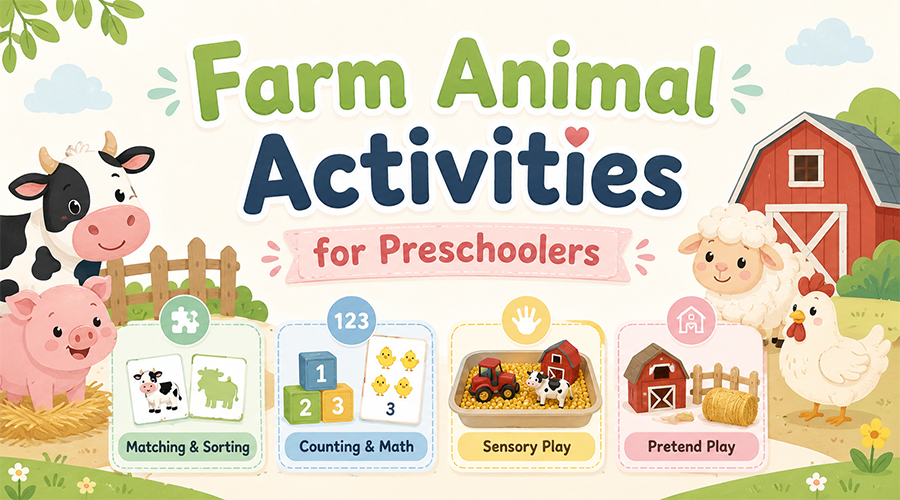
The best farm animal activities for preschoolers are short, hands-on, and easy to adjust. Try animal matching, counting games, playdough tracks, “feed the animal” fine motor play, muddy-animal washing, sound guessing, simple habitat sorting, and pretend farm play. Most of the ideas below take five minutes or less to set up and use materials you may already have.
The farm animal activities for preschoolers below use a familiar theme to support many preschool skills without elaborate lesson prep. Children can count cows, sort ducks and pigs, copy animal sounds, build a fence, tell a story, or pretend to care for a barn full of animals.
This guide keeps the activities practical rather than trying to make the longest possible list. Each idea has a clear skill goal, simple materials, and an easy way to adjust the challenge. This approach fits NAEYC’s developmentally appropriate practice guidance. The guidance emphasizes strengths-based, play-based learning that responds to individual children.
Quick Guide to Farm Animal Activities for Preschoolers
Use this chart when you need farm animal activities for preschoolers quickly. Choose by prep time or by the skill you want to practice.
| Activity | Age | Prep | Main Skill |
|---|---|---|---|
| Farm Animal Matching | 3–5 | 2 min | Visual discrimination |
| Shadow Match | 3–5 | 5 min | Observation |
| Sort the Animals | 3–5 | 2 min | Classification |
| Count the Animals | 3–5 | 2 min | Number sense |
| Feed the Animals | 3–5 | 4 min | Counting |
| Big, Small, More & Less | 4–5 | 2 min | Comparison |
| Playdough Tracks | 3–5 | 2 min | Fine motor |
| Transfer the Feed | 3–5 | 4 min | Hand control |
| Build a Farm Fence | 3–5 | 1 min | Spatial thinking |
| Wash Muddy Animals | 3–5 | 5 min | Sensory play |
| Where Does It Live? | 3–5 | 3 min | Vocabulary |
| Animal Tracks | 4–5 | 5 min | Observation |
| Guess the Sound | 3–5 | 0 min | Listening |
| Farm Story Retelling | 4–5 | 2 min | Sequencing |
| Pretend Farm | 3–5 | 3 min | Language & social play |
Matching and Sorting Farm Animal Activities
Matching and sorting are useful starting points because children can participate even before they know every animal name. Adults can add language naturally by naming what the child notices.
Farm Animal Matching
Place several farm animal pictures or cards in front of your child. Ask them to find the matching pair, then name the animal together. Once matching feels easy, add a simple prompt such as, “What do you notice about these two cows?”
Make it easier: Start with three very different animals. Make it harder: Add similar-looking animals or ask the child to explain how they knew the pair matched.
Farm Animal Shadow Match
Pair animal pictures or figurines with simple silhouettes. Encourage the child to look at ears, legs, tails, horns, and overall shape instead of guessing from color.
Try this question: “Which detail helped you decide?” It turns a quick match into simple reasoning practice.
Sort the Farm Animals
Give the child a small group of animal figures or cards and choose one sorting rule. Try feathers and fur, two legs and four legs, or small and large. Let the child suggest a new sorting rule after the first round.
Keep it preschool-friendly: The goal is noticing and explaining, not memorizing formal animal categories.
Start with a Ready-to-Use Farm Matching Activity
If you want a no-planning option, use the free Farm Animals Matching printable. It gives preschoolers a clear visual matching task. It also fits naturally into a farm week at home or in the classroom.
Farm Animal Math Activities for Preschoolers
A farm theme makes early math concrete. Connect each number to an animal the child can touch, move, or pretend to feed. This makes quantity easier to see than working with numbers in isolation.
Count the Farm Animals
Line up 3–10 farm animal figures. Ask the child to touch or move one animal for each number word. If the total changes, count again instead of correcting the answer immediately.
For more ways to build this skill, see one-to-one correspondence activities for preschoolers.
Feed the Animals Counting Game
Place a number card beside an animal. The child gives that animal the same number of “food” counters—pom-poms, blocks, large buttons, or another age-appropriate manipulative. Use only materials that are safe for the child you are supervising.
Need more number ideas? Try these counting activities for preschoolers.
Big, Small, More, and Less
Make two small groups of animals. Ask, “Which group has more?” “Which animal is smaller?” or “Can you make both groups have the same number?” Keep the quantities small so the child can reason with the objects instead of guessing.
Fine Motor Farm Activities
Fine motor practice works best when the hand movement has a purpose. These farm activities give children a reason to pinch, press, transfer, build, and position objects.
Farm Animal Playdough Tracks
Flatten a small piece of playdough and press clean animal feet into the surface. Compare the marks and make paths across the “farm.” Children also practice rolling, flattening, pinching, and pressing as they play.
See more preschool playdough activities for easy variations.
Transfer the “Animal Feed”
Put larger pom-poms or other safe manipulatives in one bowl. Use child-safe tongs to move them into small “feeding” bowls. Start with fingers if tongs are frustrating, then introduce the tool later.
Adjust the challenge: Wider tongs and larger objects are easier. Smaller targets require more control.
Build a Farm Fence
Use blocks or craft sticks to make a fence around a few animals. Ask, “How can we make the gate wide enough for the horse?” Then try, “Can you build a smaller pen for the chickens?” The child practices fine motor control while planning a simple solution.
Sensory and Simple Science Farm Activities
These activities focus on noticing, comparing, and exploring. Keep the questions open-ended so the child can describe what they see rather than search for one “correct” answer.
Wash the Muddy Farm Animals
Cover washable plastic animals with a small amount of child-safe pretend “mud.” Provide a shallow bowl of water and a soft brush. Children can scrub, rinse, and dry the animals.
Less-mess version: Skip the mud. Draw washable marker spots on laminated animal cards, or use only water and a brush.
Which Animal Lives Where?
Create simple areas for a barn, coop, pond, and field using paper labels or blocks. Let the child place animals where they think they belong, then talk about their choices. If the child invents a silly answer, use it as a language opportunity before gently adding real-world information.
Farm Animal Tracks Investigation
Press animal feet into playdough or washable paint and compare the prints. Ask, “Which print is widest?” or “Which one has two parts?” Then ask the child to find the animal that made a track. The goal is careful observation and comparison, not memorizing scientific terms.
For more low-prep sensory ideas, visit sensory activities for preschoolers.
Farm Animal Language and Pretend Play
Farm themes are useful for language practice. Children can make sounds, act out actions, name objects, and build short stories without a complicated setup.
Guess the Farm Animal Sound
Make an animal sound and ask the child to identify the animal. Then switch roles. Extend the game with clues: “This animal says moo and gives milk,” or “This bird has feathers and says cluck.”
Farm Story Retelling
Use three animal figures to tell a very short story. Then invite the child to retell it using first, next, and last. A four-year-old may tell only part of the story; that is still useful language practice.
Create a Pretend Farm
Set out animals, blocks, a toy vehicle, and a few small containers. Let the child decide what is happening on the farm. Adults can extend the play with one simple prompt. Try, “The gate is open—what should we do?” or “The animals need food. What is your plan?”
NAEYC explains that engaged play can support curiosity, problem solving, attention, and persistence. Follow the child’s lead and add just enough language or challenge to keep the play moving.
A Simple 5-Day Preschool Farm Plan
You do not need to complete all 15 ideas. Use these farm activities for preschoolers as a simple five-day sequence. Families and teachers can offer one manageable activity per day while repeating familiar farm vocabulary.
Farm Animal Matching + name each animal.
Count the Animals + compare two groups.
Wash Muddy Animals + talk about clean/dirty, wet/dry.
Animal Tracks + compare shape and size.
Pretend Farm + tell a short beginning-middle-end story.
Repeat an activity if the child wants to do it again. Preschool learning does not need a new project every day. Repetition can help children become more confident and independent with a familiar task.
What Do Preschoolers Learn From Farm Animal Activities?
Farm animal activities can support several areas of early learning without turning play into formal lessons. NAEYC describes high-quality preschool learning across physical, social, emotional, language, literacy, and thinking domains. It also emphasizes materials and experiences that help children explore.
- Vocabulary: animal names, sounds, habitats, actions, and descriptive words.
- Early math: counting, one-to-one correspondence, comparing, sorting, and quantity.
- Visual discrimination: noticing small differences in pictures, shapes, and tracks.
- Fine motor control: pinching, transferring, pressing, building, and placing.
- Observation: looking closely and explaining what is similar or different.
- Language: retelling, predicting, answering questions, and explaining choices.
- Pretend play: using objects symbolically and creating simple roles and stories.
- Problem solving: deciding how to build, sort, count, or complete a play scenario.
The most useful activity is not necessarily the one with the most steps. Choose a level that lets the child participate successfully, then add one small challenge when the activity becomes easy.
Optional Farm Activity Supplies Worth Keeping
You can do many of these activities with materials already at home or in a classroom. If you build themed activity bins regularly, a few reusable supplies can make setup faster.
Useful Reusable Supplies
- Washable farm animal figurines
- Child-safe tongs or tweezers
- Playdough
- Craft sticks or small building blocks
- Washable markers or paint
Free Farm Animal Printable
If your child enjoys matching, start with the free Farm Animals Matching printable. It is a simple way to add a quiet table activity to a farm theme while practicing visual discrimination and animal vocabulary.
Keep the Farm Theme Simple
Print the matching activity, choose one hands-on idea from this guide, and reuse both during the week. A familiar activity plus one new variation is often easier to manage than preparing a completely new lesson every day.
Frequently Asked Questions
What farm animals should preschoolers learn?
Start with familiar animals such as cows, pigs, horses, sheep, chickens, ducks, and goats. Children do not need to memorize a long list. A smaller set gives them more chances to learn names, sounds, features, and simple facts through repeated play.
What age are these farm animal activities for?
Most activities in this guide are designed for ages 3–5. Younger preschoolers may need fewer choices, larger materials, and more adult modeling. Older preschoolers can handle extra counting, sorting rules, sequencing, and “why” questions.
What are some mess-free farm activities?
Try farm animal matching, sound guessing, counting animal figures, or sorting by simple features. Building a block fence, retelling a farm story, and pretend farm play are also easy to reset.
How can I teach farm animals at home?
Combine a picture book or simple conversation with one hands-on task. For example, name three animals, match their pictures, count the figures, then use the same animals in pretend play. Reusing the same vocabulary across different activities is more manageable than trying to teach many facts at once.
Can farm activities teach preschool math?
Yes. Farm animals make useful counters and sorting objects. Preschoolers can practice counting, one-to-one correspondence, comparisons, simple patterns, and grouping. Real objects or picture cards both work well.
More Preschool Activities
Keep the skill familiar while changing the theme, or keep the theme familiar while changing the skill. These related guides make it easy to plan the next activity without starting from scratch.
About This Guide
This guide was created for families, teachers, homeschool families, and caregivers who want low-prep learning ideas that fit naturally into play. The activities are adjustable. Adults can respond to a child’s current skills instead of expecting every preschooler to complete the same task in the same way. Learn more about Nini Printables.
Teaching & Safety References
- National Association for the Education of Young Children (NAEYC): Developmentally Appropriate Practice
- NAEYC: What Do Children Learn in a High-Quality Preschool Program?
- NAEYC: How to Support Children’s Approaches to Learning? Play with Them!
- Centers for Disease Control and Prevention (CDC): Farm Animals — Healthy Pets, Healthy People