
20 Movement Activities for Preschoolers: Easy Gross Motor Games for Ages 3–5
Movement activities for preschoolers do not need complicated equipment or a large play space. Simple games that involve jumping, balancing, crawling, throwing, catching, and imaginative whole-body movement can turn a few free minutes into useful active play at home or in the classroom.
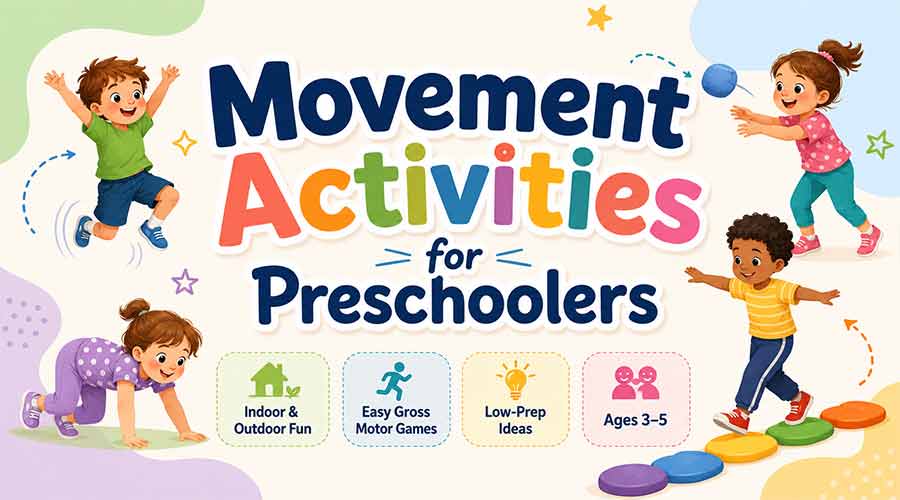
For example, this guide gives parents, preschool teachers, and caregivers 20 low-prep ideas for ages 3–5. Use the quick-pick table when you need an activity fast, then adjust each game to make it easier or more challenging for the children and space you have.
Quick Picks: Choose a Preschool Movement Activity
Not every activity fits every moment. If you have five minutes before lunch, a small living room, or a group that needs to burn off energy, use this table to choose quickly.
| If you need… | Try this | Space | Prep | Main movement |
|---|---|---|---|---|
| A 5-minute activity | Animal Walks | Small | None | Crawling and coordination |
| Quiet indoor movement | Tape-Line Balance | Small | 2 minutes | Balance and control |
| A high-energy activity | Simple Obstacle Course | Medium | 5 minutes | Whole-body movement |
| A no-supplies group game | Simon Says | Small | None | Listening and body control |
| Throwing practice | Laundry Basket Toss | Small | 2 minutes | Throwing and aim |
| Outdoor active play | Follow-the-Leader Trail | Large | None | Walking, hopping, and direction changes |
What Are Gross Motor and Movement Activities?
Gross motor activities use the larger muscles of the body for actions such as running, jumping, climbing, balancing, throwing, and catching. Fine motor activities use smaller hand and finger movements for tasks such as drawing, cutting, tracing, and manipulating small objects.
In contrast, fine motor practice focuses on smaller hand and finger movements. If you are looking for hand-strength, scissor, drawing, or pre-writing ideas instead, see Fine Motor Activities for Preschoolers.
20 Easy Movement Activities for Preschoolers
The best preschool gross motor activities are easy to explain and easy to repeat. For each idea below, start with the basic version. Then use the easier or harder option to match the child rather than expecting every preschooler to perform the same way.
No-Equipment and Small-Space Movement
1. Animal Walks
You need: Nothing.
How to play: Call out an animal and move like it across a short path. Try bear crawls, penguin waddles, frog jumps, crab walks, or slow elephant steps.
What they practice: Coordination, weight shifting, balance, and whole-body control.
Make it easier: Choose one familiar animal and copy the adult.
Make it harder: Switch animals at a marker or combine two movements.
Best for: Indoor or outdoor play.
2. Simon Says
You need: Nothing.
How to play: Give short movement directions such as “Simon says touch your toes,” “jump twice,” or “reach up high.” Keep the pace playful rather than trying to trick younger children.
What they practice: Listening, body awareness, stopping, starting, and following directions.
Make it easier: Use one-step directions and demonstrate each action.
Make it harder: Combine two actions, such as “hop, then turn around.”
Best for: Small groups and transition times.
3. Freeze and Move
You need: Optional music.
How to play: Children move around the space, then freeze when you clap, say “freeze,” or pause the music. Change the movement between rounds: march, tiptoe, sway, stomp, or walk slowly.
What they practice: Starting and stopping, balance, rhythm, and body control.
Make it easier: Use the same movement for several rounds.
Make it harder: Call a new movement immediately after each freeze.
Best for: Indoor groups when you want high participation with almost no setup.
4. Follow the Leader
You need: Nothing.
How to play: Lead children through simple actions: march, step sideways, reach, squat, hop, or walk around a chair. Let children take turns being the leader once they understand the game.
What they practice: Imitation, coordination, direction changes, and turn-taking.
Make it easier: Stay in one place and copy simple actions.
Make it harder: Create a short path with three or four movement changes.
Best for: Classroom circles, hallways, or outdoor paths.
5. Mirror My Movement
You need: A partner.
How to play: Face each other. One person moves slowly while the other copies like a mirror. Reach high, bend sideways, lift one foot, make big arm circles, or squat and stand.
What they practice: Body awareness, balance, visual attention, and controlled movement.
Make it easier: Use large, slow upper-body movements.
Make it harder: Add balance poses or switch leaders without stopping.
Best for: Two children, parent-and-child play, or partner stations.
Jumping, Balancing, and Whole-Body Movement
6. Tape-Line Balance
You need: Painter’s tape or another removable floor-safe tape.
How to play: Make a straight, curved, or zigzag line on the floor. Children walk along it while trying to keep their feet close to the path.
What they practice: Balance, slower controlled steps, and body positioning.
Make it easier: Use one wide, straight line.
Make it harder: Add curves, backward steps, or a light beanbag to carry.
Best for: Small indoor spaces.
7. Lily Pad Jumps
You need: Paper circles, floor spots, or chalk marks.
How to play: Space several “lily pads” close enough for safe jumps. Children travel from pad to pad without stepping into the imaginary water.
What they practice: Jumping, landing, judging distance, and planning the next move.
Make it easier: Put the pads closer together and allow two-foot steps.
Make it harder: Vary the spacing or ask children to choose a route.
Best for: Indoor or outdoor movement stations.
8. Simple Indoor Obstacle Course
You need: Safe household or classroom items such as cushions, tape lines, cones, or a sturdy tunnel.
How to play: Build a short route: step over a tape line, crawl through a tunnel, walk around a cone, then touch a finish marker.
What they practice: Whole-body coordination, changing levels, balance, and movement planning.
Make it easier: Use two stations with plenty of space.
Make it harder: Add one new movement or change the order.
Best for: Days when outdoor play is limited.
9. Traffic Light Movement Game
You need: Nothing, or red/yellow/green cards.
How to play: Green means move, yellow means move slowly, and red means stop. Start with walking before introducing hopping, marching, or tiptoeing.
What they practice: Speed changes, stopping, attention, and movement control.
Make it easier: Use only green and red.
Make it harder: Add a movement for each color.
Best for: Groups with a clear open path.
10. Fast, Slow, and Stop
You need: Nothing.
How to play: Choose one safe movement such as marching. Call “fast,” “slow,” or “stop” and let children adjust their speed while staying in control.
What they practice: Pace, listening, self-control, and adapting a familiar movement.
Make it easier: Alternate only slow and stop.
Make it harder: Add “tiny,” “giant,” or “backward” movements when the space allows.
Best for: Quick movement breaks.
Throwing, Rolling, and Catching Games
11. Laundry Basket Toss
You need: A laundry basket and soft balls, rolled socks, or beanbags.
How to play: Place the basket a short distance away and let children toss items into it. Return the items and repeat rather than keeping score.
What they practice: Throwing, aiming, force control, and hand-eye coordination.
Make it easier: Move the basket closer or use a larger target.
Make it harder: Move the starting line back a small amount.
Best for: Indoor play with soft equipment.
12. Beanbag Target Toss
You need: Beanbags or rolled socks and two or three floor targets.
How to play: Put targets at different distances. Children choose where to aim and toss one item at a time.
What they practice: Aiming, throwing direction, and adjusting force.
Make it easier: Use one large target.
Make it harder: Offer near and far targets and let children choose their challenge.
Best for: Small-group stations.
13. Balloon Keep-Up
You need: One balloon and close adult supervision.
How to play: Tap the balloon upward and try to keep it off the floor. Clear the area first so children can watch the balloon without bumping into furniture.
What they practice: Tracking a moving object, reaching, positioning, and gentle force control.
Make it easier: Let the balloon bounce once before tapping it again.
Make it harder: Take turns or alternate hands.
Best for: One or two children in a clear indoor space.
14. Roll and Chase
You need: A soft playground ball.
How to play: Roll the ball across an open area and have the child move to stop it, then roll it back. Change the direction instead of making the roll faster.
What they practice: Tracking, changing direction, bending, and moving toward a target.
Make it easier: Roll straight and slowly.
Make it harder: Roll gently to the left or right so the child changes direction.
Best for: Open indoor or outdoor spaces.
15. Partner Ball Roll
You need: One medium soft ball and a partner.
How to play: Sit or kneel facing each other and roll the ball back and forth. Encourage children to watch the ball and stop it with both hands.
What they practice: Hand-eye coordination, timing, turn-taking, and controlled force.
Make it easier: Sit closer together with legs making a wide “goal.”
Make it harder: Increase the distance slightly.
Best for: Pairs and calmer gross motor play.
After a big-body movement break, switch to a quieter printable or fine motor task. This gives children a natural change of pace without turning the day into one long lesson.
Browse Free Preschool PrintablesImaginative Movement Activities
16. Weather Movements
You need: Nothing.
How to play: Pretend to be different kinds of weather. Sway like wind, reach upward like sunshine, crouch low like a cloud, or make gentle raindrop finger-and-arm motions while walking.
What they practice: Creative movement, changing body levels, and following descriptive cues.
Make it easier: Copy the adult’s weather movement.
Make it harder: Let the child invent the next weather action.
Best for: Circle time or movement stories.
17. Move Like a Vehicle
You need: Nothing.
How to play: Move like a slow train, a turning bus, a flying airplane, or a bicycle going up a hill. Use clear boundaries so children know where to move.
What they practice: Speed changes, direction, imagination, and whole-body coordination.
Make it easier: Use one vehicle and copy the adult.
Make it harder: Add “stop,” “turn,” or “slow hill” cues.
Best for: Children who enjoy transportation themes. For more themed ideas, continue with Transportation Activities for Preschoolers.
18. Movement Story Adventure
You need: A short made-up story.
How to play: Tell a simple adventure and let children act it out: step over a puddle, crawl under a branch, tiptoe past a sleeping bear, then stretch tall to reach an imaginary apple.
What they practice: Sequencing movements, listening, imagination, and switching between actions.
Make it easier: Pause after every direction and demonstrate it.
Make it harder: Let children add the next part of the story.
Best for: Small groups, home learning, and rainy days.
19. Copy-the-Animal Challenge
You need: Optional animal pictures.
How to play: Show or name an animal and ask children to invent one movement for it. A bird might flap, a rabbit might hop, and a turtle might move slowly.
What they practice: Motor planning, creative thinking, balance, and movement vocabulary.
Make it easier: Give two movement choices.
Make it harder: Combine two animal movements into a short sequence.
Best for: Farm, ocean, zoo, or animal themes. For a ready-made farm theme, see Farm Animal Activities for Preschoolers.
20. Movement Scavenger Hunt
You need: A safe room, playground, or yard.
How to play: Give movement-based clues instead of asking children to collect objects: “hop to something blue,” “tiptoe to the door,” or “walk backward three steps, then find a circle.”
What they practice: Locomotor movement, listening, visual scanning, and changing directions.
Make it easier: Use one movement and one obvious destination.
Make it harder: Combine two clues in sequence.
Best for: Turning familiar spaces into active play areas.
How to Adjust Movement Activities for Ages 3, 4, and 5
Age can guide your starting point, but it should not become a pass-or-fail test. Children develop skills at different rates. Instead of asking whether a child can complete the “age 4 version,” adjust the distance, number of steps, speed, or amount of support.
A Simple 5-Day Preschool Movement Plan
In addition, you do not need a different activity every day. A short weekly rotation gives preschoolers variety while keeping preparation manageable.
| Day | Activity | Approx. play block | Main focus |
|---|---|---|---|
| Monday | Animal Walks | 5–10 minutes | Coordination and whole-body movement |
| Tuesday | Tape-Line Balance | 5–10 minutes | Balance and controlled steps |
| Wednesday | Laundry Basket Toss | About 10 minutes | Throwing and aiming |
| Thursday | Simple Obstacle Course | 10–15 minutes | Whole-body coordination |
| Friday | Movement Story Adventure | About 10 minutes | Listening and imaginative movement |
Repeat the plan the following week with small changes. For example, change the animal, reshape the tape path, move the basket, or tell a new movement story. Familiar structure plus a small variation is often more useful than constantly introducing a brand-new game.
Optional Supplies That Make Movement Games Easier to Reuse
Most of these preschool movement activities work with household materials. However, a small set of reusable supplies can make setup faster for classrooms, childcare spaces, and families who use gross motor games often.
- Soft playground balls: easier to use indoors for rolling and gentle throwing.
- Beanbags: useful for target tosses, carrying games, and balance challenges.
- Floor spot markers: quick visual targets for jumping, standing, or routes.
- Painter’s tape: useful for lines, start points, paths, and simple boundaries.
- Small cones: useful for weaving routes and marking start/finish points.
- Hoops: useful as large targets, stepping zones, or stations when space allows.
There is no need to buy everything at once. Start with what you already own, notice which games children repeat, and add equipment only when it makes those activities easier to set up or reuse.
Safety and Setup for Preschool Gross Motor Activities
Before active play, clear enough space for the movement you are asking children to do. Then move unstable furniture, sharp objects, cords, and tripping hazards out of the route. Indoors, use lightweight or soft throwing materials and keep targets away from windows, screens, and breakable items.
- Choose movements that fit the available space.
- Demonstrate a new movement before asking children to try it.
- Use stable, age-appropriate equipment.
- Supervise active play, especially around balloons, climbing surfaces, or equipment.
- Offer an easier version when a child looks unsure or frustrated.
- Stop or change the activity if the space becomes crowded or unsafe.
Movement play should feel active and enjoyable, not like a performance test. NAEYC guidance emphasizes varied, enjoyable physical activity and giving children room to move safely.[2]
Frequently Asked Questions
What are good movement activities for preschoolers?
Good movement activities for preschoolers include animal walks, follow the leader, tape-line balancing, simple obstacle courses, jumping games, target tosses, balloon keep-up, and movement stories. The best choices use simple directions, safe space, and a challenge that can be adjusted.
What are examples of gross motor activities for preschoolers?
Examples include running, jumping, hopping, crawling, balancing, throwing, catching, rolling a ball, marching, and moving through an obstacle course. These activities use the larger muscles of the body rather than the smaller hand and finger movements used in fine motor tasks.
What movement activities can preschoolers do indoors?
Try Simon Says, animal walks, tape-line balance, mirror movements, a simple indoor obstacle course, laundry basket toss, partner ball roll, or a movement story. Match the activity to the room and use soft equipment when throwing or rolling indoors.
Do preschool movement activities need special equipment?
No. Many games need no equipment at all. Others can use common items such as rolled socks, a laundry basket, cushions, paper markers, or removable tape. Reusable balls, beanbags, spots, cones, and hoops are optional.
How long should a preschool movement activity last?
There is no need to force one game to last a fixed amount of time. A simple activity may work for five minutes, while an obstacle course or outdoor game may hold interest longer. Preschoolers should have opportunities to be active throughout the day, so several short active-play periods can fit naturally into home or classroom routines.[1]
Keep Preschool Movement Simple
Successful movement activities for preschoolers do not need elaborate themes or long instructions. Start with one clear movement, give children enough room to try it safely, and adjust the challenge when the basic version becomes easy.
Afterward, pair big-body play with quieter hands-on activities for a balanced routine. Nini Printables has free preschool and kindergarten resources that can follow a movement break without requiring another complicated setup.
Browse free tracing, matching, counting, pre-writing, animal, shape, and vehicle printables for simple follow-up learning activities.
Explore Free PrintablesRelated activity guide: If your next goal is hand control rather than whole-body movement, continue with Fine Motor Activities for Preschoolers.
Teaching References
- Centers for Disease Control and Prevention (CDC). CDC physical activity recommendations for children. Used in this guide to support the recommendation that children ages 3–5 should be physically active throughout the day and encouraged to take part in active play.
- National Association for the Education of Young Children (NAEYC). What Do Children Learn in a High-Quality Preschool Program? Used in this guide for preschool physical-development context, including large-muscle movement such as running, jumping, climbing, throwing, and catching.