
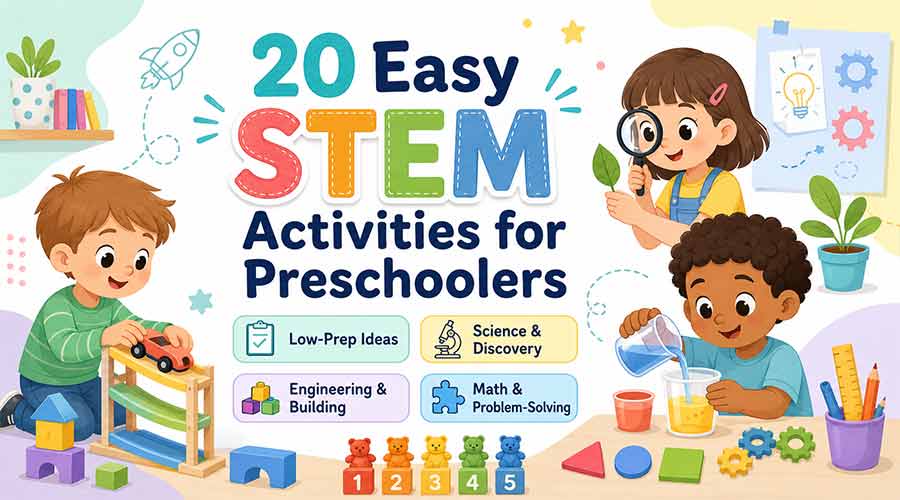
20 Easy STEM Activities for Preschoolers (Ages 3–5)
STEM activities for preschoolers do not need expensive kits, complicated experiments, or long lessons. For children ages 3–5, some of the most useful STEM learning happens when they build, compare, predict, test, notice what changed, and try again with simple materials.
This guide gives parents, caregivers, homeschool families, and preschool educators 20 low-prep ideas that can be used at home or in a classroom. Each activity includes a simple setup, a question to ask, the skill being practiced, and an easy way to adjust the challenge.
Quick Answer
Easy preschool STEM activities include testing which objects sink or float, building bridges and ramps, comparing container capacity, making patterns, observing seeds, exploring shadows, and solving simple building problems. The goal is not to teach advanced science. Instead, help children notice, predict, test, explain, change something, and try again.
Quick Picks: Choose a Preschool STEM Activity
If you need an activity right now, start here. These STEM activities for preschoolers are easy to choose by time, space, and the materials you already have.
| If you need… | Try this | Prep | Mess | Main STEM skill |
|---|---|---|---|---|
| A 5-minute activity | Shadow Hunt | None | None | Observation |
| A quiet table activity | Make and Continue a Pattern | Low | None | Math and prediction |
| An outdoor idea | Build and Test a Ramp | Low | Low | Engineering |
| Water play | Sink or Float | Low | Medium | Science |
| A small-group challenge | Build a Bridge | Low | Low | Engineering and teamwork |
What Counts as STEM for Preschoolers?
Preschool STEM is less about memorizing facts and more about practicing ways of thinking. The National Association for the Education of Young Children (NAEYC) describes early STEM learning as something that can grow through play, building, testing ideas, exploring materials, and revising plans. Head Start also provides preschool STEAM guidance that supports hands-on engineering exploration.
A simple way to think about preschool STEM:
- Science: notice, compare, predict, and test.
- Technology: use tools and processes to solve a problem. It does not have to mean screens.
- Engineering: build, test, change, and rebuild.
- Math: count, measure, sort, compare, and make patterns.
Useful learning loop: Play → Predict → Test → Notice → Change → Try Again.
That loop is the reason a block tower can become a meaningful STEM activity. Instead of stopping when it falls, ask what might make it more stable and let the child test another idea.
Science and Discovery STEM Activities
1. Sink or Float
- Materials
- A bowl or tub of water and 5–8 safe household objects.
- Try this
- Choose one object at a time. Let the child predict whether it will sink or float, then test it.
- Ask
- “What do you think will happen? What did you notice?”
- What children practice
- Prediction, observation, comparing results, and using evidence from a simple test.
- Adjust the challenge
- For a younger child, choose between two objects. For an older preschooler, sort all objects into “sink” and “float” groups before testing.
2. Ice Melt Investigation
- Materials
- Two or three ice cubes, small plates, and different locations such as sun and shade.
- Try this
- Put ice cubes in different places and watch which one changes first.
- Ask
- “Which ice cube do you think will melt faster? Why?”
- What children practice
- Observing change over time, comparing conditions, and making a simple prediction.
- Adjust the challenge
- Add a third location or compare a large cube with a small cube.
3. Color Mixing
- Materials
- Washable paint or colored water, clear cups, and a spoon or dropper.
- Try this
- Combine two colors and watch the result. Start with small amounts so the child can repeat the test.
- Ask
- “What changed when we mixed these two colors?”
- What children practice
- Cause and effect, observation, prediction, and comparing outcomes.
- Adjust the challenge
- Let older preschoolers predict the result before each new mix.
4. Shadow Hunt
- Materials
- Sunlight or a flashlight.
- Try this
- Look for shadows made by hands, toys, furniture, trees, or playground equipment.
- Ask
- “What happens to the shadow when we move the object?”
- What children practice
- Careful observation, comparing size and position, and noticing light-and-shadow relationships.
- Adjust the challenge
- Try moving the light source closer or farther away and compare what changes.
5. Watch a Seed Grow
- Materials
- A fast-sprouting seed, soil or another suitable growing setup, water, and a safe container.
- Try this
- Check the seed at about the same time each day. Notice new roots, stems, or leaves.
- Ask
- “What is different today?”
- What children practice
- Observation over time, describing changes, and building simple ideas about living things.
- Adjust the challenge
- Draw one quick picture each day. For more plant-focused ideas, see Plant Activities for Preschool.
Engineering and Building STEM Activities
6. Build and Test a Ramp
- Materials
- A piece of cardboard or board, books or blocks, and a toy car or ball.
- Try this
- Make a low ramp, test it, then raise or lower one end.
- Ask
- “What changed when the ramp got higher?”
- What children practice
- Testing one change at a time, comparing movement, and redesigning a setup.
- Adjust the challenge
- Mark where the object stops or compare two different ramp surfaces. For more vehicle play, visit Transportation Activities for Preschoolers.
7. Build a Bridge
- Materials
- Blocks, cardboard, paper tubes, or other safe building materials and one small toy.
- Try this
- Build a bridge wide enough for the toy to pass under or strong enough for the toy to sit on top.
- Ask
- “What could make the bridge stronger?”
- What children practice
- Balance, stability, planning, testing, and improving a design.
- Adjust the challenge
- For younger children, build together. For older preschoolers, make the bridge span a wider gap.
8. Build the Tallest Stable Tower
- Materials
- Blocks, cups, boxes, or another stackable material.
- Try this
- Build upward until the tower becomes unstable. Then change the base and try again.
- Ask
- “Why do you think it fell? What could we change?”
- What children practice
- Balance, comparing designs, persistence, and learning from an unsuccessful attempt.
- Adjust the challenge
- Count the pieces or compare a wide-base tower with a narrow-base tower.
9. Foil Boat Challenge
- Materials
- Aluminum foil, a tub of water, and a few identical counters or other safe small weights.
- Try this
- Shape a simple foil boat and test how many weights it can hold before taking on water.
- Ask
- “What could we change so the boat holds more?”
- What children practice
- Design, testing, comparing, counting, and revising a model.
- Adjust the challenge
- Keep the amount of foil the same and compare two boat shapes.
10. Build a Little Shelter
- Materials
- Blocks, cardboard, paper, craft sticks, or natural materials and a small toy animal.
- Try this
- Build a shelter that fits the toy and can stay standing on its own.
- Ask
- “What does the shelter need to do?”
- What children practice
- Planning around a simple need, choosing materials, building, and checking whether the design works.
- Adjust the challenge
- Add one condition, such as a doorway large enough for the toy to enter.
Want a Quiet Follow-Up Activity?
Hands-on STEM works well alongside short, focused practice. When you need a calmer table activity after building, sorting, measuring, or counting, browse Nini Printables for free preschool resources that can extend the same early-learning skills.
Math-Rich STEM Challenges
These activities use math as part of a larger problem rather than turning STEM time into a worksheet. If you want a broader collection of counting, sorting, measuring, shape, and number ideas, use the separate guide to Math Activities for Preschoolers.
11. Which Container Holds More?
- Materials
- Two containers with different shapes and a safe material to transfer, such as water, rice, or large pom-poms.
- Try this
- Predict which container holds more, then fill and compare.
- Ask
- “Which one do you think holds more? How can we check?”
- What children practice
- Capacity, comparison, prediction, and testing an idea.
- Adjust the challenge
- Use the same scoop to count how many scoops fill each container.
12. Sort and Graph Objects
- Materials
- A small collection of safe objects that can be sorted by color, size, shape, or type.
- Try this
- Sort the objects into groups, then line each group up to compare.
- Ask
- “Which group has more? How do you know?”
- What children practice
- Classification, counting, comparing quantities, and representing simple information visually.
- Adjust the challenge
- Ask the child to choose a different rule for sorting the same objects.
13. Make and Continue a Pattern
- Materials
- Blocks, colored paper pieces, large buttons, or another safe set with visible differences.
- Try this
- Create a simple AB pattern, such as red-blue-red-blue, and ask the child what comes next.
- Ask
- “What do you notice repeating?”
- What children practice
- Recognizing regularity, predicting, sequencing, and describing a rule.
- Adjust the challenge
- Move from AB to AAB or ABC when the first pattern is easy.
14. Measure With Blocks
- Materials
- Same-size blocks and 3–5 objects to measure.
- Try this
- Line blocks up from one end of an object to the other. Count how many blocks long it is.
- Ask
- “Which object is longer? How can we show it?”
- What children practice
- Nonstandard measurement, one-to-one counting, and comparison.
- Adjust the challenge
- Predict which object will need the most blocks before measuring.
15. Roll, Build, and Compare
- Materials
- A large foam die or number cards and blocks.
- Try this
- Roll or choose a number, then build a tower with that many blocks. Repeat and compare the two towers.
- Ask
- “Which tower has more blocks? How many more can you see?”
- What children practice
- Counting, quantity comparison, visual estimation, and building.
- Adjust the challenge
- For focused number practice, also see Counting Activities for Preschoolers and Number Recognition Activities for Preschoolers.
Technology and Unplugged Problem-Solving Activities
Preschool technology does not have to mean handing a child a tablet. In early STEM, children can use simple tools, follow sequences, choose a useful tool for a task, and solve problems without a screen.
16. Human Robot Directions
- Materials
- Open floor space and one simple destination.
- Try this
- One person is the “robot.” Give one-step directions such as forward, turn, stop, or pick up.
- Ask
- “What direction should the robot follow next?”
- What children practice
- Sequencing, spatial language, planning, and noticing when instructions need to change.
- Adjust the challenge
- Older preschoolers can plan two or three steps before the robot moves.
17. Build a Path
- Materials
- Blocks, paper squares, tape lines, or other safe markers and one toy.
- Try this
- Create a start and finish point. Build a path that gets the toy from one to the other.
- Ask
- “What should happen first? What comes next?”
- What children practice
- Planning a sequence, spatial reasoning, and changing a route when something blocks the way.
- Adjust the challenge
- Add one obstacle that the path must go around.
18. Which Tool Can Help?
- Materials
- A few safe tools such as a spoon, scoop, funnel, tongs, brush, or measuring cup.
- Try this
- Set a simple task, such as moving pom-poms or pouring water into a narrow container. Let the child choose a tool.
- Ask
- “Which tool could make this easier?”
- What children practice
- Matching a tool to a purpose, comparing results, and changing strategy.
- Adjust the challenge
- Try two tools and compare which worked better for the same task.
19. Flashlight Investigation
- Materials
- A child-safe flashlight and several objects or materials.
- Try this
- Shine the light on, behind, or through different materials and notice what happens.
- Ask
- “Can the light go through this? What do you see?”
- What children practice
- Observation, testing, describing visible differences, and tool use.
- Adjust the challenge
- Compare a transparent item with an opaque one using simple words such as “light goes through” and “light is blocked.”
20. Fix It and Try Again
- Materials
- Any safe activity that did not work as expected: a falling tower, blocked path, weak bridge, or slow ramp.
- Try this
- Instead of fixing the problem for the child, identify one thing that could change and test the new version.
- Ask
- “What could we change and try again?”
- What children practice
- Persistence, flexible thinking, identifying a problem, and using a new attempt as information.
- Adjust the challenge
- Ask the child to explain what changed between version one and version two.
How to Adjust STEM Activities for Ages 3, 4, and 5
These STEM activities for preschoolers can be adjusted without changing the core idea. Preschool development varies widely, so age is best used as a starting point rather than a strict checklist. Keep the same activity and change how much planning, explaining, counting, or recording you expect.
| Age | Keep the activity focused on… | Helpful adult support |
|---|---|---|
| Age 3 | Touching, trying, choosing, noticing, and using simple words such as big/small, more/less, fast/slow. | Offer two choices, model one step, and keep the activity short. |
| Age 4 | Making simple predictions, sorting, comparing, repeating a test, and explaining what changed. | Ask one open question and give time to test another idea. |
| Age 5 | Planning a few steps, counting or measuring results, comparing designs, and explaining why a change helped. | Encourage the child to record a result with a drawing, tally, or simple mark when useful. |
5 Questions That Turn Play Into STEM Learning
You do not need to explain every scientific idea while a child is playing. Often, one well-timed question is more useful than a long explanation.
- What do you notice?
- What do you think will happen?
- What changed?
- Why do you think that happened?
- What could we change and try again?
These prompts encourage children to observe, predict, compare, explain, and revise. That approach is consistent with early-childhood STEM guidance from NAEYC and Head Start, which emphasizes play, exploration, building, testing, and thoughtful adult support.
Preschool STEM Safety and Setup
- Supervise water, flashlights, small objects, and any activity that includes tools.
- Avoid small loose parts when they are not appropriate for the child.
- Use child-safe, non-toxic materials and check labels when using paint, glue, or sensory materials.
- Keep hot water, sharp tools, batteries, strong magnets, and household chemicals out of preschool STEM activities.
- Consider allergies and family or classroom rules before using food, seeds, natural materials, or sensory fillers.
- Choose a short successful activity over a complicated experiment that requires adults to do most of the work.
Turn STEM Into a Simple 5-Day Preschool Week
You do not need five completely different projects to make STEM activities for preschoolers part of the week. Use one short way of thinking each day and reuse familiar materials.
| Day | Simple focus | Example |
|---|---|---|
| Monday | Observe | Shadow Hunt |
| Tuesday | Predict and test | Sink or Float |
| Wednesday | Build | Build a Bridge |
| Thursday | Measure or compare | Measure With Blocks |
| Friday | Change and try again | Improve a ramp, tower, or bridge |
If a child becomes deeply interested in one activity, stay with it. Repeating and changing a familiar challenge can produce more meaningful thinking than rushing through a new project every day.
Helpful Supplies You May Already Have
Most of these easy STEM activities for preschoolers can be done with ordinary materials. A small reusable activity bin can make setup faster.
- Blocks or stacking cups
- Cardboard pieces and paper tubes
- Washable paint or food-safe colored water
- Clear cups, spoons, scoops, and measuring cups
- Child-safe tongs or droppers
- A flashlight
- Toy cars, balls, or small toy animals
- Paper, crayons, and tape
You do not need to buy everything on the list. Start with what is already available, then add a tool only when it makes an activity easier to repeat or helps a child test a new idea.
More Preschool Learning Ideas
Use these related guides when you want to continue one part of STEM learning without repeating the same activity:
- Sensory Activities for Preschoolers for hands-on exploration.
- Shape Activities for Preschoolers for building, sorting, and visual comparison.
- Math Activities for Preschoolers for counting, patterns, measuring, and early number ideas.
- Plant Activities for Preschool for nature observation and growth.
- Transportation Activities for Preschoolers for ramps, movement, and vehicle-themed play.
- Fine Motor Activities for Preschoolers for hand control that supports tool use and making.
Keep the Next Activity Simple
Choose one activity, ask one useful question, and give the child time to test an idea. When you want a screen-free follow-up, use a free printable for counting, matching, tracing, shapes, or fine motor practice.
Frequently Asked Questions About STEM Activities for Preschoolers
What is a STEM activity for preschoolers?
A preschool STEM activity gives children a chance to explore science, technology, engineering, or math through age-appropriate play and problem-solving. It can be as simple as testing objects in water, building a stable tower, comparing containers, making a pattern, or changing a ramp and seeing what happens.
What are easy STEM activities for a 3-year-old?
Good choices for many 3-year-olds include sink or float, shadow hunts, simple color mixing, block towers, matching tools to a task, and measuring an object with blocks. Keep directions short, offer only a few materials, and focus on noticing rather than getting a “correct” result.
Do preschool STEM activities require screens?
No. Preschool technology can include tools, processes, sequencing, and problem-solving. A funnel, scoop, flashlight, measuring cup, or set of directions can support technology-related thinking without a tablet or computer.
How long should a preschool STEM activity last?
Many preschool STEM activities work well in about 5–20 minutes, but there is no required length. Stop when interest fades, or continue when the child is still testing ideas. A short activity that invites real thinking is more useful than stretching a project to fill a schedule.
What supplies do I need for preschool STEM?
Start with ordinary materials such as blocks, cardboard, containers, water, paper, washable art supplies, toy cars, a flashlight, and simple child-safe tools. Specialized STEM kits are optional, not required.
Can I use these activities at home and in preschool?
Yes. The activities are designed to be flexible for home, homeschool, childcare, or preschool use. Adjust the number of materials, group size, supervision, and challenge level to fit the children and setting.
About This Guide
Nini Printables creates low-prep learning resources for preschool and kindergarten children. This guide is designed around a practical early-learning approach: give children a clear hands-on task, keep the setup manageable for adults, and use simple questions that help children notice, compare, test, and try again.
The activities are educational ideas for parents, caregivers, homeschool families, and educators. They are not a developmental assessment, and individual children may need easier or more challenging versions of the same activity.
Teaching References
The activity structure in this guide was checked against established early-childhood STEM guidance. No peer-reviewed research paper is directly relied on for a specific study finding in this article, so a DOI reference is not required.
- National Association for the Education of Young Children (NAEYC). STEM Starts with Play. Discusses play, building, testing, revising ideas, open-ended materials, and thoughtful questions as foundations for early STEM learning.
- HeadStart.gov. Exploring Engineering with Preschoolers. Part of Head Start’s preschool STEAM resources for early-childhood educators.