
18 All About Me Activities for Preschoolers: Easy, Low-Prep Ideas for Ages 3–5
These All About Me activities for preschoolers help children explore their names, interests, feelings, bodies, families, and abilities through simple, hands-on play—not long worksheets.
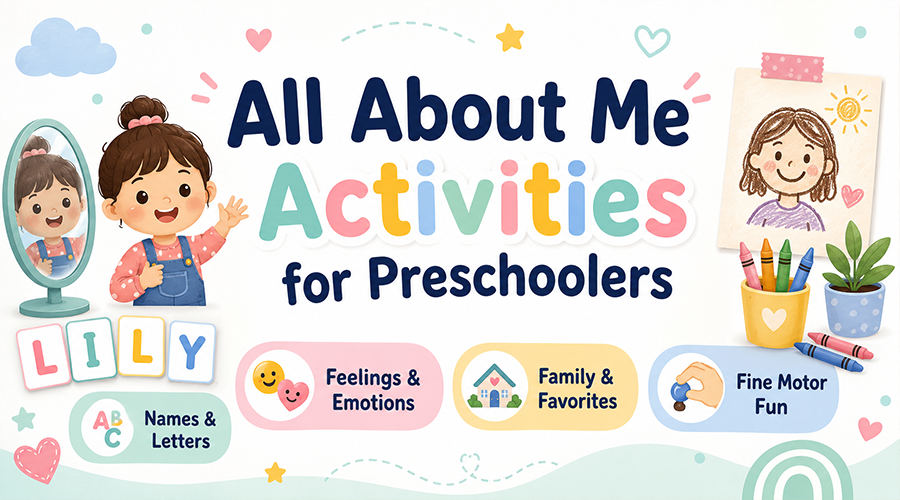
The best All About Me activities for preschoolers are short, hands-on, and easy to personalize. Start with a mirror self-portrait, name-building activity, favorites graph, feelings game, or movement activity. For ages 3–5, keep writing optional and let children answer by talking, pointing, choosing pictures, moving, or drawing.
An All About Me theme works especially well at the start of a preschool year, during a new-group transition, or anytime you want children to get comfortable sharing a little about themselves. However, you do not need a full week of matching worksheets to make the theme useful.
The activities below mix art, early literacy, fine motor practice, early math, movement, and social-emotional learning. Each one includes a simple way to make it easier or add a little more challenge, so you can choose what fits the child in front of you.
Quick Picks: Choose an All About Me Activity
If you are planning for tomorrow—or the next ten minutes—start with the situation you need to solve.
What Are All About Me Activities for Preschoolers?
All About Me activities invite children to notice and communicate things about themselves: their names, preferences, feelings, bodies, abilities, important people, and everyday experiences. The learning comes from talking, making, moving, comparing, and playing—not from producing a perfect finished page.
This approach fits well with NAEYC’s developmentally appropriate practice guidance, which emphasizes joyful, strengths-based, play-based learning that considers each child’s individuality and context. Head Start’s early learning framework also describes a growing sense of identity and belonging as part of young children’s social-emotional development.
Keep the goal simple: help children notice, express, and share what matters to them. These activities are learning opportunities, not tests of personality, language, drawing skill, or development.
18 Easy All About Me Activities for Preschoolers
You can use one activity as a quick center, combine two for a small-group lesson, or spread several across an All About Me preschool theme. Most use supplies you may already have.
1. Mirror Self-Portrait
Give the child a safe mirror and paper. Invite them to look closely at their face before drawing what they notice. Instead of correcting the picture, use prompts such as “What do you notice about your hair?” or “Which color would you like for your eyes?”
- Materials
- Child-safe mirror, paper, crayons or washable markers.
- Practices
- Observation, body vocabulary, drawing, self-expression.
2. Make a Life-Size Body Outline
Have a child lie on a large sheet of paper while an adult traces around the body. Then let the child add clothing, hair, facial features, or labels. The point is not anatomical accuracy; it is noticing body parts and using words while creating.
- Materials
- Roll paper or taped sheets, washable markers or crayons.
- Practices
- Body-part vocabulary, spatial awareness, large-motor positioning.
3. Build a Playdough Face
Flatten a large playdough circle, then add eyes, a nose, a mouth, hair, glasses, or other details with small pieces of dough and simple loose parts. Let the child decide whether the face looks like them or is simply a face they created.
- Materials
- Playdough and optional child-safe loose parts.
- Practices
- Pinching, rolling, pressing, facial-feature vocabulary.
4. Make a “My Favorites” Collage
Offer pictures, old magazines, stickers, or simple drawings representing foods, colors, animals, toys, and activities. Let the child choose a few favorites and glue them to one page. Talk about the choices without requiring a reason for every answer.
- Materials
- Paper, child-safe scissors, glue stick, pictures or drawing supplies.
- Practices
- Choice making, cutting, gluing, descriptive language.
5. Create a My Favorites Mini Book
Staple a few blank half-sheets into a tiny book. Give each page one simple prompt: “I like…,” “My favorite color is…,” or “I like to play….” Preschoolers can draw while an adult writes down their words.
- Materials
- Blank paper, stapler used by an adult, crayons.
- Practices
- Oral language, idea generation, drawing as early writing.
6. Build My Name With Letter Cards
Write the child’s name clearly as a model. Provide just the letters needed and invite the child to place them in the same order. For younger preschoolers, start with the first letter only. Avoid turning the activity into a spelling test.
- Materials
- Name card plus magnetic letters, paper letter cards, or letter tiles.
- Practices
- Name recognition, left-to-right sequence, visual matching.
7. Draw the People Who Are Important to Me
Ask the child to draw one or more people who are important to them. Use open wording rather than assuming a specific family structure. A child might draw parents, grandparents, siblings, caregivers, friends, or another important person.
- Materials
- Paper and drawing tools.
- Practices
- Belonging, storytelling, describing familiar people.
8. Build My Home With Blocks
Invite the child to build a place that feels like home using blocks, boxes, or magnetic tiles. Ask simple questions about rooms, favorite spaces, or where important objects might go. The model does not need to match a real floor plan.
- Materials
- Blocks, boxes, or other construction materials.
- Practices
- Spatial language, planning, pretend play, storytelling.
9. Make Feelings Faces in a Mirror
Say a feeling word such as happy, sad, surprised, worried, or frustrated. Let the child try a matching facial expression in the mirror, then switch roles. Keep the mood playful and avoid telling the child there is only one “correct” face for a feeling.
- Materials
- Child-safe mirror; optional feeling picture cards.
- Practices
- Emotion vocabulary, noticing facial cues, expressive language.
10. Finish “I Feel ___ When ___”
Start with a familiar feeling and invite the child to finish a simple sentence: “I feel happy when….” If that is too demanding, offer two picture choices or let the child point instead of speaking.
- Materials
- No materials required; optional feeling pictures.
- Practices
- Emotion words, connecting feelings to experiences, listening.
11. Make a Class Favorites Graph
Choose one safe, simple question such as favorite fruit, color, or playground activity. Each child adds one sticker or name card to a category. Then compare the columns: Which has more? Which has fewer? Are any the same?
- Materials
- Chart paper or whiteboard, stickers or name cards.
- Practices
- Counting, comparing quantities, group conversation.
12. Measure Me With Blocks
Choose a body part such as a hand or foot and line up equal-size blocks beside it. Count how many blocks long it is. Repeat with another object and compare. Keep the focus on the idea of measuring with repeated units, not on children’s bodies being bigger or smaller.
- Materials
- Same-size blocks or linking cubes.
- Practices
- One-to-one counting, comparison, early measurement.
13. Make Fingerprint Art
Use washable ink pads or finger paint to make prints, then turn them into simple flowers, balloons, bugs, or patterns. You can mention that fingerprints have details to notice, but you do not need to turn this into a forensic science lesson.
- Materials
- Washable ink or paint, paper, wipes for cleanup.
- Practices
- Finger isolation, pattern making, observation.
14. Sort My Favorite Colors
Ask the child to pick a favorite color, then find a few safe objects in that color. Place them together and talk about what is the same or different. For a group, each child can choose a color and add one object to a class collection.
- Materials
- Everyday safe objects, color cards if helpful.
- Practices
- Sorting, visual discrimination, describing attributes.
15. Make an “I Can” Board
Invite children to name, draw, or act out something they can do: jump, build, help, pour water, tell a story, zip a coat, sing, or make someone laugh. Add the ideas to a class board or individual page.
- Materials
- Paper or poster board; optional photos or drawings.
- Practices
- Strengths-based language, self-expression, listening to peers.
16. Play Body-Part Freeze Dance
Play music and let children move. When the music stops, call a body-part direction such as “touch your knees,” “put one hand on your head,” or “stand with your feet together.” Keep directions simple and safe for the space.
- Materials
- Music is optional; you can clap or tap a rhythm instead.
- Practices
- Listening, body vocabulary, stopping and starting movement.
17. Play “Move Like Me”
One child chooses a simple movement—two claps, a stomp, a stretch, or a silly walk—and everyone copies it. Then another child gets a turn. This is an easy All About Me activity when you want children to notice that everyone can contribute an idea.
- Materials
- None.
- Practices
- Imitation, attention, gross motor control, turn-taking.
18. Share One Thing I Like
Ask each child to share one thing they like. They can bring an object, choose a picture, draw something, point, or simply say a word. Keep turns short so the activity feels manageable for preschool attention spans.
- Materials
- Optional object, picture choices, or drawing paper.
- Practices
- Expressive language, listening, noticing shared interests.
Choose All About Me Preschool Activities by Learning Goal
If you are planning around a skill rather than a theme, use this quick guide.
A Simple 5-Day All About Me Preschool Plan
You do not have to use all 18 ideas. This five-day sequence gives you one short focus each day and leaves plenty of room for normal play, routines, outdoor time, and other learning centers.
How to Adapt the Activities for Ages 3–5
Preschoolers of the same age can differ widely in language, attention, motor control, confidence, and previous experience. NAEYC recommends considering both individual differences and the child’s social and cultural context when making teaching decisions. So, instead of treating an age label as a strict ability level, adjust the task to the child.
When a Child Needs More Support
- Offer two choices instead of many.
- Let the child point instead of speak.
- Use larger materials.
- Model the first step.
- Shorten the activity.
- Use pictures or real objects.
When a Child Is Ready for More
- Ask the child to explain a choice.
- Compare two results.
- Count or graph responses.
- Invite a dictated sentence.
- Add a label or first letter.
- Follow a two-step direction.
The CDC’s 4-year milestone information can be useful for understanding examples of skills many children show by that age, such as talking about something that happened during the day, naming some colors, drawing a person with several body parts, and using a crayon or pencil with fingers and thumb. However, milestone lists should not be used as scorecards for these activities.
Keep All About Me Activities Inclusive
All About Me themes become more useful when children have control over what they share. A few small wording choices can make the activities more comfortable for different families, languages, abilities, and communication styles.
- Say “important people” instead of assuming one family structure.
- Let children pass on personal questions.
- Accept drawing, pointing, gestures, or picture choices.
- Avoid comparing bodies as better, taller, smaller, or stronger.
- Use children’s preferred names and correct pronunciation.
- Focus on strengths without ranking abilities.
That approach also reflects NAEYC’s emphasis on culturally, linguistically, and ability-appropriate practice and on understanding each child in context.
When Should You Use a Printable?
Hands-on play is usually the stronger starting point for an All About Me theme because children can move, talk, choose, build, and create. A printable can be useful afterward when you want a short, quiet follow-up tied to a real skill such as tracing, matching, counting, or pre-writing.
A good rule is simple: use the hands-on activity to introduce or explore the idea, then use a printable only if it gives the child a useful next step. You can browse the current free preschool and kindergarten printables and choose a resource that matches the skill you are already working on.
Frequently Asked Questions
What are good All About Me activities for preschoolers?
Good choices include a mirror self-portrait, favorites collage, name-building activity, feelings mirror, class favorites graph, body-part movement game, and “I Can” board. The best activity is one the child can participate in through play, talking, pointing, moving, or drawing.
What is the easiest All About Me activity for a 3-year-old?
Start with a mirror self-portrait, favorite-color sort, or “Move Like Me” game. Keep choices limited, model the first step, and do not require writing. A 3-year-old can participate successfully by pointing, choosing, copying a movement, or making marks on paper.
How long should an All About Me preschool theme last?
It can be as short as one activity or last several days. A five-day theme is convenient, but there is no need to fill every center with All About Me work. Stop when the theme is no longer helping children engage with a meaningful learning goal.
Can I do All About Me activities without worksheets?
Yes. Mirrors, blocks, playdough, drawing, movement games, conversation, sorting, and simple graphing can cover the theme without worksheets. A printable is optional and works best as a short follow-up rather than the entire lesson.
How can I use All About Me activities in a preschool classroom?
Use one activity during small group, one as an art or fine-motor center, and one movement option for transitions. Keep sharing optional, use inclusive language about families and abilities, and let children respond in different ways.
More Preschool Learning Ideas
If an All About Me activity reveals a skill your child or group enjoys, continue with a more focused guide:
About This Guide
This guide is designed for parents, preschool teachers, homeschool families, and caregivers looking for practical activities rather than a developmental test. The activity choices prioritize low-prep, play-based participation, flexible communication, and easy ways to adjust support. Learn more about the site on the Nini Printables About page.
Teaching References
Source note: This guide does not directly rely on a peer-reviewed research paper or quote study findings that require a DOI. The references below are professional early-childhood and government guidance.
- National Association for the Education of Young Children (NAEYC): Developmentally Appropriate Practice
- Head Start: Sense of Identity and Belonging
- Head Start: Social-Emotional Resources for Families
- CDC: Developmental Milestones by 4 Years
External references are provided for educational context. If you have concerns about a child’s development, use the appropriate professional or health guidance rather than treating an activity result as an assessment.