
50 Preschool Writing Prompts for Ages 3–5: Draw, Tell, Label & Write
These preschool writing prompts help young children share ideas without turning early writing into a handwriting test. Use each prompt for drawing, talking, labeling, dictation, or a simple sentence—whatever matches the child’s current stage.
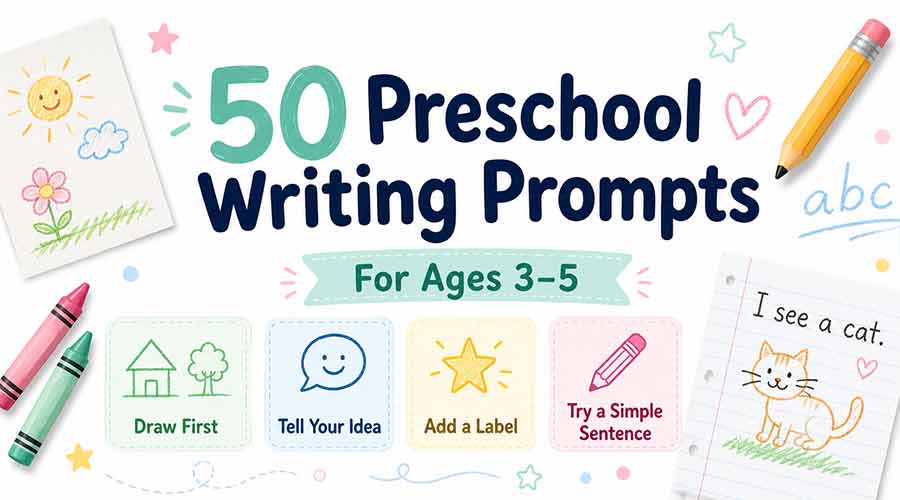
Good preschool writing prompts give a child something meaningful to communicate. They do not require perfect pencil grip, correct spelling, or a full sentence before the activity “counts.”
That distinction matters because early writing develops gradually. The National Association for the Education of Young Children (NAEYC) describes emergent writing as children’s early attempts to communicate through drawing, symbolic marks, letters, words, dictation, and other forms of written expression.[1] Head Start likewise describes preschool writing as progressing from drawing and scribbling toward letter-like forms, letters, and increasingly meaningful writing.[2]
The 50 prompts below are designed for parents, preschool teachers, homeschool families, and caregivers who want a simple way to invite more language and early writing into the day. Choose a few prompts that connect with the child’s interests rather than trying to complete the whole list.
What Counts as Writing in Preschool?
Preschool writing is about learning that marks, pictures, letters, and words can carry meaning. A child who draws a dog and tells you, “This is my dog running at the park,” is already working with an idea that can become written language.
NAEYC notes that young children build several kinds of writing knowledge at the same time: they learn that writing has a purpose, they develop the mechanics of making letters and words, and they gradually learn to put thoughts into written form.[1] Head Start’s preschool literacy guidance similarly includes drawing and scribbling as part of early writing development rather than treating them as activities that must be left behind before “real” writing begins.[2]
- Drawing a response to a prompt
- Scribbling or making purposeful marks
- Telling an adult what the picture says
- Dictating a word, phrase, or sentence
- Adding a letter or label to a picture
- Trying invented spelling
- Writing familiar words such as a name
- Trying a simple sentence when ready
Need to build pencil control first? If the child is still most comfortable tracing paths, making lines, or experimenting with a crayon, start with 15 Pre-Writing Activities for Preschoolers. Writing prompts can come alongside that practice rather than replacing it.
How to Use These Preschool Writing Prompts
Pick one prompt and let the child respond at a level that feels manageable. The same question can work for a child who only wants to draw and for a child who is beginning to write words.
| Current Stage | Simple Response | Adult Support |
|---|---|---|
| Not writing yet | Draw + tell | Ask one open question and write down the child’s words if they want you to. |
| Making marks | Draw + scribble + tell | Treat purposeful marks as meaningful and invite the child to explain them. |
| Beginning letters | Draw + label | Help stretch out one useful word and notice its first sound. |
| Writing words | Picture + one or two words | Offer a model only when needed; leave room for invented spelling. |
| Beginning sentences | Draw + simple sentence | Help the child say the sentence aloud before trying to write it. |
These are flexible response options, not age tests. Preschoolers develop at different rates, and one child may use several of these approaches in the same week.
50 Preschool Writing Prompts for Ages 3–5
Start with familiar topics. Children usually have more to say when the prompt connects to their own lives, favorite things, play, or imagination. You can read the prompt aloud and let the child draw first.
All About Me Writing Prompts
- My favorite toy is…
- Something that makes me happy is…
- My favorite color is…
- I am really good at…
- My favorite thing to eat is…
- My favorite place is…
- Something I like to play is…
- I feel proud when…
- Today I want to…
- If I could choose any snack, I would choose…
Family & Everyday Life Prompts
- Something I like to do with my family is…
- My favorite thing about home is…
- For breakfast, I like…
- Before bedtime, I…
- At the playground, I like to…
- If I could help make dinner, I would…
- Something helpful I can do is…
- My favorite part of the day is…
- On a fun weekend, I would…
- When I get ready to go out, I…
Animal & Nature Writing Prompts
- My favorite animal is…
- If I could be an ocean animal, I would be…
- If I found a dinosaur, I would…
- On a farm, I would like to see…
- If a butterfly landed on me, I would…
- My favorite thing about rain is…
- If I had a garden, I would grow…
- At the beach, I would look for…
- That cloud looks like…
- My favorite season is… because…
Extend an interest-based prompt with a related activity: try Ocean Activities for Preschoolers or Dinosaur Activities for Preschoolers.
Feelings & Friendship Prompts
- Something that makes me laugh is…
- A good friend can…
- I can help someone by…
- Someone helped me when…
- Something that makes me excited is…
- One kind thing I can do is…
- When I feel frustrated, I can…
- I like playing with others when…
- I can cheer up a friend by…
- Something I like to share is…
Imagination & Story Starter Prompts
- If I could fly, I would go…
- If my favorite toy could talk, it would say…
- If I found a dinosaur egg, I would…
- If I lived under the ocean, my home would…
- If animals went to preschool, they would…
- If my bed could travel anywhere, it would take me…
- If I had a tiny dragon, we would…
- If I could build any vehicle, it would…
- One morning I opened the door and found…
- Once upon a time, there was…
How to Adapt One Prompt for Different Preschool Writers
Instead of changing the prompt for every age, change the response. This keeps the idea interesting while making the writing demand appropriate for the child in front of you.
Example prompt: “What animal would you like to be?”
Draw the animal. No writing is required.
Explain the picture while an adult listens or writes down the child’s words.
Add one useful word such as lion, even if the spelling is still emerging.
Try a short idea such as “I want to be a lion.”
NAEYC recommends scaffolding early writing around children’s current abilities and giving them meaningful reasons to communicate.[1] That makes this “same prompt, different response” approach more useful than expecting every preschooler to produce the same finished page.
Need an easier pencil-and-paper starting point?
Pair idea sharing with a short pre-writing activity. The free printable library includes themed paths and tracing practice that can help children become more comfortable using writing tools.
A Simple 5-Minute Preschool Writing Routine
Preschool writing practice does not need to become a long lesson. A short routine is often easier to repeat and gives the child a clear finish point.
Read one prompt aloud and make sure the child understands it.
Talk about one or two possible ideas without choosing the answer for the child.
Draw, mark, label, or write. Use the easiest successful response.
Invite the child to explain the finished page and stop while the activity still feels manageable.
Optional supplies: plain paper or a small blank journal, crayons, washable markers, beginner pencils, a clipboard, and a reusable dry-erase sleeve can all be useful. You do not need a special writing kit—use whatever makes it easy to begin.
What If My Preschooler Says “I Don’t Know”?
“I don’t know” often means the prompt is too open, the child needs more conversation first, or the writing demand feels bigger than the idea. Try reducing the decision rather than supplying a complete answer.
- Offer two choices. “Would you rather write about a dog or a dinosaur?”
- Let the child answer aloud. Talking can come before drawing or writing.
- Model one answer. Give your own short example, then ask for a different idea.
- Start with the picture. Once something is on the page, ask what is happening.
- Use a strong interest. Vehicles, animals, food, family, and pretend play often produce easier ideas.
Keep the prompt smaller if needed. “Tell me about your weekend” may feel too broad. “What was one thing you played with?” gives the child a clearer place to start.
Writing Prompts vs. Handwriting Practice
Writing prompts and handwriting practice support different parts of early writing. Prompts focus on what the child wants to communicate. Handwriting practice focuses more on how letters and marks are formed and controlled.
A child can have a wonderful story idea and still be learning how to form letters. Another child may copy letters neatly but need help generating something to say. Keeping these goals separate makes it easier to choose the right activity.
| If the goal is… | Try… | Related Nini Guide |
|---|---|---|
| Sharing an idea | Drawing, dictation, labels, simple prompts | This preschool writing prompts guide |
| Pencil control | Lines, paths, curves, tracing | Pre-Writing Activities for Preschoolers |
| Letter formation | Short, age-appropriate handwriting practice | Handwriting for 4-Year-Olds |
| More structured composition | Simple sentences, story sequence, labels and captions | Writing Activities for Kindergarten |
Where to Use Preschool Writing Prompts
Prompts work best when they fit naturally into the day. You do not need a separate writing lesson every time.
- Preschool writing center
- Morning arrival activity
- Homeschool literacy time
- Quiet-time table activity
- After a favorite read-aloud
- Weekly drawing-and-writing journal
- Seasonal or thematic units
- Small-group language practice
If you are setting up a dedicated classroom or home-learning space, see Pre-K Writing Center Ideas for simple materials and activity ideas.
Keep the next step low-prep
When a ready-to-print activity is more useful than a blank page, browse the printable library by skill and choose one clear practice goal for the day.
When Your Child Is Ready for More Writing
Add more writing when the current version feels easy—not simply because of a birthday. A child who happily labels drawings may be ready to add a short phrase. A child who already writes simple sentences may enjoy adding a second detail, a caption, or a beginning-middle-end sequence.
For children moving toward kindergarten-level composition, continue with Writing Activities for Kindergarten. That page can take the next step without turning this preschool article into another broad kindergarten-writing guide.
Frequently Asked Questions About Preschool Writing Prompts
Are writing prompts appropriate for preschoolers?
Yes, when the response is flexible. A preschool prompt can lead to a drawing, oral story, adult dictation, label, letter-like marks, a word, or a short sentence. The goal is to give the child a meaningful reason to communicate, not to require conventional writing before the child is ready.
What should a 3-year-old write?
There is no single writing checklist every 3-year-old should meet. Head Start describes the 36–48 month range as including drawing and scribbling that begins to convey meaning, with some letter-like forms or letters appearing with support.[2] For a prompt, drawing and telling an adult about the picture can be a very appropriate response.
What should a 4-year-old write?
Four-year-olds vary widely. Many are experimenting with drawings, purposeful marks, names, letter-like forms, labels, or early invented spelling. Use the child’s current work as the starting point instead of requiring a full sentence. For letter-formation practice specifically, see Handwriting for 4-Year-Olds.
What if my preschooler cannot write letters yet?
Let the child draw and talk. You can write down exactly what the child says, then read it back. NAEYC specifically includes adult-recorded dictation and shared writing among ways to help young children connect spoken ideas with written language.[1]
How often should preschoolers practice writing?
Regular, meaningful opportunities are more useful than forcing a long worksheet session. Writing can appear naturally in drawing, sign-in routines, pretend play, lists, notes, journals, and short prompt activities.[3] Stop before the task becomes frustrating, and return to it another day.
Keep Preschool Writing Playful
The best preschool writing prompt is one that helps a child think, talk, draw, and eventually put more of that idea onto the page. Some days the finished work may be a picture with one letter. On another day it may be a labeled drawing or a simple sentence. All of those attempts can be part of early writing development.
Start with one prompt, follow the child’s interest, and use draw → tell → label → write as a flexible path rather than a fixed checklist. When the child wants more table practice, choose a simple printable that supports the next skill instead of adding unnecessary pressure.
Looking for a simple activity for today?
Explore free preschool and kindergarten printables for pre-writing, tracing, counting, matching, shapes, and fine motor practice.
Enjoying the free resources? Sharing a useful Nini Printables guide with another parent or teacher is an easy way to support the site and help more families find low-prep learning ideas. A direct voluntary-support button can be added here later if the site has a confirmed support URL.