
Easy Playdough Recipe for Preschool: Simple & Flour-Free
This practical preschool playdough recipe gives parents and teachers a simple cooked method, clear batch sizes, storage guidance, and quick fixes when the texture is not quite right.
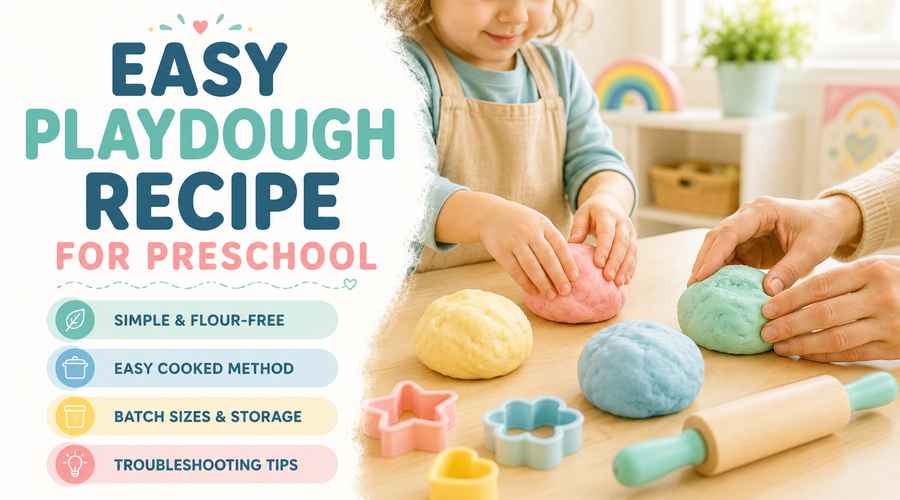
Quick Answer
For a simple playdough recipe for preschool, combine 2 cups baking soda, 1 cup cornstarch, and 1½ cups water, then cook the mixture over medium heat while stirring until it thickens. Cool it completely before children touch or knead it. This flour-free version follows the ingredient proportions in NAEYC’s published “Bouncy Playdough” recipe [1].
Homemade playdough can be useful because one batch can move from sensory play to counting, shape building, pretend play, and early hand-strength activities. NAEYC describes playdough as a material that can support small-muscle use, language, problem-solving, and early math experiences [1].
This guide uses a cooked, flour-free preschool playdough recipe. That choice is intentional: the U.S. Food and Drug Administration advises that children should not play with raw dough or play clay made with raw flour [2]. The FDA also advises against trying to heat-treat flour at home [3].
Playdough Recipe for Preschool at a Glance
Cooked Flour-Free Playdough
Ingredients
- 2 cups baking soda
- 1 cup cornstarch
- 1½ cups water
- Optional: a small amount of food coloring added to the water
This is a play material, not food. Children should not taste or eat homemade playdough.
Recipe source: The base proportions and cooking method follow NAEYC’s “Bouncy Playdough” recipe. Nini Printables adds classroom scaling, troubleshooting, storage guidance, and current safety context [1].
Ingredients and Equipment You’ll Need
Baking soda
Baking soda forms most of the dry base in this recipe and combines with the cornstarch and water to create the finished play material. Keep the mixture for play rather than tasting, and supervise children who may still put materials in their mouths.
Cornstarch
Cornstarch helps the mixture thicken as it cooks. Measure it before children join the activity so the setup stays simple and loose powder is easier for the adult to manage.
Water
Water brings the ingredients together. If color is wanted, mixing food coloring into the water before cooking usually distributes the color more evenly than kneading liquid coloring into finished dough.
Basic equipment
- Medium saucepan
- Wooden spoon or sturdy silicone spatula
- Measuring cups
- Heat-safe surface or bowl for cooling
- Airtight container for storage
- Clean play mat or washable table surface
How to Make Playdough for Preschool
- Combine the dry ingredients. Put the baking soda and cornstarch into a medium saucepan and stir briefly so the powders are evenly distributed.
- Add the water. Pour in the water and stir until the mixture looks smooth. Add food coloring to the water first if a colored batch is desired.
- Cook over medium heat. An adult should cook the mixture while stirring continuously. It will gradually thicken and begin to gather together.
- Stop when it becomes dough-like. Remove the saucepan from the heat once the mixture has thickened into a soft mass rather than a pourable paste. Overcooking can make the finished dough dry or crumbly.
- Cool completely. Transfer the dough to a heat-safe surface or bowl. Only the supervising adult should check the temperature. Children should not touch it until it is fully cool.
- Knead until smooth. Once cool, knead the dough with clean hands until the texture becomes even and ready for play.
Small Batch vs. Preschool Classroom Batch
A standard batch works well for a small group. For one or two children, a half batch reduces waste. For a larger preschool group, doubling the recipe is easier than making one oversized batch in a small saucepan.
| Batch | Baking Soda | Cornstarch | Water |
|---|---|---|---|
| Half batch | 1 cup | ½ cup | ¾ cup |
| Standard batch | 2 cups | 1 cup | 1½ cups |
| Double batch | 4 cups | 2 cups | 3 cups |
Batch: Half batch
Baking soda: 1 cup
Cornstarch: ½ cup
Water: ¾ cup
Batch: Standard batch
Baking soda: 2 cups
Cornstarch: 1 cup
Water: 1½ cups
Batch: Double batch
Baking soda: 4 cups
Cornstarch: 2 cups
Water: 3 cups
When preparing playdough for a classroom, two standard batches are often easier to cook evenly than one very large batch. Separate colors can also make sharing and cleanup simpler.
What About a No-Cook Preschool Playdough Recipe?
Many no-cook playdough recipes use raw wheat flour. For preschool use, this guide does not recommend that approach. The FDA states that flour is a raw food and advises adults not to let children use raw dough for crafts or “play clay” [2]. The agency also advises against trying to heat-treat flour at home because home treatment may not reliably eliminate bacteria [3].
For that reason, the main recipe here is both cooked and flour-free. If a classroom uses a different homemade recipe, the ingredients and safety instructions should be checked carefully before children handle it.
How Preschoolers Can Help Make Playdough
Making playdough can become part of the learning, not just preparation. NAEYC highlights measuring ingredients, following recipe directions, and manipulating dough as opportunities for early math, language, and hand-use practice [1].
Children can help with
- Counting measuring cups before cooking begins
- Choosing a color for the batch
- Naming textures such as smooth, soft, firm, or sticky
- Kneading the dough after an adult confirms it is fully cool
- Dividing the finished dough into equal pieces
- Cleaning child-safe tools after play
Adults should handle
- The saucepan, stove, and hot mixture
- Temperature checking
- Loose powder near very young children
- Any troubleshooting that requires reheating the dough
Already Made the Dough?
Turn the batch into a learning activity instead of searching for another idea. Nini Printables has a separate guide focused on what preschoolers can do with playdough, including fine-motor, counting, shape, letter, and pretend-play ideas.
How to Fix Playdough That Goes Wrong
The playdough is too sticky
The mixture may need a little more cooking time. Return it to low-to-medium heat and stir continuously for a short period, then cool it again before checking the texture. Avoid fixing a cooked batch by adding raw flour.
The playdough is too dry or crumbly
It may have cooked too long. After it is fully cool, knead it with slightly damp hands. Add moisture gradually rather than pouring water directly into the dough. If the texture does not improve, a fresh batch is usually more predictable.
The playdough feels too soft
Let it cool completely before changing anything. Warm dough naturally feels softer. If it is still too loose after cooling, brief additional cooking can remove excess moisture.
The color looks uneven
For the next batch, mix food coloring into the measured water before cooking. If the current dough is already cool, knead it thoroughly before adding more coloring.
The dough is firmer after storage
First knead it in warm hands. If it remains firm, use slightly damp hands and knead again. Discard the dough instead of trying to refresh it if it has an unusual odor, visible growth, or contamination from food or dirty surfaces.
How to Store Homemade Playdough
Let the playdough cool completely before sealing it. Then place it in a clean airtight container or reusable zip bag. NAEYC’s flour-free “Bouncy Playdough” guidance says the dough can be reused and stored on a shelf in an airtight container [1].
- Use a clean, airtight container
- Store only fully cooled dough
- Keep different classroom batches separate
- Label classroom containers with the preparation date
- Use clean hands and tools during play
- Discard if odor, visible growth, or contamination appears
Homemade play materials do not need an exaggerated “lasts for months” promise. Clean preparation, airtight storage, and regular inspection are more useful than relying on a fixed shelf-life claim.
Simple Preschool Playdough Safety
Playdough is a sensory and learning material, not a snack. Poison Control notes that commercial Play-Doh is not intended to be eaten and advises supervision around mouthing [4]. Homemade versions should also be treated as non-food play materials.
- Supervise preschoolers during play
- Keep hot dough and cookware adult-only
- Wash hands before and after play
- Check ingredient sensitivities before classroom use
- Avoid small loose add-ins when they may create a choking risk
- Keep playdough separate from eating areas and food
What to Do With Your Playdough Next
Once the dough is ready, keep the setup simple. A few purposeful prompts are enough to turn open-ended play into useful practice without making the activity feel like a worksheet.
- Roll and pinch: build hand strength with balls, snakes, and flattened shapes.
- Make shapes: form circles, squares, triangles, and simple pictures.
- Count pieces: make five small balls, ten “cookies,” or matching sets.
- Build letters: roll thin pieces and form familiar uppercase letters.
- Pretend play: create food, animals, roads, or story characters.
For a deeper activity list, use the dedicated preschool playdough activities guide. Children who are ready to move from three-dimensional play to pencil preparation can also use these pre-writing activities for preschoolers.
Optional Playdough Supplies
Useful, but not required
A preschool playdough station does not need a large set of specialty toys. Start with household tools, then add only what makes the activity easier to repeat.
- A small rolling pin
- Large shape cutters
- Child-safe plastic dough tools
- A washable play mat
- Airtight storage containers
Move From Playdough to Printable Practice
Hands-on play works well before short paper-and-pencil practice. When a child is ready, continue the same skills with free Nini Printables resources.
Frequently Asked Questions
What is an easy playdough recipe for preschool?
A simple flour-free option uses 2 cups baking soda, 1 cup cornstarch, and 1½ cups water. An adult cooks the mixture over medium heat while stirring until it thickens, then cools it completely before children handle it.
How long does homemade playdough last?
There is no universal shelf life because ingredients, handling, humidity, and storage differ. Keep homemade playdough in a clean airtight container and discard it if it develops an unusual odor, visible growth, or contamination.
Why is my homemade playdough sticky?
Sticky playdough usually contains too much moisture or needs more cooking. Let it cool first. If it remains sticky, an adult can briefly return it to low-to-medium heat while stirring continuously.
Can preschoolers help make playdough?
Yes, but the tasks should match the child’s age. Preschoolers can count cups, choose colors, describe textures, and knead fully cooled dough. Adults should handle the stove, hot mixture, and temperature checks.
Do you need cream of tartar for playdough?
No. Many traditional flour-based recipes use cream of tartar, but the flour-free recipe in this guide uses baking soda, cornstarch, and water instead.
Is cooked or no-cook playdough better for preschool?
For this guide, cooked flour-free playdough is preferred because many no-cook recipes use raw flour. The FDA advises against letting children play with raw dough or play clay made with raw flour.
How do you keep homemade playdough soft?
Let it cool fully, store it airtight, and keep hands and tools clean. If it becomes slightly firm, knead it in warm hands first; slightly damp hands can add a very small amount of moisture.
Can I make a larger batch for a preschool classroom?
Yes. Double the standard ingredients to 4 cups baking soda, 2 cups cornstarch, and 3 cups water. If the saucepan is not large enough to stir the mixture comfortably, make two standard batches instead.
About This Guide
Nini Printables creates practical preschool and kindergarten learning resources for families, teachers, caregivers, and homeschool settings. This recipe guide is designed to help an adult make one usable batch, adjust the amount for a small group, troubleshoot common texture problems, and store the dough without turning the page into a long list of play activities.
Source transparency: Nini Printables did not invent the base recipe. The proportions and core cooking method come from NAEYC’s published “Bouncy Playdough” guidance [1]. The raw-flour safety guidance was checked against current FDA information [2][3], and the mouthing guidance was checked against Poison Control [4]. Sources were reviewed August 10, 2026.
For activity ideas after the dough is made, use the separate Preschool Playdough Activities guide.
Teaching & Safety References
- National Association for the Education of Young Children (NAEYC). Playdough Power. Covers playdough learning benefits and includes a cooked flour-free “Bouncy Playdough” recipe.
- U.S. Food and Drug Administration. Flour Is a Raw Food and Other Safety Facts. Advises against letting children use raw dough for crafts or play clay.
- U.S. Food and Drug Administration. Handling Flour Safely: What You Need to Know. Includes guidance not to use raw flour for play clay and not to rely on home heat-treatment of flour.
- National Capital Poison Center. Is Play-Doh Edible?. Explains that playdough-type materials are not intended to be eaten and recommends supervision.