
Fine Motor Games for Kindergarten: 15 Easy Ways to Build Hand Strength Through Play
Turn squeezing, pinching, threading, cutting, and pencil-control practice into short games kindergarteners can actually play at home or in the classroom.
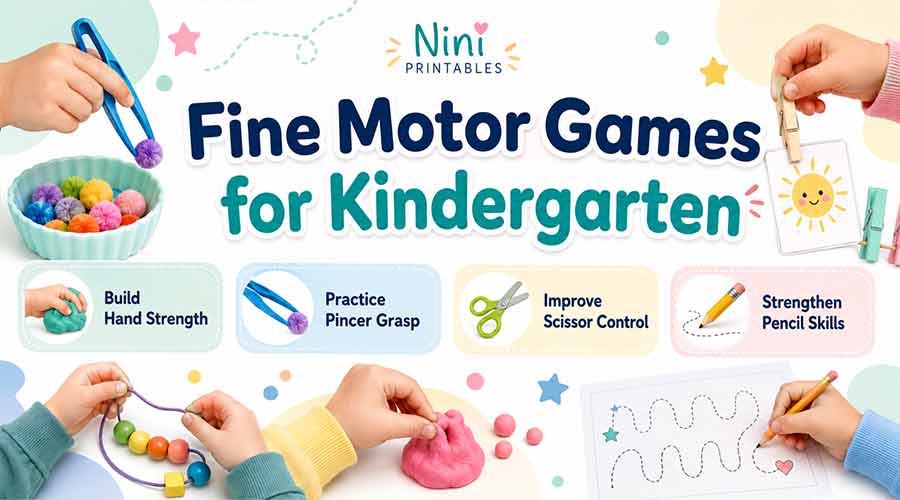
Good fine motor games for kindergarten combine a clear play rule with hand work such as squeezing, pinching, clipping, threading, cutting, tracing, or moving small objects. Start with one short game, keep materials age-appropriate, and change the size, resistance, time, or precision when the task feels too easy or too hard.
Kindergarteners use fine motor control throughout the school day: opening containers, handling manipulatives, cutting paper, drawing, writing, fastening clothing, and organizing small classroom materials. The goal of a useful fine motor game is not to make every task feel like handwriting practice. Instead, it gives children repeated chances to control their fingers, hands, wrists, and eyes while they are focused on a simple challenge.
That play-based approach also fits established early-childhood guidance. The U.S. Head Start Early Childhood Learning & Knowledge Center describes fine motor skills as the controlled use of small muscles for grasping, holding, manipulating objects, and using tools such as scissors and paint brushes. NAEYC’s Developmentally Appropriate Practice guidance emphasizes strengths-based, play-based, joyful learning that can be adapted to individual children.
If you are looking for broader preschool practice rather than game-based kindergarten ideas, use the existing Fine Motor Activities for Preschoolers guide. This page stays focused on kindergarten fine motor games with rules, turns, goals, or small challenges.
What Fine Motor Skills Do Kindergarteners Use Every Day?
Fine motor control shows up in many ordinary kindergarten tasks. Instead of treating one pencil grip or one worksheet as the whole goal, it is more useful to provide a mix of movements and tools.
- Grasping and releasing small objects with control
- Using crayons, pencils, markers, glue, and paint tools
- Opening and closing child-safe scissors
- Holding paper steady while the other hand works
- Threading, building, sorting, clipping, and connecting
- Following lines, paths, shapes, and visual targets
- Opening lunch containers, bags, buttons, or simple fasteners
- Coordinating what the eyes see with what the hands do
Choose a Fine Motor Game by Skill
When there are many kindergarten fine motor activities to choose from, start with the movement you want the child to practise. This makes it easier to select a game without turning the session into a long lesson.
| Skill to Practise | Try This Game | Main Movement | Setup |
|---|---|---|---|
| Hand strength | Playdough Pinch-and-Build | Squeeze, pinch, roll | 2 minutes |
| Pincer grasp | Tweezer Color Race | Pinch, lift, release | 3 minutes |
| Two-hand coordination | Lacing Pattern Race | Hold, thread, pull | 3 minutes |
| Scissor control | Scissor Trail Challenge | Open, close, turn | 5 minutes |
| Pencil control | Trace-and-Drive Road Race | Trace, stop, turn | 2 minutes |
15 Fine Motor Games for Kindergarten
Each game below has one clear play rule. These fine motor skills games for kindergarten are designed to make hand practice feel like play rather than a worksheet session. Use one game at a time, demonstrate a turn, and stop while the activity is still enjoyable. For games that use small loose parts, choose materials appropriate for the child and supervise closely.
Tweezer Color Race
Materials: child-sized tweezers, pom-poms or other safe manipulatives, two to four cups.
How to play: call a color or roll a color die. The child uses tweezers to move matching pieces into the correct cup before the next turn.
Builds: pincer grasp, precision, hand-eye coordination.
Clothespin Clip Challenge
Materials: clothespins and a sturdy cardboard strip, box edge, or paper plate.
How to play: add colored dots or numbers around the edge. The child clips a clothespin onto the matching target.
Builds: hand strength, controlled release, finger isolation.
Roll-and-Build Cube Game
Materials: a die and linking cubes or other easy-connect building pieces.
How to play: roll the die, then add that many cubes to a tower. Take turns until the tower reaches a chosen height.
Builds: finger pressure, bilateral coordination, controlled connection and separation.
Playdough Pinch-and-Build
Materials: playdough and simple picture or shape prompts.
How to play: choose a prompt, then roll, squeeze, pinch, and press the dough to build it. A partner can guess the finished object.
Builds: whole-hand strength, finger strength, thumb-and-finger control.
Pom-Pom Transfer Race
Materials: two bowls, child tongs, pom-poms or another safe lightweight item.
How to play: move one piece at a time from the start bowl to the finish bowl. Race against a personal best instead of another child when competition is distracting.
Builds: grasp-and-release control, wrist stability, visual targeting.
Sticker Path Challenge
Materials: dot stickers and paper with a wide line, curve, zigzag, or simple shape.
How to play: place stickers from start to finish without leaving the path. Children can take turns choosing the next color.
Builds: fingertip control, bilateral coordination, visual placement.
Sort-and-Grab Challenge
Materials: safe small manipulatives, a muffin tin or several cups, and tongs if appropriate.
How to play: draw a sorting rule such as color, shape, or type. Move each piece to the correct space before the round ends.
Builds: precise pickup, release, visual discrimination, hand-eye coordination.
Hole-Punch Count-and-Cover
Materials: child-friendly single-hole punch, paper strips, marker.
How to play: write a small number on each strip. The child punches that many holes, then checks the total by touching each hole.
Builds: hand strength, bilateral coordination, controlled placement.
Ready for a Quiet Printable Follow-Up?
After a hands-on game, a short printable path can give children another way to practise controlled hand movement without making the whole lesson worksheet-based.
Lacing Pattern Race
Materials: lacing card or punched cardboard, thick lace or shoelace.
How to play: choose a start hole and a simple pattern such as every hole or every second hole. The child threads around the card to reach the finish.
Builds: two-hand coordination, visual planning, controlled pulling.
Scissor Trail Challenge
Materials: child-safe scissors and paper with a thick road from start to finish.
How to play: cut along the trail without leaving the road. Add a simple picture or destination at the end to create a goal.
Builds: scissor opening and closing, helper-hand use, paper turning.
Tape Rescue Game
Materials: painter’s tape and a few sturdy, age-appropriate toys or classroom objects.
How to play: lightly tape the objects to a tray or table. The child peels each strip to “rescue” the object and place it in a finish basket.
Builds: fingertip strength, bilateral coordination, pulling and stabilizing.
Trace-and-Drive Road Race
Materials: a road or path, finger or small toy vehicle, then a crayon or pencil when ready.
How to play: travel from start to finish while staying on the road. Try a finger or toy first, then repeat with a drawing tool.
Builds: visual tracking, direction changes, start-and-stop control.
Dinosaur Path Challenge
Materials: dinosaur-themed path or simple homemade trail and a crayon, marker, or finger.
How to play: choose a dinosaur, follow its path to the destination, then switch to a different route or tool for the next round.
Builds: pencil control, visual attention, controlled direction changes.
Shape Build-and-Copy Game
Materials: craft sticks, playdough, or blocks plus simple shape cards.
How to play: draw or choose a shape card, build the shape, then copy it on paper if the child is ready.
Builds: visual-motor planning, two-hand coordination, early drawing control.
Draw-the-Finish-Line Challenge
Materials: paper, two stickers or small pictures, crayons or pencils.
How to play: place a start and finish target on the page. Ask the child to invent a road between them using straight, curved, zigzag, or looping lines.
Builds: purposeful line movement, planning, pencil control.
How to Use Fine Motor Games in Morning Tubs, Centers, or at Home
The same fine motor kindergarten game can work in different settings with only a small change to the rules.
| Setting | Simple Format | Useful Tip |
|---|---|---|
| Morning tub | One familiar game for 5–10 minutes | Keep the rule predictable so children can start with little explanation. |
| Classroom center | Two to four children take turns | Use a picture cue showing the rule and where materials return. |
| Early finisher | One self-contained tray or basket | Choose games the child already knows rather than introducing a new skill alone. |
| Home practice | One short game during a calm part of the day | Stop before frustration grows; repeating a familiar game is useful. |
For children who are still building broader pre-writing control, the Pre-Writing Activities for Preschoolers guide offers additional hands-on ideas before more focused pencil work.
A Simple 5-Day Kindergarten Fine Motor Game Rotation
You do not need a new game every day. A short rotation can cover different movement patterns while keeping setup manageable.
If a child enjoys one game, repeat it. Familiarity can reduce the effort spent learning the rules and leave more attention for the hand movement itself.
Optional Supplies for Fine Motor Games
Most of these fine motor activities for kindergarten can be built from inexpensive classroom or household materials. A small reusable basket is usually enough.
Useful basics
- Playdough
- Child-safe scissors
- Large tweezers or kid tongs
- Clothespins
- Thick laces or lacing cards
- Linking cubes or building pieces
- Dot stickers
- Crayons and washable markers
- Reusable trays, bowls, or muffin tins
Buying tip: choose versatile materials that can be reused across several games instead of purchasing a large single-purpose fine motor kit.
When a Fine Motor Game Feels Too Hard
A game can often be adjusted without abandoning the skill. Change one variable at a time so the child can still understand the rule.
- Use larger objects that are easier to grasp.
- Choose wider tweezers, tongs, or thicker laces.
- Reduce the number of pieces or turns.
- Shorten the path, cutting line, or transfer distance.
- Remove the timer or competitive element.
- Model one turn before asking the child to begin.
- Use wider cutting or tracing paths.
- Make the game harder later by adding a pattern, target, or precision rule.
Keep the focus on useful practice rather than perfect performance. If a child is consistently struggling with everyday classroom or self-care tasks, parents and teachers can share observations with the child’s school team or an appropriate qualified professional rather than using an online activity list as an assessment.
Move From Hands-On Play to Short Printable Practice
When a child is ready for a quieter table activity, use a printable as the next step rather than the whole lesson.
Frequently Asked Questions About Fine Motor Games for Kindergarten
What are good fine motor games for kindergarten?
Good options include tweezer sorting races, clothespin matching, playdough building, lacing challenges, scissor trails, sticker paths, building games, and road-tracing games. The best choice is a short game with a clear rule that matches the movement a child is ready to practise.
How long should kindergarten fine motor activities last?
There is no single required length. For many home or classroom routines, a short 5–10 minute game is easier to repeat than a long session. Stop earlier when attention or hand comfort drops, and repeat familiar games on another day.
Do fine motor games help with handwriting?
Some fine motor games support movements used during writing, such as hand strength, controlled grasping, visual tracking, bilateral coordination, and pencil control. However, fine motor development is broader than handwriting, so useful practice should also include building, cutting, threading, manipulating objects, and everyday tasks.
What supplies are useful for fine motor games?
A small set of reusable materials is enough: playdough, child-safe scissors, tweezers or tongs, clothespins, laces, building pieces, stickers, crayons, markers, bowls, and scrap paper. Choose age-appropriate materials and supervise small loose parts.
What are fine motor games without worksheets?
Try a tweezer color race, clothespin challenge, playdough build, pom-pom transfer, lacing game, tape rescue, sorting race, or roll-and-build game. Printable paths can be added later when you want focused tracing or pencil-control practice.
Can preschoolers use these kindergarten fine motor games?
Some can be simplified for preschoolers by using larger materials, fewer pieces, wider paths, and shorter rounds. For a broader preschool-focused list, see Fine Motor Activities for Preschoolers.
Start With One Simple Game
Fine motor practice does not need a complicated center or a new craft every day. Pick one movement, choose one simple game, and make the challenge easy enough to understand. Then adjust the materials or rule as the child becomes more comfortable.
For a ready-to-print next step, explore the free Nini Printables library for pre-writing, tracing, counting, matching, shapes, and fine motor practice.