
Preschool Thanksgiving Learning & Play
20 Thanksgiving Activities for Preschoolers: Easy, Low-Prep Ideas for Ages 3–5
These Thanksgiving activities for preschoolers turn gratitude, seasonal foods, counting, fine motor play, science, sensory exploration, and movement into simple learning ideas. They work at home or in the classroom.
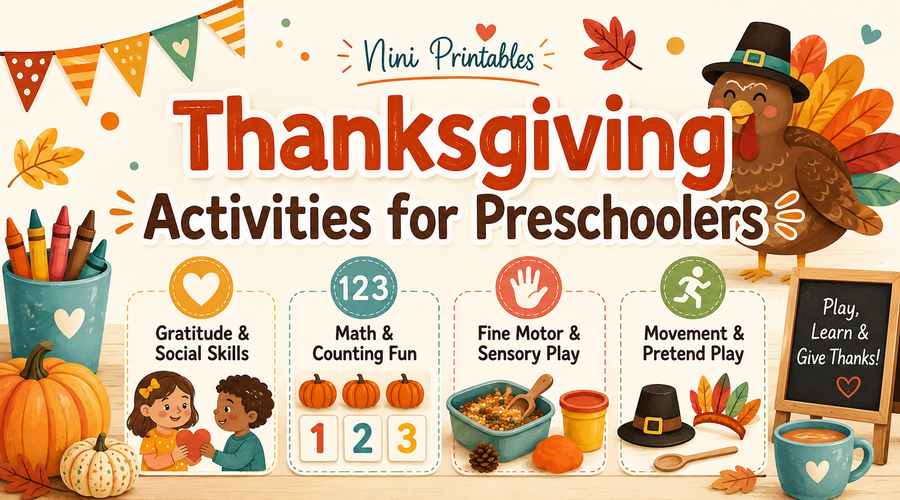
Quick answer: Easy Thanksgiving activities for preschoolers include a thankful tree, turkey feather counting, simple sorting, playdough, a cranberry sink-or-float test, helper jobs, pretend play, and movement games. Pick one activity that fits the child, the time you have, and the skill you want to practice.
Thanksgiving can support meaningful preschool learning without turning the week into a long craft checklist. One clear action is usually enough: count, sort, move, help, describe, build, or create. Skip complicated projects with many adult-led steps.
This guide is for parents, preschool teachers, homeschool families, and caregivers who want practical preschool Thanksgiving activities they can use now. The article stays focused on hands-on play. Worksheet and printable searches remain with the separate Thanksgiving Preschool Worksheets & Activity Pack, so the two pages serve different needs.
Quick Pick: Choose a Thanksgiving Activity by What You Need
Instead of starting with the longest list, start with the kind of moment you are trying to fill. A five-minute activity can be useful when it gives the child one clear job and an easy way to succeed.
| I need… | Try this | Prep | Time | Best for |
|---|---|---|---|---|
| Almost no prep | Turkey Waddle & Freeze | None | 5–10 min | Movement break |
| A quiet activity | Thankful Drawing & Story | Very low | 10 min | Table time |
| Math practice | Turkey Feather Counting | Low | 10 min | Small group |
| Fine motor practice | Feather Transfer | Low | 10 min | Table time |
| A science idea | Cranberry Sink or Float | Low | 10 min | Home / class |
| A family routine | Thanksgiving Helper Job | None | 5–15 min | Home |
| Small-group play | Thanksgiving Sorting | Low | 10 min | Classroom |
What Makes a Good Thanksgiving Activity for Preschoolers?
A useful Thanksgiving activity should be simple enough that the seasonal theme supports the learning instead of distracting from it. Start with one main goal, keep directions short, and use materials the child can handle safely and confidently.
Use one clear action
Count five objects, sort by one feature, move to one rule, or describe one observation. Add a second step only when the first feels easy.
Keep the challenge adjustable
For one child, counting 1–3 may be enough. Another may be ready for 1–10, a simple pattern, or a short explanation of how they solved the task.
Choose hands-on materials first
Use real objects, pretend food, paper shapes, playdough, crayons, bowls, and movement. These give preschoolers something concrete to touch, compare, and discuss.
Stop while it is still working
End on a successful moment. Do not stretch the activity past the child’s attention or interest just to finish the plan.
Why this fits early learning: CDC guidance for ages 3 and 4 includes playdough, drawing, pretend play, simple counting, helper behavior, and games. NAEYC describes developmentally appropriate practice as strengths-based and play-based. It also emphasizes the individual child and learning context. See the CDC pages for 3-year-olds and 4-year-olds, plus the NAEYC Developmentally Appropriate Practice statement.
A Simple Note on Keeping Thanksgiving Activities Respectful
For preschool, focus many activities on gratitude, family, helping, food, harvest, seasonal observation, kindness, and time together. If you also teach Thanksgiving history, choose accurate, age-appropriate sources. Avoid turning Native cultures into costumes, props, or generic craft themes.
Teaching reference: Smithsonian’s National Museum of the American Indian offers a Pre-K–12 Thanksgiving reference guide. It recommends accurate, tribally specific materials and discourages classroom projects that copy or stereotype Native traditions. For young children, gratitude and community activities can stay simple without recreating a misleading “First Thanksgiving” scene.
Reusable Materials for Preschool Thanksgiving Activities
Use what you already have before buying a holiday-specific kit. A few basic supplies can support most of these ideas and other preschool themes.
Useful basics
- Paper, crayons, and washable markers
- Washable paint and glue
- Playdough
- Paper plates, cups, or shallow trays
Reusable fine-motor tools
- Child-sized tongs
- Easy-to-open clothespins
- Large age-appropriate counters
- Reusable sleeves or dry-erase pockets
Small-parts safety: Pom-poms, counters, beads, kernels, and other loose parts are not appropriate for every child. Choose larger materials, supervise closely, and skip anything a child may mouth. The U.S. Consumer Product Safety Commission notes that small parts can present choking, aspiration, or ingestion hazards for children under 3. Read the CPSC small-parts guidance.
Thanksgiving Math Activities for Preschoolers
Thanksgiving math activities work best when the seasonal object supports a familiar math action: count, sort, compare, or continue a pattern. If you want more general practice, continue with counting activities for preschoolers, sorting activities, or pattern activities.
Turkey Feather Counting
Draw a simple turkey body on paper or cardboard. Give the child large paper “feathers” or easy-to-open clothespins. Ask, “Can you give the turkey 4 feathers?” Count each one as it is added.
Make it harder: Show a numeral card instead of saying the number aloud.
Sort Thanksgiving Foods or Pictures
Use toy food, grocery pictures, or safe real foods that are already part of your meal. Sort by color, size, type, or “grows on a plant / does not grow on a plant” when the categories are clear.
Ask: “What rule did you use?” The explanation matters as much as the finished piles.
Roll and Feed the Turkey
Make a simple paper turkey with a large open “plate” area. Roll one die, count the dots, and place that many large paper food pieces on the plate. Clear the plate and play again.
Make it easier: Use dot cards for 1–3 instead of a standard die.
Make a Thanksgiving Pattern
Use large paper leaves, colored blocks, or two kinds of safe objects. Start an AB pattern such as red-yellow-red-yellow and ask what comes next. Then let the child build a new pattern for you to continue.
Extend it: Try AAB or ABB only after the AB pattern is comfortable.
Fine Motor & Creative Thanksgiving Activities
Fine motor activities do not need a perfect finished craft. The useful part is the hand work: pinching, tearing, transferring, pressing, drawing, clipping, and placing. You can also continue with pre-writing activities or preschool playdough ideas.
Feather Transfer
Place large craft feathers or wide paper strips in one bowl and an empty bowl beside it. Use child-sized tongs to move the “feathers” one at a time. Count them only if counting helps rather than distracts from the hand task.
No tongs? Finger transfer still practices controlled grasp and release.
Make a Torn-Paper Turkey Collage
Give the child a large simple turkey outline or a blank page. Tear paper into pieces and glue them wherever the child chooses. The goal is tearing, placing, and making choices—not copying an adult sample.
Keep it open-ended: Use two or three colors instead of a complicated craft kit.
Build a Thanksgiving Playdough Tray
Add playdough with a small roller, craft sticks, large leaf shapes, and safe pretend-food pieces. Children can make a pie, table, turkey, plate, or something unrelated to the holiday.
Builds: Finger strength, pressing, rolling, pretend play, and descriptive language.
Decorate Family Place Cards
Fold small pieces of cardstock and let the child add a drawing, color mark, sticker, or copied first letter for a family member. An adult can write the full name if needed.
Keep writing optional: Preschoolers can contribute without being expected to form every letter correctly.
Preschool Science & Sensory Activities for Thanksgiving
Simple preschool science activities for Thanksgiving should invite children to predict, observe, compare, and describe rather than memorize a long explanation. Keep the materials familiar and the question small. For more ideas, see these sensory activities for preschoolers.
Cranberry Sink-or-Float Test
Fill a clear bowl with water and ask, “Do you think the cranberry will sink or float?” Test one or two cranberries. Then try another familiar food or safe object and compare the result.
Focus on the process: Predict, test, notice, and describe. You do not need a long science lecture.
Explore Seasonal Foods With the Senses
Choose two or three foods already available in your home or classroom, such as a cranberry, apple, squash, or ear of corn. Compare color, texture, smell, weight, and shape without requiring children to taste anything.
Ask: “Which feels smoother?” “Which is heavier?” “What do you notice first?”
Make a Thanksgiving Pour-and-Scoop Bin
Use one age-appropriate filler and add cups, scoops, and a few large themed objects. The activity can stay simple: fill, pour, scoop, empty, and compare containers.
Safety first: Avoid dry beans, kernels, or other small loose fillers when they are not appropriate for the child or supervision level.
Start a “What Changed?” Tray
Place one seasonal object on a tray for a short observation, such as a leaf, apple, squash, or dried corn husk. Revisit it later and ask whether the color, texture, smell, or firmness changed.
Keep it brief: One observation today and one comparison later is enough.
Thanksgiving Games & Movement Activities for Preschoolers
Preschool games for Thanksgiving work best with one easy rule and a clear play space. Movement can also help when children have had enough table time. For more active ideas, continue with these movement activities for preschoolers.
Turkey Waddle & Freeze
Children waddle, tiptoe, march, or flap their arms while music plays. When the music stops, everyone freezes. Change the movement rather than adding more rules.
Make it calmer: Use slow walking, stretching, or “quiet turkey steps.”
Feather Toss to a Target
Use soft fabric feathers, lightweight scarves, or crumpled paper. Toss toward a laundry basket or large floor target from a short distance. Move the target closer if the child needs an easier success.
Builds: Aiming, release, distance judgment, and turn-taking.
Thanksgiving Helper Relay
Place a few safe, lightweight items in one spot. Children carry one item at a time to a pretend table, return, and choose the next. Keep it cooperative rather than racing for speed.
Try: Napkins, paper plates, plastic cups, or soft play food.
Thanksgiving Picture Hunt
Hide a few large pictures of a leaf, cranberry, pie, turkey, cup, or family table around the room. Find one at a time and name, describe, or act out something related to the picture.
For a group: Let children search together instead of turning it into a race.
Thanksgiving Language & Pretend Play Activities
Preschoolers can practice language during real conversation and pretend play without a formal vocabulary worksheet. Give children something to talk about, a simple role to try, or a picture they can explain in their own words.
Set Up a Pretend Thanksgiving Dinner
Use play food, empty safe containers, toy dishes, or paper plates. Invite dolls, stuffed animals, or classmates to the “meal.” Children can set the table and serve pretend food. They can also take turns and practice polite social language.
Ask open questions: “Who is coming?” “What should we serve?” “What do we need next?”
Draw and Tell a Thankful Story
Ask the child to draw one good moment, person, pet, place, or activity from their day. Then invite them to tell you about the picture. Write one sentence underneath using their own words if they want you to.
No writing pressure: Talking, pointing, and drawing are valid ways to tell the story.
A Simple 5-Day Thanksgiving Preschool Plan
You do not need a different craft every day. This five-day plan rotates skills while keeping the Thanksgiving theme familiar and manageable.
Repeat a favorite activity if it is working. Familiar repetition makes progress easier to notice. Watch for more independence, accuracy, or willingness to explain.
How to Make Thanksgiving Activities Easier or Harder
Age is only a starting point. Watch what the child can do comfortably and change one part of the task at a time.
| If it feels hard… | Try this | If it feels easy… | Try this | Keep |
|---|---|---|---|---|
| Too many objects | Use 1–3 or 1–5 | Counting is easy | Use a slightly larger set | Same materials |
| Sorting is confusing | Use one obvious feature | Sorting is easy | Sort the same set a second way | Same objects |
| Directions are missed | Give one step | One step is easy | Add a simple second step | Same goal |
| Fine motor is frustrating | Use larger pieces | Grip is comfortable | Use smaller safe tools | Supervision |
| Child will not answer | Offer two choices | Child explains easily | Ask “How did you know?” | No pressure |
Frequently Asked Questions About Thanksgiving Activities for Preschoolers
What are easy Thanksgiving activities for preschoolers?
Easy choices include a thankful tree, turkey feather counting, a food sort, playdough, a cranberry test, a helper job, turkey freeze dance, or pretend Thanksgiving dinner. The easiest activities use familiar materials and one clear action.
What can preschoolers learn through Thanksgiving activities?
Preschoolers can practice counting, sorting, patterns, fine motor control, observation, prediction, descriptive language, pretend play, turn-taking, helping, and expressing gratitude. The holiday theme is most useful when it supports a familiar preschool skill rather than becoming the entire lesson.
What are some no-prep Thanksgiving activities for preschoolers?
Try a one-sentence gratitude circle, a real helper job, turkey waddle and freeze, or pretend table setting. You can also play a short movement story or a “find something red, round, soft, or smooth” observation game.
What are good Thanksgiving activities for a preschool classroom?
Good classroom choices include turkey feather counting, sorting, a thankful tree, cranberry observation, pretend meal play, and movement games. Keep materials manageable for the group size. Avoid activities that require every child to produce the same finished craft.
Do Thanksgiving activities have to be crafts?
No. Thanksgiving preschool activities can include math games, science observations, sensory play, movement, storytelling, gratitude conversations, helper jobs, and pretend play. A short printable follow-up is optional. Crafts are only one option.
How can I keep Thanksgiving activities culturally respectful?
Focus on gratitude, family, community, helping, harvest, food, and seasonal observation. If you teach Thanksgiving history, use accurate and tribally specific resources. Avoid generic “Native” costumes or crafts that copy or stereotype Native traditions.
Keep Thanksgiving Learning Simple
The best Thanksgiving activities for preschoolers do not depend on completing all 20 ideas. Pick one activity that matches the child, the skill, and the time you have. Count a small group, help set the table, test a cranberry, move to music, or draw one thankful moment.
If the activity works, repeat it with one small variation. If you need a calmer follow-up, move to the Thanksgiving activity pack rather than turning every hands-on idea into a worksheet.
About This Guide
Nini Printables creates simple, low-prep activities and printable resources for preschool and kindergarten learners. This guide follows the same site-wide design approach: one clear task, age-appropriate materials, short directions, and an easy way to adjust the challenge.
Editorial review: Each idea was screened for simple setup, a clear preschool learning action, practical material substitutions, and an easier or harder variation where useful. The early-learning notes were cross-checked against current CDC and NAEYC guidance. The Thanksgiving culture note was checked against Smithsonian NMAI Native Knowledge 360° guidance.
This is practical educational guidance for families and educators. It is not a formal developmental assessment or a substitute for a child’s school curriculum. Learn more about Nini Printables.
Teaching & Safety References
The article uses government, museum, and professional early-childhood guidance rather than presenting universal preschool expectations. Sources were rechecked on August 29, 2026.
- CDC — Milestones by 3 Years: practical play, drawing, playdough, matching, conversation, and pretend-play guidance.
- CDC — Milestones by 4 Years: pretend play, helper behavior, counting simple objects, movement games, and everyday independence.
- NAEYC — Developmentally Appropriate Practice: strengths-based, play-based learning adjusted to each child and context.
- Smithsonian NMAI Native Knowledge 360° — Rethinking Thanksgiving Celebrations: Pre-K–12 educator reference for culturally sensitive Thanksgiving teaching.
- U.S. CPSC — Small Parts Ban and Choking Hazard Labeling: small-parts safety guidance.
Research note: This article does not use or quote findings from peer-reviewed journal papers. Therefore, no DOI references are required for the sources used here.
Enjoying the free learning ideas? Sharing this guide with another parent or educator helps more families discover Nini Printables.