
20 Easy Christmas Activities for Preschoolers (Ages 3–5)
Low-prep Christmas activities for preschoolers that mix art, math, literacy, movement, fine motor practice, simple science, and quiet printable time—without turning December into another long to-do list.
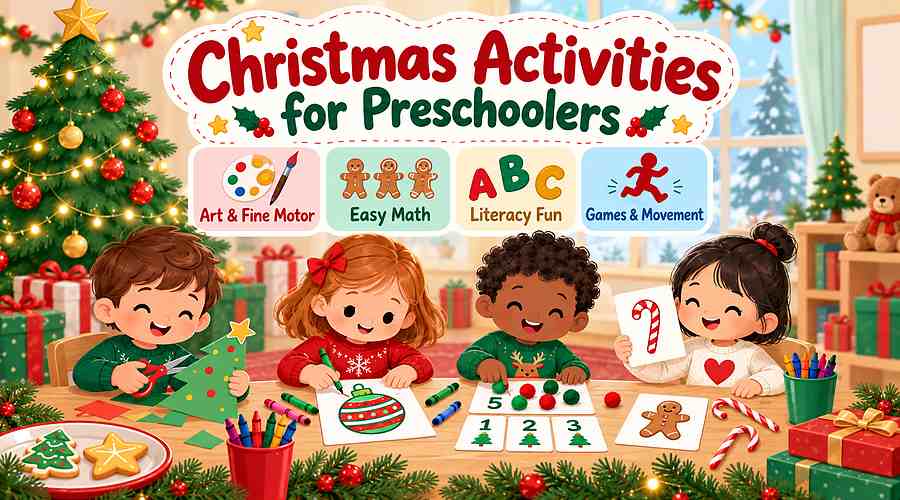
Quick Answer
The best Christmas activities for preschoolers are short, hands-on, easy to understand, and simple to adjust for the child in front of you. A useful week can include one art or fine-motor activity, one math idea, one literacy activity, one movement game, and one quiet printable—not all 20 activities at once.
Choose by energy level and time available. Ten focused minutes of counting presents, tearing paper for a collage, matching letters, or moving like a reindeer can be more useful than a complicated craft that needs constant adult rescue.
These preschool Christmas activities are written for both home and classroom use. Most use ordinary supplies, and each idea includes a clear skill focus plus an easier variation when a younger preschooler needs less complexity. The goal is playful practice, not a perfect finished product.
If you are choosing preschool activities for Christmas, start with the skill, time, and energy level you have today. Every idea below is explained on this page with a simple setup and a clear purpose, so you do not need to open a separate tutorial just to get started.
This approach is consistent with the National Association for the Education of Young Children’s emphasis on developmentally appropriate, strengths-based and play-based learning. Activities should fit the child’s interests, abilities, family context, and energy that day—not the other way around.[1]
How to Choose Christmas Activities for Preschoolers
Start with what your child or class needs right now. A busy group may need movement before table work; a tired child may do better with a quiet matching page or a simple collage.
| Need | Try | Time | Setup | Main skill |
|---|---|---|---|---|
| Quiet time | One printable page | 10 min | Very low | Tracing / matching |
| Fine motor | Sticker ornament tree | 10–15 min | Low | Finger control |
| Math | Count the presents | 10 min | Low | 1-to-1 counting |
| Literacy | Beginning sound sort | 10–15 min | Low | Sound awareness |
| Movement | Reindeer movement game | 5–10 min | None | Gross motor |
| Art | Torn-paper tree collage | 15 min | Low | Creative fine motor |
Christmas Art and Fine Motor Activities for Preschoolers
These Christmas art activities for preschoolers keep the process simple. The child gets meaningful practice with pinching, tearing, placing, gluing, stamping, or cutting while still making something that feels festive.
1. Sticker Ornament Christmas Tree
You need: a paper tree shape and large dot stickers.
What to do: Invite the child to peel and place “ornaments” anywhere on the tree. If they are ready for a small challenge, ask for a simple color pattern such as red-green-red-green.
Make it easier: peel the sticker sheet backing away so only the stickers remain. This makes the edge easier to lift.
2. Torn-Paper Christmas Tree Collage
You need: green paper scraps, a tree outline, and a glue stick.
What to do: Tear paper into pieces, then glue them inside or around the tree. There is no need to fill every gap. Tearing paper is the activity; the collage is the souvenir.
Try next: sort scraps into small and large pieces before gluing.
3. Decorate a Paper Ornament
You need: a large paper circle or ornament outline, crayons, markers, and optional stickers.
What to do: Let the child choose lines, dots, shapes, or colors. Adults can model one idea, then step back instead of trying to copy a finished sample.
4. Christmas Card Stamp Art
You need: folded cardstock, child-safe washable paint or ink, and a large stamp or sponge shape.
What to do: Make repeated prints, allow the card to dry, then let the child add a name or simple drawing inside. Keep the message short enough that the child still feels ownership of the card.
5. Cut-and-Build a Christmas Tree
You need: wide green paper strips, child-safe scissors, and glue.
What to do: Cut across short strips, then arrange the pieces from longest to shortest to make a tree. For beginners, draw one bold cutting line on each strip.
For more skill-building ideas without a holiday theme, see Cutting Activities for Preschoolers and Fine Motor Activities for Preschoolers.
Christmas Math Activities for Preschoolers
Preschool math works best when children can touch, move, compare, and count real objects or simple pictures. These Christmas math activities stay concrete and short.
6. Count the Presents 1–10
You need: 10 small paper “presents” or large blocks and number cards 1–10.
What to do: Choose a number, then move one present at a time while counting aloud. Touching or moving each object helps keep one spoken number connected to one object.
For age 3: start with 1–5. For ages 4–5: extend toward 10 when the child is comfortable.
7. Sort Christmas Ornaments
You need: large paper ornament shapes in two or three colors or sizes.
What to do: Sort by one attribute first—such as color—then ask whether the same pieces could be sorted a different way, such as size.
8. Make a Christmas Pattern Chain
You need: paper strips in two colors.
What to do: Lay out a simple AB pattern first. If that is easy, try AAB or ABB. The child can point to the next color before you turn the strips into a paper chain.
For more non-seasonal practice, visit Pattern Activities for Preschoolers.
9. More or Less Stocking Game
You need: two paper stockings and a set of large counters.
What to do: Put a small group of counters on each stocking and ask, “Which stocking has more?” Then change the groups and ask again. Count together when the answer is not obvious.
If counting is the main goal, use the ideas in Counting Activities for Preschoolers to extend the activity.
Christmas Literacy Activities for Preschoolers
For preschoolers, literacy practice can stay playful and oral. Names, picture talk, rhyming, beginning sounds, and letter matching are enough; there is no need to turn Christmas activities into long writing assignments.
10. Build Your Name with Ornament Letters
You need: one large paper ornament for each letter in the child’s name.
What to do: Write one letter on each ornament, mix them, and help the child rebuild the name from left to right. Keep a name card nearby if they need a model.
11. Christmas Beginning Sound Sort
You need: a few clear picture cards such as bell, gift, tree, star, mitten, and cookie.
What to do: Say each word slowly and notice its first sound. Sort only two beginning sounds at first. The goal is listening, not spelling the whole word.
12. Christmas Picture Story Sequence
You need: three simple pictures showing a sequence, such as wrap a gift → place it under a tree → open it.
What to do: Put the pictures in order and ask the child to tell what happens first, next, and last. Accept short answers and build on them with one follow-up question.
13. Uppercase and Lowercase Christmas Tree Match
You need: a few uppercase letters on paper trees and matching lowercase letters on paper ornaments.
What to do: Match only 4–6 letter pairs at a time. Add more pairs after the first set feels easy.
For a broader skill progression, see Letter Recognition Activities for Preschoolers.
Christmas Games and Movement Activities for Preschoolers
Movement is not a break from learning; it is part of a balanced preschool day. The CDC recommends that children ages 3–5 be physically active throughout the day through enjoyable activities.[2] These preschool Christmas games work well between quieter table activities.
14. Christmas Freeze Dance
You need: music and a safe open space.
What to do: Move while the music plays and freeze when it stops. Add simple prompts such as “freeze tall,” “freeze small,” or “freeze on one foot” for children who want more challenge.
15. Reindeer Movement Game
You need: only a clear movement space.
What to do: Call out actions such as tiptoe, stomp, jump, reach, crawl, or balance. Let children take turns choosing the next “reindeer move.”
16. Christmas Picture Scavenger Hunt
You need: 4–6 large holiday picture cards placed around one safe room.
What to do: Ask the child to find one picture at a time: “Can you find the star?” For a group, avoid racing; let children search together.
17. Deliver the Presents
You need: a few empty lightweight boxes and two baskets or floor spots.
What to do: Carry one “present” from the pickup spot to the delivery spot. Change the route by walking around a chair, stepping over a tape line, or moving slowly like a sneaky elf.
For more ideas that work year-round, see Movement Activities for Preschoolers.
Simple Christmas Sensory and Science Activities
Preschool science does not need a big experiment. A prediction, a safe test, and a short conversation about what changed are enough to create meaningful observation practice.
18. Jingle Bell Magnet Investigation
You need: one child-safe wand magnet and several large objects chosen by an adult. If you use a large bell, verify it is intact and too large to be a choking item.
What to do: Ask “Do you think the magnet will pick this up?” Make a prediction, test it, and sort objects into “magnet works” and “magnet does not work.”
Safety: never use loose small magnets for preschool exploration.
19. Melting Ice Christmas Rescue
You need: an ice block frozen around one or two large washable plastic objects, a shallow tray, warm water, and droppers or spoons.
What to do: Compare cold and warm water, drip water onto the ice, and watch how the ice changes. Ask simple questions: “What do you notice?” and “Where is the ice getting smaller?”
A Quiet Christmas Printable Activity
20. Pick One Page and Practice for 10 Minutes
Some days call for less setup. Choose one page from the free Christmas Preschool Worksheets & Activity Pack rather than trying to finish the whole pack at once.
Pick the page that matches today’s need: tracing for pencil control, counting for number practice, matching for visual attention, a pattern page for sequencing, or a cutting page for supervised scissor practice.
Keep it child-sized: stop after one successful page if attention is fading. The remaining pages will still be there tomorrow.
A Simple 5-Day Christmas Preschool Plan
You do not need a December curriculum overhaul. Pick one short activity per day and repeat favorites. A predictable rhythm reduces prep for adults and gives children a mix of skills.
Torn-paper tree or sticker ornaments
Count presents or build a pattern chain
Name ornaments or beginning sounds
Freeze dance or reindeer actions
One printable page + a favorite repeat
How to Adjust Christmas Activities for Ages 3–5
Age labels are only a starting point. Preschoolers develop at different rates, so adjust the number of pieces, amount of language, and level of adult help based on the individual child.
- For many 3-year-olds: use larger materials, one-step directions, counting 1–5, and simple AB patterns.
- For many 4–5-year-olds: try counting toward 10, beginning sounds, AB/AAB/ABB patterns, short sequences, and more independent matching.
- For a child who is frustrated: reduce the number of pieces or do the first example together.
- For a child who wants more: add one small challenge instead of making the entire activity longer.
Christmas Activity Safety Tips
- Use direct adult supervision for scissors, magnets, water activities, paint, and craft materials.
- Choose child-safe scissors and art materials intended for children; follow product labels and age guidance.
- Avoid loose small pieces for children who may still mouth objects, and keep small parts away from younger siblings.
- Use washable, age-appropriate supplies and stop an activity if materials break or create sharp edges.
- Keep movement paths clear of cords, furniture edges, and slippery craft materials.
The U.S. Consumer Product Safety Commission advises adults to follow age guidance for toys and keep small parts away from young children.[3] Its Art and Craft Safety Guide provides additional material-selection and supervision guidance for children’s art activities.[4]
If Your Classroom Celebrates Different Holidays
Not every child or family celebrates Christmas. In a classroom, check school policy and family context before making Christmas the default theme. Most of these activities can be adapted without changing the skill goal: use a winter tree instead of a Christmas tree, snowflakes instead of ornaments, winter colors instead of red and green, or a “winter surprise” instead of a present.
The learning goal can stay the same even when the theme changes. Counting, sorting, movement, letter matching, and fine motor practice do not depend on one holiday tradition.
Frequently Asked Questions
What are easy Christmas activities for preschoolers?
Good low-prep choices include sticker ornament trees, torn-paper collages, counting presents, simple pattern chains, Christmas freeze dance, picture scavenger hunts, and one-page printable activities. Choose one activity that fits the child’s current energy and attention.
What are good Christmas games for preschoolers?
Freeze dance, reindeer movement prompts, a cooperative picture scavenger hunt, and “deliver the presents” are easy Christmas games for preschoolers because the rules are simple and can be adjusted for a home or classroom space.
How can I make Christmas educational for a preschooler?
Use the holiday theme to practice skills already appropriate for preschool: count objects, copy simple patterns, sort by color or size, listen for beginning sounds, match letters, tell a short picture story, cut along bold lines, or move to simple action directions.
What Christmas activities need almost no prep?
Christmas freeze dance, reindeer movement actions, drawing or decorating a paper ornament, name-letter matching, and choosing one page from a printable pack all need very little setup.
What can preschoolers do for Christmas at home?
At home, keep it simple: make a card for someone, count pretend presents, build a paper pattern chain, play a movement game, decorate a paper ornament, or complete one short Christmas worksheet. Repeating a favorite activity is completely fine.
About This Guide
Nini Printables creates low-prep preschool and kindergarten resources built around clear instructions, focused practice, and simple setup. This guide uses the same approach: each activity has a practical preschool purpose, can be started with ordinary materials, and can be simplified when a child needs less complexity.
The developmental framing and safety notes were cross-checked against current guidance from NAEYC, the CDC, and the U.S. Consumer Product Safety Commission. This is general educational activity guidance, not a developmental assessment or medical recommendation.
Teaching & Safety References
- National Association for the Education of Young Children (NAEYC). Developmentally Appropriate Practice (DAP) Position Statement. 2020.
- Centers for Disease Control and Prevention (CDC). What You Can Do to Meet Physical Activity Recommendations. Preschool-age guidance.
- U.S. Consumer Product Safety Commission (CPSC). Toys: Safety Education Center.
- U.S. Consumer Product Safety Commission (CPSC). Art and Craft Safety Guide, Publication 5015.
Enjoying the free resources? Sharing this guide with another parent or teacher—or exploring another free printable—helps support Nini Printables.