
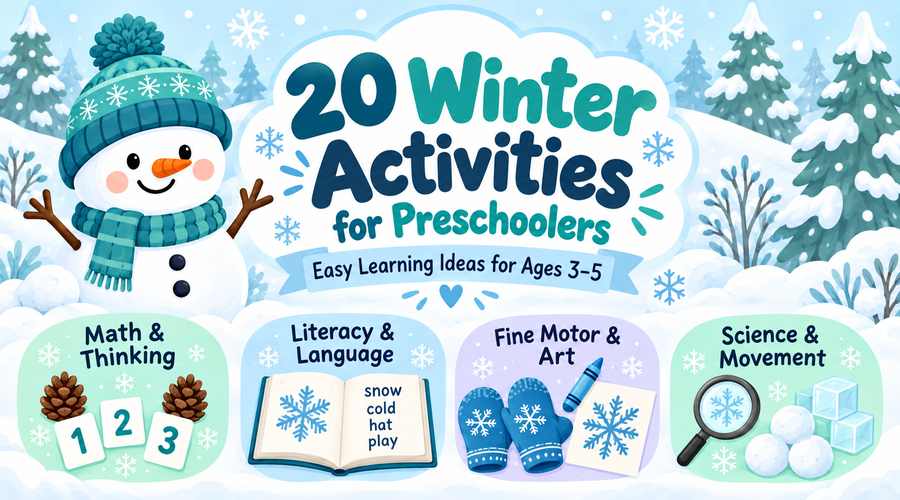
20 Winter Activities for Preschoolers: Easy Learning Ideas for Ages 3–5
Simple winter activities for preschoolers that mix math, literacy, fine motor practice, art, science, sensory play, movement, and a quiet printable option—without turning winter into a high-prep project.
Quick Answer
The best winter activities for preschoolers are simple, hands-on, and easy to adjust for ages 3–5. Try snowball counting, mitten matching, snowflake patterns, beginning-sound games, ice-melting experiments, winter movement games, and short printable activities. Most of the ideas below use ordinary home or classroom supplies, and real snow is optional.
Preschool winter activities work best when the learning goal stays small: count one group, notice one pattern, listen for one sound, test one idea, or move in one new way. NAEYC describes developmentally appropriate practice as strengths-based and play-based, with attention to each child’s individuality and context.[1] That is the approach used here—short activities, flexible expectations, and simple ways to make each idea easier. These preschool winter activities are meant to be chosen, not completed as a checklist.
Winter Activities for Preschoolers: Quick Picks
If you only have a few minutes, start with the need you have right now. These options keep setup and cleanup predictable.
| Need | Try | Prep |
|---|---|---|
| 5-minute activity | Snowball Counting | Low |
| Quiet time | Winter Preschool Worksheets | Print & go |
| Fine motor | Cotton Snowball Transfer | Low |
| Math | Snowflake Patterns | Low |
| Literacy | Winter Letter Hunt | Low |
| Science | Which Ice Cube Melts Faster? | Low |
| Movement | Indoor Snowball Toss | Low |
| Art | Design a Winter Hat | Low |
Easy Winter Math & Thinking Activities
Winter preschool activities can build early math without turning play into a worksheet lesson. Keep the numbers small, make the objects easy to touch or point to, and stop when the child has shown the skill.
1. Snowball Counting
You need: 10 crumpled white paper balls and a bowl or paper “snowbank.”
What to do: Put out 1–5 paper snowballs first. Touch or move each one while counting aloud, then ask the child to make a group with a number you name.
What children practice: one-to-one correspondence and number meaning.
Make it easier: stay with 1–3 objects. Try next: compare which of two groups has more.
2. Mitten Matching
You need: four pairs of paper mittens with simple matching patterns such as stripes, dots, zigzags, and snowflakes.
What to do: Mix the mittens and find each pair. Ask what detail helped the child decide.
What children practice: visual discrimination, matching, and descriptive language.
Make it easier: use only two pairs at a time.
3. Snowflake Patterns
You need: paper snowflakes in two colors or a mix of snowflakes and mitten shapes.
What to do: Build an AB pattern first, such as snowflake–mitten–snowflake–mitten. Pause and ask what comes next. If that is easy, try AAB or ABB.
What children practice: prediction, sequencing, and pattern recognition.
For more year-round ideas, see Pattern Activities for Preschoolers.
4. Big, Medium & Small Snowmen
You need: three copies of the same simple snowman picture in small, medium, and large sizes.
What to do: Mix the three pictures. Ask for the biggest, the smallest, then put them in order from smallest to biggest.
What children practice: size comparison and early math vocabulary.
Keep the comparison fair: use the same snowman design so size is the main thing that changes.
Winter Literacy & Language Activities for Preschoolers
Preschool literacy can stay oral and picture-based. Focus on listening, naming, sound awareness, storytelling, and the letters that matter most to the child rather than long writing tasks.
5. Winter Beginning Sounds
You need: clear pictures of a mitten, hat, boot, and snowman plus a few large letter cards.
What to do: Name one picture together and stretch the first sound: “mmm-mitten.” Offer two letter choices and ask which one matches the beginning sound.
What children practice: phonological awareness and letter-sound connections.
Make it easier: say the object name for the child; the goal is listening to the sound, not reading the whole word.
6. Winter Letter Hunt
You need: 5–8 paper letter cards placed around one room.
What to do: Ask the child to find one target letter at a time. Start with letters in the child’s name or letters they already partly recognize.
What children practice: visual letter recognition and attention.
For a broader progression, see Letter Recognition Activities for Preschoolers.
7. Build Your Name Snowman
You need: one large paper circle for each letter in the child’s first name.
What to do: Write one letter on each circle, mix them, then rebuild the name from top to bottom like a tall snowman. Keep a name card nearby if needed.
What children practice: name recognition, letter order, and visual sequencing.
Make it easier: place the first letter before the child starts.
8. Winter Picture Story
You need: three simple winter pictures, such as a snowman, sled, and mitten.
What to do: Let the child choose the order and tell a short story that uses all three pictures. Ask one follow-up question: “What happened next?” or “How did the mitten get there?”
What children practice: vocabulary, sequencing, imagination, and oral storytelling.
Keep it open: there is no single correct story.
Winter Fine Motor & Art Activities
Fine motor and art ideas are most useful when children can actually manipulate the materials. Use large pieces, short work periods, and process-focused art rather than expecting every child’s project to look the same.
9. Cotton Snowball Transfer
You need: cotton balls or large white pom-poms, two bowls, and a spoon or child-appropriate tongs.
What to do: Move the “snowballs” from one bowl to the other. Start with fingers or a spoon, then offer tongs if the child is ready.
What children practice: hand control, grasp, and coordination.
For more hand-strength ideas, visit Fine Motor Activities for Preschoolers.
10. Cut and Build a Snowman
You need: large paper circles, a hat, scarf, nose, and two simple arm pieces.
What to do: Cut around large bold shapes, then arrange and glue the pieces on another sheet. Let the child decide where the pieces go before gluing.
What children practice: bilateral coordination, scissor control, and spatial planning.
Use age-appropriate scissors and direct supervision. For more progression ideas, see Cutting Activities for Preschoolers.
11. Design a Winter Hat
You need: a large paper hat outline, crayons or washable markers, and optional stickers.
What to do: Let the child decorate the hat with lines, shapes, pictures, or a simple pattern. When finished, ask them to tell you about one design choice.
What children practice: drawing control, creativity, and expressive language.
Skip the model: a blank outline gives children more room to make their own decisions.
12. Tape-Resist Snowflake Art
You need: heavy paper, painter’s tape, washable paint, and a brush or sponge.
What to do: An adult places a few tape strips in a simple snowflake-like arrangement. The child paints over the paper. When the paint is dry, the adult removes the tape to reveal the light lines.
What children practice: mark-making, cause and effect, and creative choice.
Safety: use washable, child-appropriate art materials and supervise the activity.
Winter Science & Sensory Activities
For preschool science, keep the cycle simple: make a prediction, test it safely, and talk about what changed. The goal is observation and language, not memorizing scientific vocabulary.
13. Which Ice Cube Melts Faster?
You need: two similar ice cubes, two small dishes, and two locations with different temperatures, such as a warmer room spot and a cooler spot.
What to do: Ask which cube will melt faster, place the dishes, then check them after a few minutes. Compare what changed.
What children practice: prediction, observation, comparison, and descriptive language.
Keep it simple: one comparison is enough. Avoid hot surfaces or heating appliances.
14. Ice Color Mixing
You need: ice cubes made with lightly colored water, a shallow tray, and spoons or droppers.
What to do: Place two colors together and watch what happens as the ice melts. Ask, “What colors do you see now?” rather than requiring a specific answer before the child observes.
What children practice: observation, color language, and cause-and-effect thinking.
Safety: use washable coloring, supervise water play, and wipe spills promptly.
15. Snow-Free Winter Sensory Bin
You need: shredded white paper, cups, scoops, and a few large winter picture cards or large reusable objects.
What to do: Scoop, pour, hide, and find. Add simple prompts such as “Can you fill the cup halfway?” or “Can you find the mitten picture?”
What children practice: sensory exploration, fine motor control, vocabulary, and simple directions.
For more year-round setups, see Sensory Activities for Preschoolers.
Winter Movement Activities for Preschoolers
The CDC recommends that children ages 3–5 be physically active throughout the day, with adults encouraging active play.[2] These winter ideas give children a short movement break without needing outdoor snow.
16. Indoor Snowball Toss
You need: several crumpled paper balls and a laundry basket or large box.
What to do: Toss the paper snowballs into the target from a short distance. Move the starting line only after the first distance feels successful.
What children practice: aiming, coordination, and turn-taking.
Keep it safe: use soft paper only and keep the throwing area away from faces, breakables, and stairs.
17. Move Like a Winter Animal
You need: a clear movement space.
What to do: Try simple prompts such as “waddle like a penguin,” “hop like a rabbit,” “stomp slowly like a bear,” or “stretch tall like a deer.” Let the child invent one movement too.
What children practice: body control, listening, vocabulary, and imaginative movement.
Keep the science separate: use the animals as movement prompts, not as a complete lesson about how every species behaves in winter.
18. Follow the Snowy Path
You need: painter’s tape or paper strips arranged as a straight line, curve, and zigzag on a safe floor.
What to do: Walk each path slowly. Add simple directions such as tiptoe, take giant steps, or pause at the end.
What children practice: balance, motor planning, and following directions.
For more active ideas, visit Movement Activities for Preschoolers.
Quiet & Low-Prep Winter Activities
Not every winter activity needs paint, ice, or a full center setup. These two options work well when children need a calmer transition or an adult needs something that starts quickly.
19. Winter I Spy
You need: a homemade picture grid or a small group of winter pictures with repeated mittens, hats, boots, and snowflakes.
What to do: Ask the child to find and count one object type at a time. Keep the total small enough that the child can track what has already been counted.
What children practice: visual scanning, counting, and sustained attention.
Make it easier: point to the row or section where the child should search.
20. Choose One Winter Preschool Worksheet
Some days call for one focused page instead of another setup. The free Winter Preschool Worksheets & Activity Pack includes fourteen activity pages covering tracing, matching, counting, size comparison, positional words, patterns, shapes, beginning sounds, I Spy, a maze, cutting, classification, and open-ended drawing.
What to do: choose the page that matches today’s need, model one example if necessary, and stop after one successful page if attention is fading.
Better chosen, not more: preschoolers do not need to finish the whole pack in one sitting.
A Simple 5-Day Winter Preschool Plan
For teachers or families planning winter preschool activities, one or two short ideas per day is usually enough. This sample week reuses the activities above instead of adding more prep.
Snowball Counting + Mitten Matching
Beginning Sounds + Letter Hunt
Snowball Transfer + Winter Hat
Ice Melt + Snowy Path
Winter I Spy + one printable page
How to Adjust Winter Activities for Ages 3–5
Age labels are a starting point, not a performance target. NAEYC’s developmentally appropriate practice framework emphasizes the child’s individual strengths, experiences, and context.[1] Adjust the number of pieces, amount of language, and level of adult help rather than pushing through frustration.
- For many 3-year-olds: use larger pieces, one-step directions, counting 1–5, two choices, and short turns.
- For many 4-year-olds: add two-step directions, simple patterns, more independent matching, and short explanations.
- For many 5-year-olds: invite predictions, beginning sounds, more complex patterns, counting farther, and “How do you know?” questions.
- If a child is frustrated: reduce the choices or model the first example together.
- If a child wants more: add one small challenge instead of making the whole activity longer.
- If fine motor work is tiring: let the child point, answer verbally, or use larger tools before returning to pencil or scissor work.
What If You Don’t Have Snow?
You do not need real snow for a useful winter theme. Families and classrooms in warm climates can keep the same learning goals and swap in simple materials.
| Instead of | Use |
|---|---|
| Snowballs | Crumpled white paper |
| Loose snow | Shredded white paper |
| Outdoor ice | Ice cubes from the freezer |
| A snowy trail | Painter’s tape or paper strips |
| Building a snowman | Paper circles or playdough |
Simple Winter Activity Supplies
Most of these ideas work with materials you may already have. A short supply list is easier to reuse than buying a different kit for every activity.
- plain paper or cardstock
- crayons or washable markers
- washable paint
- child-appropriate scissors
- painter’s tape
- bowls, cups, spoons, or child-appropriate tongs
- ice cubes
- playdough or paper shapes
Optional, not required: reusable sleeves, a laminator, or specialty sensory fillers can be useful in some classrooms, but none is necessary for the core activities in this guide.
Winter Activity Safety Tips
- Use direct adult supervision for scissors, water, ice, paint, and small craft materials.
- Choose child-appropriate materials and follow product labels and age guidance.
- Keep small objects away from children who may still mouth materials and away from younger siblings.
- Wipe water and ice spills quickly so movement areas do not become slippery.
- Keep indoor movement paths clear of furniture edges, cords, and breakable objects.
The U.S. Consumer Product Safety Commission recommends following age guidance for children’s products and provides a dedicated Art and Craft Safety Guide for selecting and using art materials with children.[3]
Frequently Asked Questions
What are easy winter activities for preschoolers?
Easy winter activities for preschoolers include paper snowball counting, mitten matching, snowflake patterns, a winter letter hunt, paper snowman building, ice-melting observation, indoor snowball toss, Winter I Spy, and one-page printable activities. Choose one idea that matches the child’s current energy and skill level.
What winter activities can preschoolers do indoors?
Indoor options include paper snowball toss, winter picture stories, name snowmen, snowflake patterns, cotton-ball transfer, winter art, sensory bins, movement paths, I Spy, and printable worksheets. Real snow is not required.
What can preschoolers learn during a winter theme?
A winter theme can support counting, matching, size comparison, patterns, beginning sounds, vocabulary, fine motor control, observation, prediction, movement, and simple reasoning. The theme is the context; the skill should remain developmentally appropriate and manageable.
What if we do not have snow where we live?
Use paper snowballs, shredded white paper, freezer ice, painter’s-tape paths, paper snowmen, or winter picture cards. The learning goal does not depend on outdoor snow.
Are these winter activities suitable for 3-year-olds?
Many are, with simpler choices and more adult support. Use larger materials, one-step directions, counting 1–5, and shorter activity times. Let a child point or answer verbally when pencil or scissor work is not the best fit that day.
More Preschool Activities
Use the winter theme when it adds interest, then return to broader skill practice when a child wants more of the same kind of learning.
- Winter Preschool Worksheets & Activity Pack — the free print-and-go companion to this guide.
- Math Activities for Preschoolers — more counting, comparison, and early math ideas.
- Fine Motor Activities for Preschoolers — hand-strength and coordination ideas.
- Sensory Activities for Preschoolers — simple sensory setups beyond winter.
- Movement Activities for Preschoolers — easy gross motor play for home or classroom.
- Cutting Activities for Preschoolers — supervised scissor-skill progression.
- Pattern Activities for Preschoolers — AB, AAB, ABB, and other age-appropriate pattern practice.
About This Guide
Nini Printables creates low-prep preschool and kindergarten resources built around clear instructions, focused practice, and simple setup. This guide was planned alongside the Winter Preschool Worksheets & Activity Pack, so both resources use the same ages 3–5 scope, practical setup, and easier-or-harder adjustments. No claim is made that one activity fits every child; adults should adapt the task to the child and setting.
Before this version was finalized, the developmental framing and safety notes were checked against current guidance from the National Association for the Education of Young Children (NAEYC), the Centers for Disease Control and Prevention (CDC), and the U.S. Consumer Product Safety Commission (CPSC). This is general educational activity guidance, not a developmental assessment or medical recommendation, and the article does not claim classroom testing that has not been documented.
Teaching & Safety References
- National Association for the Education of Young Children (NAEYC). Developmentally Appropriate Practice (DAP) Position Statement. 2020.
- Centers for Disease Control and Prevention (CDC). Child Activity: An Overview. Guidance for children ages 3–5.
- U.S. Consumer Product Safety Commission (CPSC). Art and Craft Safety Guide.
Enjoying the free resources? Sharing this guide with another parent or teacher—or exploring another free printable—helps support Nini Printables.