
Social-Emotional Activities for Preschoolers: 15 Easy Ways to Build Feelings, Self-Regulation & Friendship Skills
Use these low-prep social-emotional activities for preschoolers to practice naming feelings, calming down, taking turns, showing empathy, solving small social problems, and joining play—at home or in the classroom.
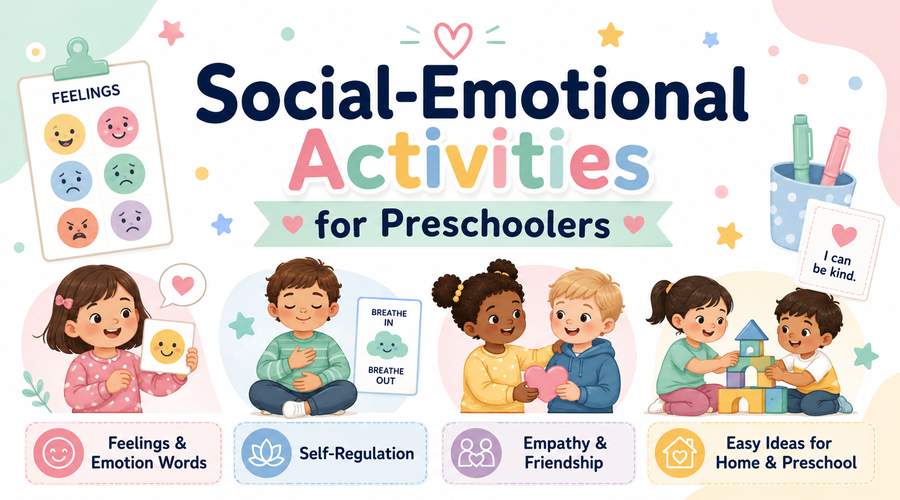
Quick answer: Start with the skill a child needs today. Use Feelings Detective or emotion matching for naming emotions, breathing or calm-down choices for self-regulation, puppet problems for problem solving, and short cooperative activities for turn-taking and friendship. Keep practice brief, model the language you want the child to use, and repeat familiar activities instead of constantly adding new ones.
These social-emotional activities for preschoolers are designed to feel like ordinary play, conversation, and routines—not a test. A child may know the word angry and still need adult help when the feeling becomes intense. Another child may play happily beside classmates but need practice asking, “Can I play too?”
That is why this guide is organized by real-life needs. You can choose one activity, use it for a few minutes, and come back to it later. Head Start describes early social-emotional learning as including friendship, understanding feelings, regulating strong emotions, and problem solving, while NAEYC also emphasizes intentionally supporting social-emotional skills in early learning. Head Start’s social-emotional learning guidance and NAEYC’s school-readiness guidance provide useful background for these goals.
What Are Social-Emotional Skills for Preschoolers?
For preschoolers, social-emotional skills are the everyday abilities children use to understand feelings, manage reactions with growing support, build relationships, and handle simple social situations. These skills develop gradually, and children of the same age can need very different levels of help.
- Emotion recognition: noticing and naming feelings such as happy, sad, angry, worried, excited, or frustrated.
- Self-regulation: beginning to pause, use words, ask for help, or try a calming strategy when feelings become strong.
- Empathy: noticing that another person may feel differently and thinking about what could help.
- Social skills: taking turns, cooperating, joining play, sharing space and materials, and solving small conflicts.
Head Start’s preschool self-regulation framework notes that children become more independent over time but may still look to adults for support during intense emotions. That is a useful expectation for these activities: you are practicing skills, not checking whether a child can manage every situation alone. See the Head Start preschool approaches-to-learning framework.
Choose a Social-Emotional Activity Based on the Skill
If you only have a few minutes, start here. Choose the need you are seeing rather than trying to complete all 15 activities.
| Child needs practice with… | Start with… | Why it fits |
|---|---|---|
| Naming feelings | Feelings Detective | Connects facial expressions with simple emotion words. |
| Understanding different reactions | Same Situation, Different Feelings | Shows that two people can feel differently about the same event. |
| Calming down | Breathing Buddy | Makes slow breathing concrete and easy to model. |
| Waiting or turn-taking | Pass-and-Add Story | Practices a very short wait before longer games. |
| Empathy | How Does the Character Feel? | Lets children discuss someone else before discussing themselves. |
| Solving a social problem | Puppet Problems | Makes conflict feel safer and easier to rehearse. |
| Joining play | “Can I Play?” Role Play | Practices exact words a child can use with peers. |
A 5-Minute Social-Emotional Learning Routine
You do not need a long SEL lesson. Use this quick routine when you want a repeatable structure for home, a small group, or a transition.
- Notice (1 minute): Name one face, body, or situation clue.
- Practice (2 minutes): Do one activity from this guide.
- Rehearse (1 minute): Practice one useful phrase such as “Can I have a turn when you’re done?” or “I need help.”
- Close (1 minute): Ask, “Which idea could we try next time?” and stop before the activity becomes tiring.
Repeating one familiar routine is usually more useful than introducing a new worksheet every day. Head Start emphasizes that children need many chances to learn and practice social-emotional skills with adult modeling and support.
Social-Emotional Feelings Activities for Preschoolers
These activities build emotion vocabulary without turning the lesson into a personal interview. The emphasis is on noticing clues, comparing possible feelings, and using simple language. For identity, family, favorites, and self-awareness themes, use the separate All About Me activities for preschoolers guide instead of repeating that search intent here.
1. Feelings Detective
You need: A picture book, family-safe photo, or simple emotion picture.
Look for three kinds of clues together: the face, the body, and what is happening. Ask, “What do you notice?” before asking for an emotion word. A child might notice tears, crossed arms, a smile, or someone moving away before they can name the feeling.
2. Emotion Matching Game
You need: Two copies of simple emotion pictures or homemade face cards.
Begin with two or three obvious pairs. Match identical faces first, then talk briefly about the feeling shown. Once that is easy, try matching a face to a simple situation, such as a broken block tower or a birthday surprise.
3. Emotion Charades
Choose one feeling and show it with your face and body without saying the word. Let the child guess, then trade roles. Keep the first round to familiar feelings before adding words such as frustrated, proud, nervous, or disappointed.
4. Same Situation, Different Feelings
Describe one neutral situation, such as “It starts raining during outdoor play” or “A new child joins the class.” Give two possible reactions: one child may feel excited while another may feel disappointed or unsure. Ask whether both feelings can make sense.
5. Feelings Sorting
Use a small set of picture cards and sort them into simple groups such as “comfortable feelings” and “uncomfortable feelings,” or sort by the named emotion. Emphasize that every feeling is allowed; the sorting is about recognizing the feeling, not labeling it as a “good” or “bad” child behavior.
Social-Emotional Self-Regulation Activities for Preschoolers
Self-regulation is not the same as expecting a preschooler to calm down instantly. The useful goal is to build a small set of strategies the child can practice with an adult and gradually use more independently.
6. Breathing Buddy
You need: A small stuffed animal.
Have the child lie down or sit comfortably and place the stuffed animal on their belly. Practice one slow breath in and one slow breath out while watching the “buddy” rise and fall. Two or three slow breaths are enough for practice.
7. Calm-Down Choice Cards
Create four to six simple choices such as take a breath, ask for help, squeeze playdough, sit in a quiet spot, get a drink, or hug a stuffed animal. When a child is ready, offer two choices rather than asking an open-ended “What do you need?”
Want a quiet follow-up after hands-on practice?
Use a printable only when it gives the child a useful next step—such as matching, sorting, tracing, or another short skill practice. Nini Printables is designed for low-prep preschool and kindergarten learning at home or in the classroom.
8. Body Clues Check-In
During a calm moment, notice one or two body clues together: hands tight or loose, shoulders lifted or relaxed, breathing fast or slow. Then connect the clue to a simple action such as taking a breath, asking for help, stretching, or getting a quiet minute.
Social-Emotional Friendship Activities for Preschoolers
These activities move from understanding feelings toward using social skills with other people. Keep the scripts short enough that a child can actually remember and reuse them during play.
9. How Does the Character Feel?
Pause once or twice during a familiar picture book and ask, “How might this character feel?” Then ask, “What makes you think that?” Use the picture, the character’s actions, or the story event as clues.
10. Puppet Problem Solving
Act out one tiny problem with two puppets: both want the same toy, one knocks down a tower, or one wants to join a game. Ask the child for one idea that could help, then let the puppets try it.
11. Build Something Together
Give two children one shared building goal: make a road, build a home for a toy animal, or create the tallest stable tower they can. Keep the project short and make sure there are enough materials to reduce unnecessary competition.
12. Pass-and-Add Story
Start a very short pretend story with one sentence, then pass the turn: “A tiny bear found a red box.” The next person adds one sentence, and you continue for only three or four turns. For younger preschoolers, offer a choice such as “Did the bear open it or carry it home?”
13. Kindness Hunt
Choose one kind action to notice during the day, such as helping, inviting, comforting, sharing, or waiting. When you see it, describe exactly what happened: “You moved over so there was space for Mia.”
14. Friendship Art
Tape one large sheet of paper to the table and invite two children to make one picture together. Give a simple shared prompt such as “Make a playground” or “Draw a garden.” The goal is not a perfect picture; it is practicing how to share space, materials, and ideas.
15. “Can I Play?” Role Play
Act out a simple scene in which one person is already playing. Practice one phrase at a time: “Can I play too?” “What are you building?” or “Can I help?” Then switch roles so the child practices both joining and responding.
Optional Supplies for Repeating These Activities
You do not need a special SEL kit. If you already have these items, they can make several activities easier to repeat. If you later add approved affiliate links, link only the item actually discussed and keep the recommendation secondary to the activity.
- Simple emotion picture cards
- Simple hand puppets or stuffed animals
- Playdough or modeling dough
- Blocks or large building pieces
- Picture books with clear facial expressions and everyday social situations
- Reusable sleeves or laminating supplies for frequently used visual cards
For a reusable hands-on material, see our preschool playdough activities for simple ways to use dough without turning this SEL article into a product list.
Social-Emotional Activities for Age 3 vs. Ages 4–5
Age can help you choose a starting point, but it should not become a scorecard. Language, temperament, prior experience, culture, and the situation all affect how a child participates.
| Starting point | Around age 3 | Ages 4–5 |
|---|---|---|
| Feelings | Name a few familiar feelings; point or choose between two pictures. | Add reasons for feelings and more precise words such as frustrated, nervous, or proud. |
| Turn-taking | Use very short back-and-forth turns with adult support. | Try slightly longer games and cooperative projects. |
| Problem solving | Offer two possible solutions and let the child choose. | Ask for one or two ideas before offering adult suggestions. |
| Empathy | Notice obvious emotions in faces and stories. | Discuss what another person may need or how two people can feel differently. |
How to Use Social-Emotional Activities at Home or Preschool
The same activity can work in different settings when you change the group size and amount of waiting.
| Activity | Best setting | Prep |
|---|---|---|
| Feelings Detective | Home, one-to-one, small group | About 2 minutes |
| Emotion Charades | Home, small group, circle time | None |
| Puppet Problems | Home, small group, circle time | About 3 minutes |
| Pass-and-Add Story | Home, partner activity, small group | 1–2 minutes |
| Cooperative Build | Home, centers, small group | About 1 minute |
For classroom planning, you can pair one of these activities with the routines in our small-group activities for preschoolers guide. If you are working on classroom transitions and comfort during the first weeks of school, the first day of preschool activities guide focuses on calm routines and easy ways to join.
Social-Emotional Activities When a Child Does Not Want to Talk
Do not turn a feelings activity into an interview. Some children talk readily about emotions; others communicate more comfortably through pictures, play, movement, or by talking about someone else.
- Let the child point to a picture instead of saying the word.
- Offer two choices instead of an open-ended question.
- Use a puppet to “answer” first.
- Talk about a book character instead of asking about the child.
- Model your own simple feeling statement without demanding a response.
- Allow the child to watch before joining a group activity.
For some children, participation increases when the activity is predictable and low pressure. NAEYC discusses predictable routines, adult regulation, and concrete strategies such as breathing, playdough, and body check-ins as ways adults can support children’s emotional regulation. See NAEYC’s guidance on helping children understand and manage emotions.
When Do Social-Emotional Printables Actually Help?
Hands-on interaction should do most of the teaching in social-emotional activities for preschoolers. A printable becomes useful when it makes one skill easier to see, repeat, or revisit.
- Emotion matching: pair identical expressions or match feelings to situations.
- Sorting: group pictures by emotion or by a simple social choice.
- Visual choices: show a small set of calm-down strategies.
- Scenario cards: discuss one short social problem at a time.
- Small-group review: reuse the same visuals so children become familiar with the language.
- Quiet follow-up: use one short page after the hands-on activity—not a long worksheet session.
Some skills are better practiced without a worksheet. Taking turns, joining play, listening to a friend, and solving a real disagreement need interaction. If a printable does not add a useful next step, skip it.
Choose the next activity by the skill you noticed
If emotion matching is hard, start with basic matching practice. If strong feelings show up during fine-motor work or transitions, choose a short sensory or playdough break before asking for more table work.
More Preschool Activities to Build Related Skills
Social-emotional learning overlaps with language, movement, play, and classroom routines. Use these guides when you want to go deeper without making this article repeat those topics:
- All About Me activities for preschoolers — identity, feelings, names, favorites, and belonging.
- Small-group activities for preschoolers — short teacher-led or caregiver-led group ideas.
- Matching activities for preschoolers — visual matching progression before emotion-picture matching.
- Preschool playdough activities — hands-on fine-motor and creative play.
- Sensory activities for preschoolers — simple sensory play ideas.
- Kindergarten readiness activities — broader school-readiness practice across multiple skill areas.
Social-Emotional Activities for Preschoolers: FAQ
What are examples of social-emotional activities for preschoolers?
Good examples include Feelings Detective, emotion matching, emotion charades, breathing with a stuffed animal, calm-down choice cards, puppet problem solving, cooperative building, a pass-and-add story, kindness hunts, and role play for joining play.
What social-emotional skills should preschoolers practice?
Useful areas include recognizing and naming feelings, communicating needs, trying simple calming strategies, noticing other people’s feelings, taking turns, cooperating, joining play, and solving small social problems with adult support.
How do you teach a preschooler to identify emotions?
Start with a few familiar emotion words and connect them to clear facial expressions, pictures, book characters, and everyday situations. Let the child point or choose before expecting a spoken explanation, then add more precise feeling words gradually.
What activities help preschoolers with self-regulation?
Short activities such as breathing with a stuffed animal, choosing from two calm-down options, squeezing playdough, practicing a predictable quiet routine, and naming what the body feels like can help children build strategies they can use with adult support.
How can I teach sharing and taking turns?
Start with very short back-and-forth games where the wait is only a few seconds. Narrate “my turn” and “your turn,” then slowly increase the waiting time. For shared materials, give children a simple script such as “Can I have a turn when you’re done?”
Need something simple for your next preschool activity?
Browse the free printable library for low-prep matching, tracing, counting, pre-writing, shapes, and fine-motor practice. If this guide helped, sharing it with another parent, teacher, or homeschool family is a simple way to support Nini Printables while keeping the resources easy to discover.
About This Guide
Nini Printables creates low-prep preschool and kindergarten resources for families, teachers, homeschoolers, and caregivers. This guide was organized around common reader needs—naming feelings, regulation, empathy, turn-taking, problem solving, and joining play—and checked against current Head Start and NAEYC early-childhood guidance. Activities were selected for short setup, repeatability, and easy adaptation to home or small-group use. It is educational support, not a developmental assessment, behavioral treatment plan, or medical advice.
Editorial Method
We avoid presenting age expectations as pass/fail milestones and do not claim that a single activity will “fix” behavior. Where a factual developmental point is used, the article links to an official early-childhood source.