
First Day of Preschool Activities: 15 Calm, Low-Prep Ideas for Ages 3–5
Plan a welcoming first day with simple activities that help preschoolers learn names, explore the room, practice routines, move their bodies, and leave feeling successful.
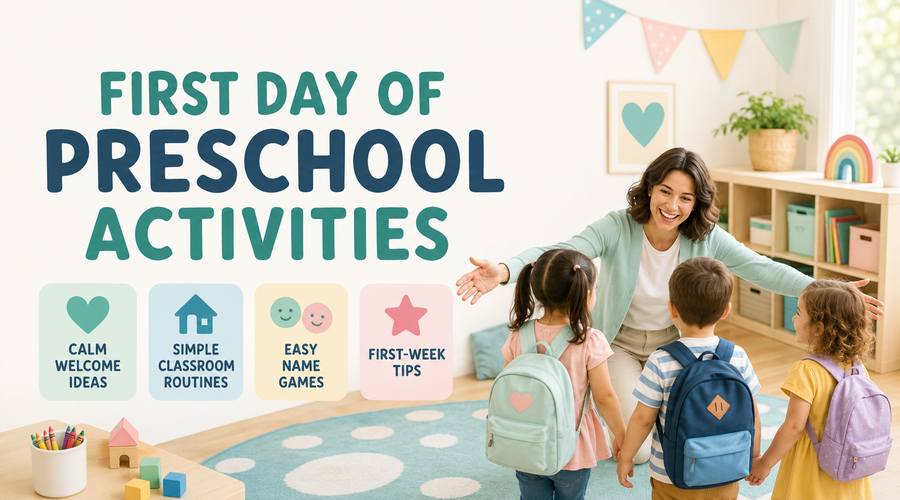
The best first day of preschool activities are short, predictable, and easy to join. Start with a calm table invitation, learn names, tour the classroom, practice one or two routines, add movement and play, then end with a consistent goodbye. The goal is not to fit in a full academic day; it is to help children feel safe enough to participate and return with confidence.
A preschool classroom can feel exciting and unfamiliar at the same time. On the first day, some children will jump into play, while others may watch quietly, stay close to an adult, or need extra time before joining. A flexible plan makes room for all of those responses.
For that reason, these first day of preschool activities focus on low-prep ideas with a clear purpose. Each one supports connection, classroom familiarity, communication, movement, or independence. You can use the full schedule or choose only the activities that fit your group.
What Should Preschoolers Do on the First Day?
A strong first day is less about completing a long activity list and more about helping children understand what this new place feels like. Predictable routines can make classroom transitions easier, while caring relationships help children build trust. Head Start guidance on schedules and routines emphasizes predictability, while NAEYC guidance on home-to-school transitions highlights teacher-family collaboration and consistent transition strategies.
Instead of measuring success by how many projects the class finishes, use these six priorities:
- Feel welcomed and emotionally safe.
- Learn a few names and friendly faces.
- Explore important classroom spaces.
- Practice one or two simple routines.
- Complete an activity with a sense of success.
- Know what happens when the day ends.
That approach also leaves space for individual differences. A child who watches a name game today may join it tomorrow. Observation can still be part of learning.
A Simple First-Day Preschool Schedule
You do not need a minute-by-minute script. However, a simple sequence helps adults stay consistent and reduces unnecessary transitions. Keep the first day familiar, flexible, and easy to repeat.
| Part of the Day | First-Day Focus | Simple Activity |
|---|---|---|
| Arrival | Settle in | Welcome table drawing |
| Morning circle | Names and connection | Hello name song |
| Classroom tour | Learn the space | Picture scavenger hunt |
| Centers | Explore materials | Playdough, blocks, or matching |
| Movement | Release energy | Follow-the-teacher game |
| Snack | Practice routine | Wash, sit, eat, clean up |
| Story | Calm and reconnect | Short first-day read-aloud |
| Closing | Predictability | Goodbye circle |
If your program has longer blocks, repeat familiar choices rather than adding many new ones. For example, children can revisit blocks or playdough after the classroom tour instead of learning another center immediately.
15 First Day of Preschool Activities That Keep the Day Calm
These activities for the first day of preschool work best when directions are brief and participation stays flexible. Most require materials you already have.
1. Welcome Table Drawing
Place paper and a small set of washable crayons or markers on a table near arrival. Invite children to draw anything they like while adults greet families.
This open-ended activity gives children something familiar to do without requiring conversation or a complicated direction.
2. Name Sticker Match
Prepare a name card for each child and a matching sticker or photo label. Help children find their name, then place the matching sticker on a cubby, attendance board, or folder.
For children who are ready to notice letters, point out the first letter without turning the activity into a test. You can continue that skill later with these letter recognition activities for preschoolers.
3. Hello Name Song
Use one short tune and repeat it for each child: greet the child by name, add one simple action such as waving, and let the group copy the action.
Children who do not want to sing can wave, watch, or sit nearby. Because the pattern repeats, the activity becomes easier to predict after only a few turns.
4. Classroom Picture Scavenger Hunt
Show simple picture clues for the bathroom, cubbies, books, blocks, art area, and meeting space. Walk together and find each location.
Keep the goal practical: children are learning where important things are, not racing to finish. This is also a natural time to demonstrate where materials go when play ends.
5. Meet-the-Teacher Guessing Game
Place three familiar objects in a bag, such as a favorite picture book, a paintbrush, and a toy animal. Pull out one object at a time and share one short fact about yourself.
Then invite children to choose which object they like best. This creates connection without asking every child to speak in front of the group.
6. First-Day Self-Portrait
Provide paper, crayons, and a mirror. Invite children to draw themselves as they look today. Avoid correcting proportions or asking the picture to look realistic.
Save the drawing and repeat the activity later in the year. If you want to build on the idea, try these All About Me activities for preschoolers.
7. Favorite Things Choice Circle
Offer simple either-or choices: blocks or playdough, apples or bananas, cats or dogs, red or blue. Children can answer by pointing, moving to a side, or holding up a picture.
Because there is no single correct answer, the activity helps children learn about classmates without adding academic pressure.
8. Practice One Classroom Routine
Choose one routine the class will use every day. For example: find your cubby, put away your item, and walk to the meeting rug.
Model the routine, let two or three children try it, and then repeat it naturally later. Teaching one useful sequence is usually more manageable than presenting a long list of rules at once.
9. Follow-the-Teacher Movement Game
Invite children to walk, tiptoe, stretch, march, or reach while following the teacher around a safe open space. Finish with slower movements before returning to the next activity.
For more gross-motor ideas after the first week, see these movement activities for preschoolers.
10. Simple Playdough Invitation
Set out one color of playdough per tray with a roller and a few large cutters. Let children squeeze, roll, flatten, or simply explore.
A familiar sensory material can provide a quiet center choice. If you need a classroom batch, use this playdough recipe for preschool.
11. Short First-Day Read-Aloud
Choose a picture book with clear illustrations and a short story about school, friendship, feelings, or a new experience. Pause only when a comment helps children connect the story to the classroom.
Keep the first read-aloud brief. If the group is restless, it is fine to stop early and return to the book later.
12. Build Our Classroom Together
Put out blocks and invite children to build something the class might need: a tiny school, a playground, a table, or a home for toy animals.
Adults can narrate cooperative actions—“You found a long block,” or “You both made room”—without requiring children to work as a team before they are ready.
13. Friendship Ball Roll
Sit in a loose circle and gently roll a soft ball to one child. Say that child’s name, then help them roll it to someone else.
Use a small group if the full class is too large. A short round is enough; the goal is name familiarity and turn-taking, not perfect participation.
14. First-Day Drawing Keepsake
Ask children to draw one thing they noticed at preschool. Younger children may make marks or choose a sticker instead.
Write the child’s words underneath when appropriate. Families get a meaningful first-day artifact, while children practice recalling part of the experience.
15. Predictable Goodbye Circle
End with the same short sequence you can reuse tomorrow: one goodbye song, one preview of what will happen next time, and a clear dismissal routine.
For example, remind children that the blocks, books, and meeting rug will still be there tomorrow. Predictability helps turn an unfamiliar first day into the beginning of a routine.
First Day of Preschool Activities for 3-Year-Olds vs. 4-Year-Olds
Age can help you adjust an activity, but it should not become a rigid checklist. Children enter preschool with different experiences, language skills, comfort levels, and independence. Start with what the child can do in the classroom today.
| For Many 3-Year-Olds | For Many 4-Year-Olds |
|---|---|
| Use one-step directions first. | Try simple two-step directions when appropriate. |
| Keep group time especially short. | Extend group time only while engagement stays strong. |
| Accept more side-by-side or parallel play. | Offer more partner choices without forcing teamwork. |
| Model how to use and put away materials. | Invite more independent material choices. |
| Offer fewer choices at one time. | Add choices as children show they can manage them. |
In other words, the same activity can work for both ages. Change the number of steps, the amount of teacher support, or the length of participation rather than replacing the whole lesson.
What Not to Do on the First Day of Preschool
A first-day plan can become harder than it needs to be when adults try to introduce every expectation at once. Instead, remove unnecessary complexity.
- Avoid too many worksheets. Children first need to understand the people, space, and routine.
- Avoid long circle times. A short successful gathering is more useful than a long one that becomes frustrating.
- Avoid complicated crafts. Multi-step projects can wait until children know where tools are and how cleanup works.
- Avoid teaching every rule in one talk. Model expectations when they become relevant.
- Avoid too many transitions. Longer periods of simple play can make the day feel more manageable.
- Avoid forcing participation. Watching from nearby can be a reasonable first step for a hesitant child.
Head Start’s classroom-transition guidance recommends planning the daily schedule to minimize unnecessary transitions, especially transitions that require every child to move at the same time. That principle is especially useful on day one, when almost everything is new.
What If a Child Cries or Does Not Want to Join?
Some children separate quickly; others need a slower transition. If a child cries, stays near the door, or refuses an activity, keep the response calm and predictable. A familiar goodbye routine between family and school can help, and NAEYC recommends teacher-family collaboration when choosing and adjusting home-to-school transition strategies.
Try this simple sequence:
- Greet the child by name and acknowledge the feeling without a long discussion.
- Keep the family goodbye brief and consistent whenever possible.
- Offer one easy choice, such as drawing or sitting near the playdough table.
- Allow the child to watch without requiring immediate participation.
- Keep the classroom routine moving so the child can see what comes next.
- Share useful observations with the family at pickup and adjust together.
HealthyChildren.org from the American Academy of Pediatrics also recommends a quick, consistent goodbye ritual for separation anxiety. However, persistent distress deserves individual attention from the family and the child’s school rather than a one-size-fits-all classroom trick.
Easy First-Week Preschool Activities
Once the first day is over, keep using familiar routines while adding one new focus at a time. The best first week of preschool activities build on what children already learned instead of replacing the routine with a completely new plan each day.
Repetition is useful here. Children do not need five completely different themed days. Instead, keep a familiar base and make one small addition when the group is ready. For more simple choices, revisit the All About Me activities or the preschool movement activities already on Nini Printables.
Optional Supplies for the First Day
Use what you already have first. A successful first day does not require a shopping list. If you are preparing a classroom, the most useful basics are washable crayons or markers, paper, name labels, playdough, a soft ball, blocks, and one or two picture books.
Choose washable, easy-to-share materials that children can use with minimal adult help. You do not need matching sets or specialty tools; fewer familiar supplies usually make setup, sharing, and cleanup easier on the first day.
Free Printables for the First Days of Preschool
Printable activities work best after children know a few basic routines: where to sit, how to choose materials, and where finished work goes. Start with simple pages that do not require long directions.
For example, a child can trace a broad path, match familiar pictures, or count a small set after settling into a center. Those tasks give teachers an easy activity to revisit while supporting early skills.
Frequently Asked Questions
What should I do on the first day of preschool?
Focus on welcoming children, learning names, exploring the classroom, practicing one or two routines, offering simple play, and ending with a predictable goodbye. Keep directions short and leave room for children who prefer to watch before joining.
What are good first day of preschool activities for 3-year-olds?
Good choices include drawing, simple playdough, a very short name song, a classroom tour, blocks, a soft-ball roll, and a brief story. Use one-step directions, fewer materials, and plenty of adult modeling.
What are good first day of preschool activities for 4-year-olds?
Four-year-olds can use the same basic activities with slightly more independence. Try a picture scavenger hunt, self-portrait, simple two-step routine, partner choice, building challenge, or short class-memory drawing.
How long should preschool activities last on the first day?
There is no single correct length. Watch the group instead of the clock. Short activities are often easier on the first day, and open-ended centers can continue longer when children are engaged.
What should teachers teach first in preschool?
Begin with the classroom itself: where belongings go, how children move between spaces, how materials are used, and what happens during arrival, cleanup, snack, and goodbye. Academic skills can be woven in gradually.
What if a preschooler does not want to participate?
Offer one low-pressure choice and allow observation. Keep the routine predictable, avoid forcing public participation, and work with the family when a child needs a more individualized transition plan.
What are easy no-prep first day preschool activities?
Try a hello song, follow-the-teacher movements, a classroom walk, favorite-things choices, block building, drawing, or a goodbye circle. These activities use common classroom materials and need little setup.
About This Guide
This guide is designed as practical planning support for preschool and Pre-K classrooms, homeschool settings, and caregivers working with young children. It is not a developmental checklist, and it does not assume that every 3- or 4-year-old should respond in the same way. The recommendations emphasize simple routines, flexible participation, developmentally appropriate expectations, and a calm first-day experience.
Learn more about the purpose and approach behind the site on the About Nini Printables page.
Teaching References
- Tours, S. B., & Dennis, L. R. (2015). Easing First Day Jitters: Strategies for Successful Home-to-School Transitions. National Association for the Education of Young Children (NAEYC).
- HeadStart.gov. Classroom Transitions. Guidance on planning transitions and reducing unnecessary whole-group transitions.
- HeadStart.gov. Schedules and Routines. Guidance on creating classroom schedules and routines children can learn to follow.
- HealthyChildren.org, American Academy of Pediatrics. (Updated 2026). How to Ease Your Child’s Separation Anxiety. Guidance on brief, consistent goodbye routines.