
25 Fall Activities for Preschoolers: Easy Learning Ideas for Ages 3–5
Turn leaves, apples, pumpkins, movement, and simple household supplies into low-prep fall learning. These fall activities for preschoolers are organized by skill so you can quickly choose an idea that fits your child, classroom, or homeschool day.
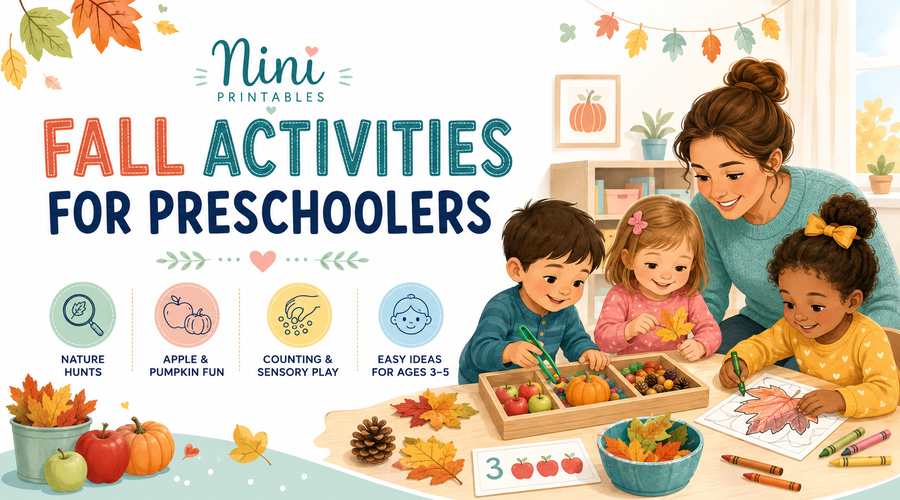
Fall gives young children plenty to notice without requiring an elaborate theme setup. A handful of leaves can become a sorting activity, a pumpkin can become a science investigation, and a walk outside can turn into a color, movement, or vocabulary game.
This guide is designed for parents, preschool teachers, homeschool families, and caregivers who want preschool fall activities that are simple enough to use now. Each idea includes a skill focus and an easy way to adapt it. You do not need to complete all 25 activities; pick the ones that match the materials, time, and interests you already have.
How to Choose Fall Activities for Preschoolers
Start with the kind of experience you need today. A two-minute setup can be just as useful as a longer project when the activity gives the child something clear to notice, count, compare, move, or describe.
| Activity | Main skill | Materials | Prep | Setting |
|---|---|---|---|---|
| Leaf sorting | Math + observation | Leaves | Very low | Both |
| Apple counting | Counting | Apples or counters | Low | Indoor |
| Pumpkin investigation | Science language | One pumpkin | Low | Both |
| Leaf rubbing | Fine motor + art | Leaves, paper, crayons | Low | Indoor |
| Nature hunt | Observation + vocabulary | None required | None | Outdoor |
What Can Preschoolers Learn From Fall Activities?
Seasonal materials can support several preschool skills because they give children something concrete to handle and talk about. NAEYC defines developmentally appropriate practice around strengths-based, play-based, joyful and engaged learning.[1] Its principles also identify play as a context for language, cognitive, social, and content learning.[2] Head Start describes nature-based learning as using the world around children to support exploration across learning domains.[3]
- Count small groups and compare quantities
- Sort by color, size, texture, or type
- Build fall vocabulary through conversation
- Practice hand control through pinching, rubbing, rolling, and transferring
- Notice patterns and changes in the natural world
- Use simple prediction and observation language
- Follow one- and two-step directions
- Move, balance, reach, toss, and pretend
Keep the teaching language short. Questions such as “What do you notice?”, “Which one is bigger?”, “How many do you have?”, and “What changed?” often create more useful interaction than a long explanation.
Nature & Discovery Fall Activities
These ideas use the season itself as the activity. Head Start’s nature-based learning guidance supports direct outdoor exploration,[3] and its “Nature Walk and Roll” activity specifically encourages children to notice colors, textures, smells, and sounds while following their interests outdoors.[4]
Go on a Fall Nature Hunt
You need: Nothing, or a small basket for safe found objects.
Look for two or three simple categories such as red leaves, brown leaves, something rough, and something smooth. Let the child point, collect where permitted, or simply describe what they see.
Builds: Observation, vocabulary, matching, attention.
Sort Leaves by Color and Size
You need: A small group of dry leaves.
First sort by one feature, such as color. Mix the leaves again and sort by another feature, such as big and small. Ask the child to explain where one leaf belongs.
Builds: Classification, comparing, math language.
Compare Pinecones, Acorns, and Leaves
You need: Safe, clean natural objects collected with adult supervision.
Place two or three types of objects on a tray. Compare texture, weight, shape, and size. Keep small objects away from children who still mouth materials.
Builds: Descriptive language, comparing, sensory observation.
Make a Small Fall Nature Table
You need: A tray or shallow basket and a few safe seasonal objects.
Set out a changing collection of leaves, seed pods, photos, or other safe local materials. Revisit it for a few minutes each day and ask what is new, missing, softer, drier, or different.
Builds: Observation over time, memory, conversation.
Apple & Pumpkin Learning Ideas
Apples and pumpkins are familiar fall materials that can support tasting, counting, comparing, and simple investigation. If you are planning a larger apple or pumpkin theme, use the focused guides linked below for more ideas.
Try an Apple Taste Test
You need: Two or three apple varieties cut by an adult.
Taste one small piece at a time and describe it with simple words such as sweet, tart, crisp, soft, red, green, or yellow. Ask the child to choose a favorite and explain why.
Builds: Vocabulary, comparing, expressing preferences.
Count Apples or Apple Counters
You need: Small apples, paper apple shapes, or safe counters.
Start with a small group. Ask the child to touch or move one item for each number word, then ask, “How many are there altogether?”
Builds: One-to-one counting, cardinality, number language.
Investigate a Pumpkin
You need: One pumpkin.
Before cutting it, notice the color, stem, lines, size, and weight. Ask what the child thinks may be inside. If an adult opens the pumpkin later, compare the prediction with what the child observes.
Builds: Prediction, observation, science vocabulary.
Compare Pumpkin Sizes
You need: Two or more pumpkins or pumpkin pictures.
Order them from smallest to largest. Use words such as heavier, lighter, taller, shorter, wider, and narrower without requiring exact measurement.
Builds: Comparing, ordering, measurement language.
Want a full theme? Continue with apple activities for preschoolers or pumpkin activities for preschool instead of squeezing every apple or pumpkin idea into one fall lesson.
Fall Counting & Early Math Activities
Use fall objects to practise skills children are already developing. The seasonal theme should make the activity inviting; it does not need to introduce several new math ideas at once.
Count a Small Group of Leaves
Place three to five leaves in a row. Ask the child to touch each leaf once while counting. Increase the group only when the smaller set feels steady.
Builds: Accurate object counting.
Build a Leaf Pattern
Use two leaf colors or two paper shapes to make an AB pattern such as red-yellow-red-yellow. Pause and ask what should come next.
Builds: Pattern recognition, prediction.
Sort Fall Objects Into Groups
Sort by object type, color, or size. For an extra challenge, ask the child to invent the sorting rule and explain it.
Builds: Classification, flexible thinking.
Match Pumpkin Numbers to Quantities
Write numerals on paper pumpkin shapes and match each numeral with a small set of counters. Keep the number range within what the child can count accurately.
Builds: Numeral recognition, quantity matching.
For deeper skill practice, use counting activities for preschoolers, number recognition activities, or the broader preschool math activities guide.
Need a quiet activity between fall projects?
Use one short printable page for counting, tracing, matching, shapes, or pre-writing when you want a calm table activity without adding another craft setup.
Fine Motor & Sensory Fall Play
These activities add pinching, squeezing, transferring, and tactile exploration. Always choose materials that are appropriate for the individual child and supervise small loose parts closely.
Set Up a Fall Playdough Tray
You need: Playdough plus a few safe tools such as a roller, large leaf cutter, craft stick, or plastic child tool.
Roll, pinch, press, and make simple leaf or pumpkin shapes. Keep the tray small enough that the tools support play rather than overwhelm it.
Builds: Hand strength, finger control, pretend play.
Transfer Large Fall Objects With Tongs
Move large pom-poms, fabric leaves, or other safe manipulatives from one bowl to another with child-sized tongs. Avoid small choking hazards for children who still mouth objects.
Builds: Grip, hand-eye coordination, controlled release.
Try Simple Leaf Lacing
Use a sturdy paper or laminated leaf with large punched holes and a thick lace. Thread around the edge without requiring a perfect pattern.
Builds: Bilateral coordination, visual-motor control.
Make a Low-Mess Fall Sensory Bin
Choose one familiar filler and add a few large fall-themed objects for scooping, sorting, and pretend play. Keep the goal simple and select materials that fit your setting and supervision level.
Builds: Sensory exploration, scooping, sorting, language.
More skill-specific ideas are available in fine motor activities for preschoolers, preschool playdough activities, and sensory activities for preschoolers.
Simple Creative Fall Projects
Keep art open enough for children to make choices. These three ideas support the broader fall theme without turning this article into a complete fall art curriculum.
Make a Leaf Rubbing
Place a dry leaf under paper and rub gently with the side of an unwrapped crayon. Try two leaves with different vein patterns and compare the results.
Builds: Pressure control, observation, cause and effect.
Try Apple Printing
An adult cuts the apple. Dip the flat surface lightly into washable paint and stamp it onto paper. Talk about the shape or make a simple color pattern.
Builds: Hand control, patterning, creative choice.
Build a Torn-Paper Fall Tree
Tear red, yellow, orange, and brown paper into small pieces and glue them around a simple tree trunk. Younger children can use larger pieces; older preschoolers can make smaller ones.
Builds: Finger strength, planning, color recognition.
Fall Literacy & Language Activities
Preschool literacy does not need to begin with a worksheet. Seasonal objects and pictures can create reasons to name, describe, listen, retell, and notice letters.
Describe One Fall Object
Choose a leaf, apple, pumpkin, or photo. Ask the child to give two clues without naming it: “It is red. It is smooth.” Then switch roles.
Builds: Vocabulary, describing, listening.
Go on a Fall Letter Hunt
Pick one familiar letter and look for it on signs, labels, books, or simple fall word cards. One target letter is enough for a short activity.
Builds: Letter recognition, visual scanning.
Tell a Leaf Story
Choose one leaf and start a tiny story: “This leaf was high in a tree. Then the wind…” Let the child add what happens next. Write down one sentence if they want to see their words in print.
Builds: Oral language, sequencing, imagination.
For more focused practice, see letter recognition activities for preschoolers and preschool writing prompts.
Movement & Outdoor Fall Activities
Outdoor fall preschool activities can be brief. A few minutes of looking, moving, and pretending can connect seasonal observation with gross-motor play.
Move Like a Falling Leaf
Reach high like a leaf in a tree, sway side to side, spin slowly, then crouch down to “land.” Change the speed when the “wind” becomes gentle or strong.
Builds: Balance, body control, listening.
Roll a Pumpkin to a Target
Use a small, sturdy pumpkin in a clear supervised space. Roll it toward a line, box, or large target rather than throwing it. Compare short and long rolls.
Builds: Force control, coordination, distance language.
Play a Leaf Color Hunt
Call one color and walk to find a matching leaf, tree, sign, or object. If natural leaves do not change color where you live, use local seasonal colors instead of forcing a “classic fall” palette.
Builds: Color matching, movement, observation.
Need more active ideas? Continue with movement activities for preschoolers.
Make Fall Activities Easier or Harder for Ages 3–5
Age labels are only a starting point. A more useful approach is to watch what the child can do comfortably and change one part of the activity at a time.
| If the activity feels difficult | If the child is ready for more |
|---|---|
| Count 1–3 or 1–5 objects | Count a slightly larger set |
| Sort by one obvious feature | Sort the same objects in a second way |
| Use larger objects and tools | Use smaller safe manipulatives with supervision |
| Give one direction at a time | Try a simple two-step direction |
| Offer two words to choose from | Ask the child to describe or explain |
Watch engagement, not the calendar. If a child is rushing, guessing, or becoming frustrated, reduce the number of materials or steps. If the child finishes easily and stays interested, add one small challenge rather than replacing the activity completely.
A Simple 5-Day Fall Preschool Plan
You can turn the article into one week of low-prep learning without using five unrelated crafts. Repeat familiar skills with different fall materials.
Take a short nature hunt and sort a few leaves by color.
Count apples or counters, then compare two quantities.
Investigate a pumpkin and record one observation.
Use fall playdough, lacing, or a simple transfer activity.
Play a movement game, then finish with one quiet printable page.
Repeat favorite activities instead of constantly adding new ones. Familiar routines make it easier to notice whether the child is becoming more accurate, more independent, or more willing to explain what they see.
Optional Supplies for Fall Activities
Use what you already have first. Most of these fall activities can be done with household materials, classroom basics, or safe objects found outdoors. If you prefer reusable supplies, these are the items most likely to work across several activities:
- Washable crayons or markers
- Washable tempera paint
- Child-safe scissors
- Playdough and a small roller
- Child-sized tongs
- Large reusable counters
- Reusable sleeves or laminating sheets
- Shallow sorting trays or bowls
Free Preschool Printables for Quiet Fall Learning
The core Nini Printables packs are skill-based rather than seasonal, which makes them useful as quiet follow-ups after a more active fall lesson. Choose a counting, tracing, matching, or pre-writing page that fits the skill you want to practise next.
Choose the next activity by skill
Browse the free printable library when you want a short, screen-free follow-up for counting, matching, shapes, tracing, pre-writing, or fine-motor practice.
Frequently Asked Questions
What are easy fall activities for preschoolers?
Easy choices include sorting leaves, counting apples, investigating a pumpkin, making a leaf rubbing, using fall playdough, going on a short nature hunt, and moving like falling leaves. The easiest activities use materials you already have and focus on one clear skill.
What can preschoolers learn about fall?
Preschoolers can notice seasonal changes, compare colors and textures, talk about weather and plants, count and sort natural objects, build new vocabulary, and use movement or art to represent what they observe. What children notice will vary by local climate and community.
What fall activities require very little prep?
A nature walk, leaf color hunt, leaf sorting, pumpkin observation, simple apple counting, fall-object describing game, and falling-leaf movement game can all be started with little or no special setup.
What are good indoor fall activities for preschoolers?
Try leaf sorting, apple counting, pumpkin comparison, fall playdough, leaf rubbing, torn-paper trees, simple letter hunts, sensory play, or one printable skill page. Indoor activities are especially useful when weather makes outdoor exploration impractical.
What are good outdoor fall activities for preschoolers?
Short nature hunts, color searches, leaf collecting where permitted, outdoor sorting, movement games, pumpkin rolling in a safe space, and simple observation walks all work well. Use local seasonal changes rather than assuming every region has the same leaves or weather.
How do you teach preschoolers about autumn?
Begin with what the child can actually observe: weather, clothing, plants, local foods, daylight, colors, and outdoor changes. Use short conversations, books, hands-on materials, movement, and simple comparisons. Concrete experiences are usually more meaningful than asking preschoolers to memorize a long list of seasonal facts.
Keep Fall Learning Simple
The best fall activities for preschoolers do not need a crowded supply list or a full month of themed worksheets. Start with one seasonal object, one skill, and one short question. Sort a few leaves, count a small group, describe a pumpkin, move like the wind, or notice what has changed outside.
When the child stays interested, repeat the activity with one small variation. If you want to go deeper, continue with a focused apple, pumpkin, math, movement, or printable activity rather than adding more steps to the same lesson.
Choose what to do next
Continue the fall theme with a focused apple or pumpkin guide, or move into the free printable library for a short quiet activity.
About This Guide
Nini Printables creates simple, low-prep activities for preschool and kindergarten learners. This guide is organized around practical choices adults need when planning fall activities: materials, preparation, skill focus, setting, and ways to adjust the challenge. It is intended for parents, caregivers, homeschool families, and educators as general educational guidance, not as a developmental assessment or a substitute for a child’s school curriculum.
The activity approach is consistent with professional early-childhood guidance that emphasizes play, active engagement, individual differences, and opportunities to explore the natural world. Learn more about the site on the About Nini Printables page.
Teaching References
Enjoying the free resources? Sharing this guide with another parent or teacher, exploring another Nini Printables article, or using a free printable are simple ways to support the site and help keep new resources available.