
15 Apple Activities for Preschoolers: Easy Hands-On Ideas + a 5-Day Apple Week
These low-prep apple activities for preschoolers turn a familiar fall fruit into simple math, science, fine motor, literacy, art, sensory, and movement practice for ages 3–5.
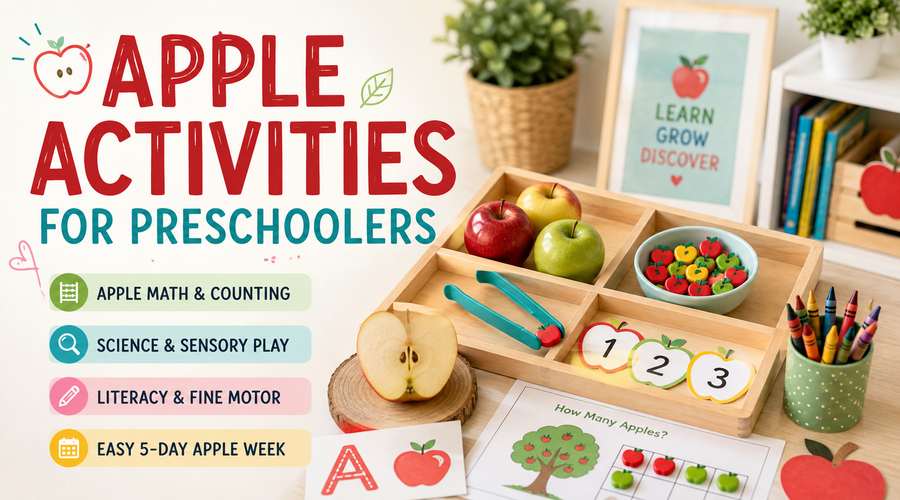
The easiest apple activities for preschoolers use real or pretend apples for one clear job: sort, count, compare, predict, move, create, or talk. Start with one or two activities that fit the child’s current skills, keep directions short, and repeat favorites rather than trying to complete every idea in one day.
An apple theme works well because children can see, hold, smell, compare, and sometimes taste the same object they are learning about. That makes abstract ideas such as counting, patterning, prediction, and descriptive vocabulary easier to connect to something concrete.
This guide keeps the activities practical. You do not need a full classroom theme kit, and most ideas use apples, paper, washable art supplies, playdough, or materials already found in a preschool space. If a child is not ready for a suggested number range or literacy step, simply reduce the challenge and keep the hands-on part.
Food and small-parts safety
For cutting or tasting activities, an adult should prepare the apples and follow the allergy, food-safety, and supervision rules for the home, school, or childcare setting. Keep small loose parts out of reach of children who may mouth them, and substitute larger paper or felt pieces when needed.
Apple Activities for Preschoolers at a Glance
Use this quick guide to choose an activity by skill instead of working through the list in order.
What Can Preschoolers Learn From an Apple Theme?
Good preschool apple activities are not valuable because they use a seasonal theme; they are valuable because the theme gives children a concrete way to practice important early-learning skills. For example, children can count apple pictures, compare real apples, predict what will happen in water, describe what they notice, and use their hands to transfer or create.
This approach fits established early-childhood guidance. The National Association for the Education of Young Children (NAEYC) defines developmentally appropriate practice as a strengths-based, play-based approach to joyful, engaged learning.[1] The Head Start Early Learning Outcomes Framework organizes early learning across five central domains, including language and literacy, cognition, and perceptual, motor, and physical development.[2]
- Count and compare small groups.
- Notice color, size, shape, texture, and change.
- Make a simple prediction and check what happens.
- Build hand strength and coordination.
- Practice letters, names, and descriptive words.
- Follow short directions during movement and play.
How these 15 activities were selected
Each idea was kept only if it met four practical checks: it uses common or reusable materials, has a clear learning purpose, can be simplified or extended for ages 3–5, and can be explained in a few steps. Activities that overlap with deeper Nini Printables guides—such as counting, fine motor, sensory, STEM, letter recognition, or plant learning—stay brief here and link to the dedicated skill page instead of repeating the same lesson.
Easy Apple Math Activities for Preschool
Keep preschool math concrete. Real apples, paper apples, and simple manipulatives give children something they can move while they sort, count, compare, and notice patterns.
1. Apple Color and Size Sort
Materials: red, green, and yellow apples or paper apple cutouts.
Try it: Put the apples in one basket and invite the child to sort them by color. Next, mix the group again and sort by size. Ask questions such as, “How did you decide where this apple belongs?” or “Can one apple fit into more than one group?”
2. Apple Seed Counting With Tongs
Materials: paper apples labeled with numerals, child-sized tongs, and large black felt circles or other supervised counters.
Try it: Choose a small number range. The child reads or matches the numeral, then moves one pretend “seed” at a time onto the apple. Finish by asking, “How many seeds are there altogether?” Moving each piece helps slow the count and supports one-to-one correspondence.
For more practice with this specific counting skill, use the site’s one-to-one correspondence activities for preschoolers.
3. Red-Green-Yellow Apple Patterns
Materials: colored paper apples, dot stickers, or blocks in apple colors.
Try it: Start an AB pattern such as red-green-red-green and pause before the next piece. Ask, “What comes next? How do you know?” When that feels easy, try AAB or ABC patterns using three colors.
4. Measure an Apple With Blocks
Materials: two or three apples and equal-sized blocks or cubes.
Try it: Line up blocks beside each apple to compare height. Then compare which apple feels heavier or looks wider. Preschoolers do not need formal units for this activity; the useful language is taller, shorter, heavier, lighter, wider, and narrower.
If the child enjoys hands-on number work, continue with these counting activities for preschoolers.
Want a ready-to-print counting option too?
Use the apple theme for hands-on learning, then switch to a short printable when you need a quieter table activity or an easy review page.
Apple Science and STEM Activities for Preschoolers
Preschool science works best when children can predict, observe, compare, and talk about what happened. Head Start’s Exploring Science with Preschoolers resource describes preschoolers using inquiry and scientific reasoning to figure out how the world works.[3]
5. Will an Apple Sink or Float?
Materials: a clear tub of water, one apple, and a towel.
Try it: Before placing the apple in the water, ask the child to predict whether it will sink or float and explain the guess. Test the apple, observe what happens, and compare the result with another familiar object.
6. Look Inside an Apple
Materials: one apple, a plate, and an adult-use knife.
Try it: Let the child examine the whole apple first. An adult then cuts it open so the child can compare the skin, flesh, core, stem, and seeds. Ask what changed when the apple was opened and which parts look or feel different.
If the discussion turns to how apples grow, keep this section brief and continue with the site’s broader plant activities for preschool.
7. Apple Taste-Test Graph
Materials: two or three apple varieties, small serving pieces prepared by an adult, and a simple paper chart.
Try it: Compare color, smell, crispness, and taste. Each child places a mark or name under a favorite variety. Count the marks together and ask which column has more, fewer, or the same number.
For more prediction-and-observation ideas, see these STEM activities for preschoolers or Head Start’s Exploring Science with Preschoolers resource.
Apple Fine Motor and Sensory Activities
These activities keep the apple theme while giving hands and fingers more work. If fine motor development is the main goal, use the apple activity as one example and then move to the site’s broader skill-based resources.
8. Apple Transfer With Tongs
Materials: child-sized tongs, two bowls, and large pretend apples, felt apples, or other safe items.
Try it: Put the apples in one bowl and ask the child to transfer them to the second bowl using tongs. Change the distance between bowls or ask the child to sort colors while transferring.
For more hand-strength and coordination ideas, see fine motor activities for preschoolers.
9. Apple Playdough Counting
Materials: red, green, or yellow playdough and numeral cards.
Try it: Roll small playdough balls as pretend apples, then place the requested number on a paper tree. Squashing, rolling, and pinching adds fine motor work while the child counts.
See more open-ended ideas in preschool playdough activities.
10. Simple Apple Sensory Bin
Materials: a shallow bin, toy or felt apples, fabric leaves, cups, scoops, and baskets.
Try it: Invite the child to gather, sort, scoop, sell, or “pick” apples. Add simple language prompts such as, “Can you find two green apples?” or “Which basket has fewer?”
If sensory play is the main objective, continue with these sensory activities for preschoolers.
Optional Supplies for an Apple Theme
Use household or classroom materials first. Reusable supplies can make setup faster, but none of these activities requires a special apple-theme kit.
- Child-sized tongs
- Washable tempera paint
- Playdough
- Large counters or felt pieces
- Reusable sleeves
- Washable dot markers
Apple Literacy and Art Activities
Keep literacy playful and brief. The goal is to connect letters, names, and descriptive language to the theme without turning every apple activity into handwriting practice.
11. Letter A Apple Match
Materials: paper apples marked with uppercase A, lowercase a, and a few other letters.
Try it: Ask the child to find the apples showing A or a. Say the letter name and connect it to the beginning of the word “apple.” For children who already know A, use several familiar letters and sort them into matching pairs.
For a broader letter-learning sequence, use these letter recognition activities for preschoolers.
12. Build Your Name With Paper Apples
Materials: small paper apples, one letter of the child’s name on each apple, and a name model if needed.
Try it: Mix the letters, then help the child arrange the apples in name order. A younger child can match each apple to a written name card; an older preschooler can build the name from memory.
13. Apple Printing Art
Materials: an apple cut by an adult, washable paint, paper, and a shallow paint tray.
Try it: Dip the cut side of the apple lightly in paint and press it onto paper. Compare prints made with different amounts of paint or different cuts. Ask what shapes and marks the child notices instead of requiring one finished product.
14. Torn-Paper Apple Collage
Materials: red, green, or yellow paper, glue, and a simple apple outline.
Try it: Tear paper into manageable pieces and glue them inside the apple shape. Let the child decide whether to fill the whole apple, mix colors, or create a pattern. Tearing paper adds hand work without requiring scissors.
An Apple Orchard Movement Game
15. Pick, Carry, and Sort the Apples
Materials: paper or felt apples placed around the room and two or three baskets.
Try it: Children move around the “orchard,” pick up one apple at a time, and carry it to the correct basket. Change the movement by asking them to walk slowly, tiptoe, take giant steps, or stop when they hear a signal.
For more whole-body play, continue with movement activities for preschoolers.
A Simple 5-Day Apple Week
You do not need five completely different lesson plans. Reuse the same materials and change the learning focus each day. This keeps prep manageable and gives children repeated contact with familiar ideas.
If a child wants to repeat Wednesday’s water experiment on Thursday, repeat it. Preschool themes are most useful when they create a familiar context for learning—not when adults feel pressure to finish every planned activity.
How to Adapt Apple Activities for 3-, 4-, and 5-Year-Olds
Age labels are only a starting point. Children develop at different rates, so choose the version that produces successful participation and then add one small challenge.
Head Start’s preschool mathematics guidance describes developmental progressions for skills such as quantity, written numerals, comparison, and repeating patterns across the preschool years.[4] Therefore, adjust the quantity, language, or number of steps before replacing an activity a child enjoys.
Keep the learning going without adding more prep
Use the apple theme as one week of hands-on practice, then move into another familiar preschool theme while keeping the same skills.
More Preschool Activities
Choose the next article by the skill your child or class needs most. This keeps the apple page focused on apple-themed learning while the skill pages provide deeper practice.
Frequently Asked Questions
What do preschoolers learn from an apple theme?
An apple theme can support counting, sorting, comparing, patterning, prediction, observation, vocabulary, letter recognition, fine motor control, creative art, and gross motor play. The theme is most useful when each activity has one clear learning purpose.
What is an easy apple activity for a 3-year-old?
Start with a simple two-color apple sort, moving large pretend apples with tongs, or finding paper apples around the room. Keep the number of choices small and model the first turn before asking the child to continue.
How long should a preschool apple theme last?
A few days to one week is enough for many homes and classrooms. Repeat favorite activities rather than adding a new activity every day. A theme should make learning easier to organize, not create pressure to complete a fixed list.
Can these preschool apple activities be used at home?
Yes. Most use common materials and work with one child or a small group. For home use, shorten group games, use household objects first, and choose only the sections that match the child’s interests.
Do I need worksheets for an apple preschool theme?
No. Preschoolers can sort, count, compare, move, build, taste, paint, and observe without worksheets. A printable can be useful for a short quiet activity or review, but it works best as one part of a broader hands-on experience.
Looking for simple practice you can print and use?
Nini Printables offers free preschool and kindergarten activities designed for short, focused practice at home, in homeschool, or in the classroom.
About This Guide
Nini Printables creates simple, low-prep learning activities for preschool and kindergarten children. This guide is organized around hands-on participation, clear skill goals, short directions, and easy ways to reduce or extend the challenge. It is intended for parents, teachers, homeschool families, caregivers, and early-learning settings, not as a formal developmental assessment or a substitute for a school curriculum.
Learn more about Nini Printables.
Teaching References
- National Association for the Education of Young Children (NAEYC). DAP: Defining Developmentally Appropriate Practice.
- Head Start. Head Start Early Learning Outcomes Framework.
- Head Start. Exploring Science with Preschoolers.
- Head Start. Math: Preschool.
Enjoying the free resources? Sharing this guide with another parent or teacher and exploring the printable library are simple ways to support Nini Printables and help more families find the free activities.