
Prewriting Skills by Age: A Practical Guide for Ages 2–5
Use this age-by-age guide to see which early lines and shapes children may be working on, notice what a child can already do, and choose one useful next step without turning pre-writing into a test.
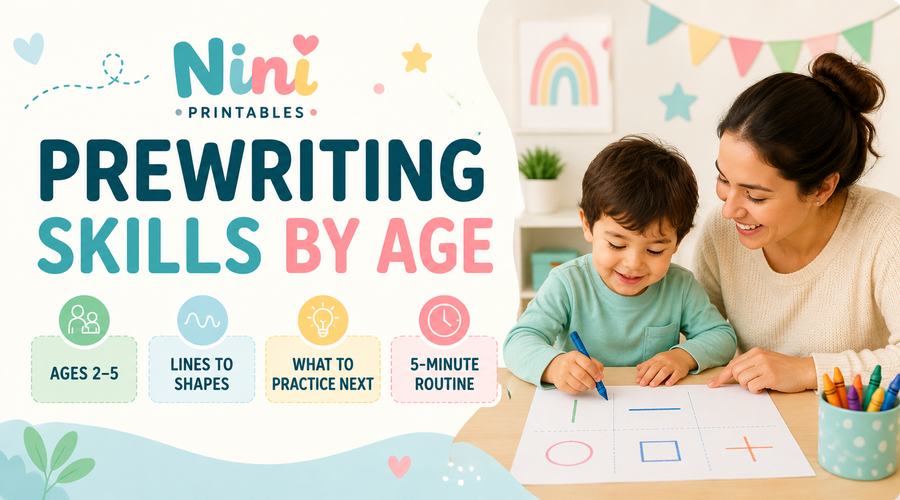
Parents and teachers searching for prewriting skills by age usually want two answers: “What is reasonable around this age?” and “What should we practice next?” This guide answers both. It also keeps pre-writing separate from formal handwriting so a child is not pushed into letter drills before basic mark-making feels manageable.
Head Start describes early writing as a continuum from marks and scribbling toward drawing and letter formation, while NAEYC encourages adults to make writing meaningful through everyday drawing, lists, cards, names, and messages. [1][2] Therefore, the goal is steady development and useful practice—not perfect handwriting on a particular birthday.
What Are Prewriting Skills?
Prewriting skills are the movements and mark-making abilities children use before conventional handwriting becomes consistent. They include scribbling, controlling a crayon or marker, drawing basic lines and curves, copying simple forms, changing direction, and combining strokes. NHS occupational-therapy guidance similarly describes pre-writing lines and shapes as building blocks used before letter formation. [6]
Prewriting vs. handwriting
Prewriting builds movement and control. Handwriting uses those movements to form recognizable letters and words. If a child is still working hard to follow a simple path, strengthen that skill first. For a larger activity bank, use 15 Pre-Writing Activities for Preschoolers.
Imitating vs. copying
Imitating means the child tries a line or shape after watching an adult draw it. Copying means the child looks at a finished model and reproduces it independently. A child may imitate a form before they can copy the same form, so these are useful stages to observe rather than treating every attempt as simply right or wrong.[5]
Prewriting Skills by Age: Quick Chart
This chart combines current public-health guidance with a professional occupational-therapy progression. The ranges are approximate. Children may show some skills earlier, later, or in a different order.
| Age | Children May Be Working On | A Useful Next Step |
|---|---|---|
| 2–3 | Scribbling; imitating vertical or horizontal movement; experimenting with circles; copying a simple straight line [3][5] | Use large lines, finger paths, chalk, and simple adult demonstrations. |
| 3–4 | Copying horizontal and vertical lines and circles; beginning crosses, diagonals, and simple square-like forms [4][5] | Combine two familiar strokes and copy one simple shape at a time. |
| 4–5 | More controlled crosses, diagonals and squares; beginning X and triangle-type forms; familiar letters and name attempts [1][5] | Use shapes in drawings, then connect familiar strokes to meaningful letters. |
| Around 5 | More complex copied forms, recognizable letters, first-name writing, labels, lists, and purposeful early writing [1][2] | Keep letter practice meaningful: names, signs, labels, cards, and short messages. |
Do not use this chart as a screening test. The CDC explains that developmental milestones are broader markers of how children play, learn, speak, act, and move. A single difficult pre-writing form does not determine a child’s overall development.[4]
How to Use the Age Chart Without Turning It Into a Test
First, notice what the child can do without heavy prompting. Next, choose one movement that is only a little harder. Then model it slowly and let the child try. This “observe → choose → model → practice” approach is more useful than asking a preschooler to complete every skill listed for an age group.
- Notice what the child can do comfortably today.
- Choose one slightly more challenging movement.
- Model it before asking the child to copy it.
- Use a larger surface if small pencil work is frustrating.
- Keep the task short enough to stay positive.
- Return to drawing and meaningful marks, not tracing alone.
For example, if a child can draw circles but struggles with corners, build a square with craft sticks or draw a large box-shaped road before asking for a small copied square. The skill stays the same, but the motor demand becomes easier.
What Should a Child Practice Next?
Use the child’s current skill—not just age—to pick the next activity.
If the Child Is Mostly Scribbling
Try large marks, finger paths, vertical and horizontal movements, and simple “watch me, now you try” drawing.
If Basic Lines Are Becoming Easy
Add curves, circles, crossing lines, and paths that change direction. Keep the forms large at first.
If Simple Shapes Can Be Copied
Try diagonals, corners, X-like forms, patterns, and pictures that combine several familiar strokes.
If Shapes Are Becoming Comfortable
Connect the same strokes to familiar letters, especially letters from the child’s name, labels, or simple messages.
Prefer a Ready-to-Print Next Step?
Choose a printable that matches the movement the child is already practicing. One useful page is enough for a short session.
How Can You Help Preschool Children Develop Pre-Writing Skills?
The strongest practice is not limited to worksheets. Instead, vary the size, tool, and surface while keeping the target movement clear. NAEYC recommends giving young children frequent, meaningful opportunities to scribble, draw, and write with different materials.[2]
1. Use big movement before small movement
Draw large lines on a whiteboard, easel, sidewalk, or large paper. Bigger movements reduce the precision demand.
2. Finger-trace before adding a writing tool
Let the child follow a road, curve, circle, or simple shape with one finger. Then repeat it with a crayon or marker.
3. Build lines and shapes by hand
Playdough, craft sticks, yarn, or blocks make corners and curves easier to see, touch, and rebuild.
4. Draw alongside the child
Model one form instead of assigning a whole page. Head Start and NAEYC both emphasize adult modeling and meaningful early writing experiences.[1][2]
5. Use printables for targeted practice
Pick only the paths or shapes that match the next skill. For more hands-on choices, visit Pre-Writing Activities for Preschoolers.
A Simple 5-Minute Pre-Writing Routine
Five minutes is only a planning example. Stop sooner if attention fades, or continue if the child is happily using the skill.
When Are Children Ready to Move From Shapes to Letters?
There is no birthday when shape practice should abruptly stop. Instead, move toward letters when the child shows growing control, recognizes familiar letters, and wants to use writing for a purpose. Head Start describes the progression from marks and drawing toward letter formation, while NAEYC suggests everyday writing such as names, cards, lists, and messages. [1][2]
- Basic lines and circles are becoming intentional.
- The child can imitate or copy some simple forms.
- Writing tools can be used without immediate frustration.
- The child notices letters in names, signs, or books.
- The child wants to write a name, label, card, or message.
- Short writing attempts still feel manageable.
For age-4 expectations, use Handwriting for 4 Year Olds. For letter-focused activity ideas across preschool, see Handwriting Activities for Preschoolers. Those pages handle handwriting intent; this guide stays focused on the developmental sequence and the next pre-writing step.
Free Pre-Writing Practice by Skill
For roads, routes, and changing directions
Vehicles Pre-Writing Paths offers a 16-page route-based printable with straight, curved, wavy, zigzag, roundabout, and spiral-style paths.
For themed line and fine-motor practice
Dinosaur Pre-Writing & Fine Motor Activity Pack provides a 16-page dinosaur theme for children who respond well to playful path practice.
Choose Practice That Matches the Child
Print only the pages that support the current skill. Then return to drawing, play, or another hands-on activity.
Optional Supplies for Pre-Writing Practice
You can do most activities with materials already at home or in a classroom. A few reusable tools can make practice easier to vary.
Useful, Not Required
- Washable markers: smooth, visible marks for beginner paths.
- Chunky crayons: useful for large drawing and mark-making.
- Playdough: useful for building lines, curves, corners, and shapes.
- Reusable dry-erase sleeves: repeat favorite printable pages without reprinting.
- Whiteboard or drawing board: makes large demonstrations quick and easy.
Choose supplies because they support a task—not because a child needs a bigger writing kit.
When to Ask for More Guidance
This article is an educational planning guide, not a developmental screening tool. If a parent or teacher has ongoing concerns across several areas of development, notices a loss of previously used skills, or sees persistent difficulty with everyday fine-motor tasks, discuss those observations with the child’s pediatric healthcare professional, school team, or another appropriately qualified professional. The CDC also provides broader age-based milestone resources for families. [4]
Frequently Asked Questions About Prewriting Skills by Age
What are prewriting skills?
They are early mark-making and movement skills used before conventional handwriting becomes consistent, including scribbling, controlled lines, circles, intersecting lines, simple shapes, paths, and early copying.
What age do prewriting skills begin?
Early mark-making begins before formal preschool handwriting. Young children often scribble and experiment with drawing before they can copy lines, shapes, or letters consistently.
What pre-writing skills can a 2- to 3-year-old practice?
What pre-writing skills can a 3- to 4-year-old practice?
What pre-writing skills can a 4- to 5-year-old practice?
Should preschoolers trace letters?
Letter tracing can be useful when a child is interested and ready, but it does not need to be the starting point. Lines, curves, shapes, drawing, and playful paths can build control first.
What is the difference between copying and imitating?
Imitating means trying a line or shape after watching someone demonstrate it. Copying means reproducing a finished model. A child may imitate a form before copying it independently.
How can you help preschool children develop pre-writing skills?
Use large movements, finger paths, playdough or other hands-on materials, adult modeling, short drawing tasks, and targeted printable practice. Change the tool or surface before simply making the worksheet longer.
Use the Chart to Choose One Next Step
A useful prewriting skills by age guide should lead to action. Observe the child’s easiest current form, choose one reachable next movement, model it, and keep practice brief. When a printable makes setup easier, use only the pages that match that next step.
Ready for One Easy Next Step?
Browse the free Nini Printables library and choose one short activity that fits what the child is practicing today.
Enjoying the free resources? Sharing this guide with another parent, teacher, homeschool family, or caregiver helps more people discover Nini Printables and supports the continued growth of the free resource library.
About This Guide
Nini Printables creates low-prep preschool and kindergarten printables for pre-writing, tracing, counting, matching, shapes, fine-motor practice, and related early-learning skills. For this article, broad early-writing guidance was checked against Head Start, NAEYC, and CDC resources, while the line-and-shape progression was cross-checked against professional occupational-therapy guidance. Age ranges are presented as flexible planning references rather than diagnostic cutoffs. Learn more about Nini Printables.
Teaching References
- U.S. Head Start — Alphabet Knowledge and Early Writing
- NAEYC — Support Writing at Home
- CDC — Milestones by 30 Months
- CDC — Milestones by 3 Years
- Kid Sense Child Development — Writing Readiness (Pre-Writing) Skills
- Hampshire and Isle of Wight Healthcare NHS Foundation Trust — Handwriting and Fine Motor Skills