
Preschool Fall Learning
Pumpkin Activities for Preschool: 15 Easy Math, Science, Literacy & Fine Motor Ideas
Turn a simple fall theme into meaningful hands-on learning with low-prep pumpkin activities for preschoolers that practice counting, language, science, fine motor skills, sensory exploration, STEM, and movement.
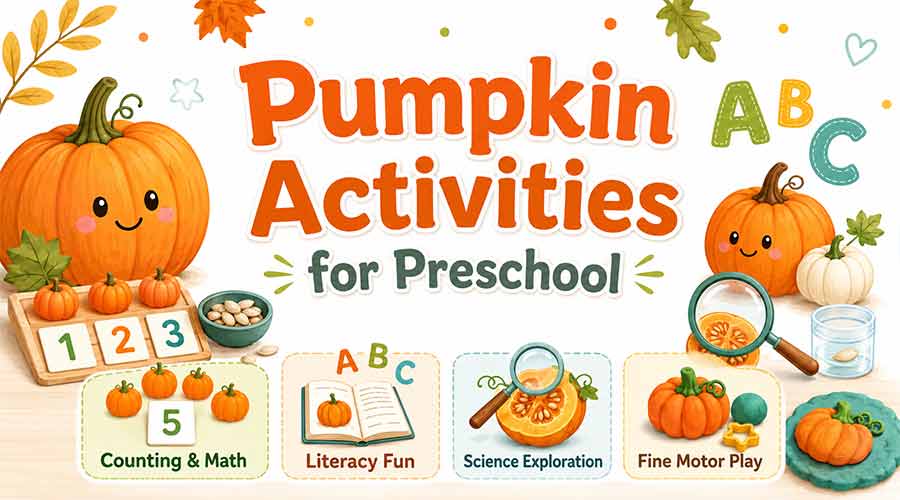
The best pumpkin activities for preschool combine a familiar seasonal theme with one clear learning goal. Try counting pumpkin seeds, hunting for letters, comparing pumpkin sizes, testing whether a pumpkin sinks or floats, exploring the inside of a pumpkin, building a mini-pumpkin bridge, or setting up a simple pumpkin washing station. Most of the ideas below take only a few minutes to prepare.
Pumpkin themes work well in preschool because one real object can support many kinds of play. A pumpkin can become a counting tool, a science specimen, a vocabulary prompt, a sensory material, or even a small engineering challenge. That variety lets parents and teachers reuse the same supplies without turning the week into a complicated craft project.
These activities follow a play-based approach: the adult sets up a simple invitation, gives the child room to explore, and adds short questions or prompts when useful. This is consistent with the National Association for the Education of Young Children (NAEYC), which describes developmentally appropriate practice as strengths-based, play-based, joyful, and responsive to the individual child. See the NAEYC Developmentally Appropriate Practice statement.
Quick Pick: Choose a Pumpkin Activity by Skill
Short on planning time? Start with the skill you want to practice, then choose one activity. There is no need to complete all 15 ideas.
| Learning goal | Try this activity | Typical prep |
|---|---|---|
| Counting | Pumpkin Seed Counting | 2–3 minutes |
| Number sense | Roll and Fill the Pumpkin | 5 minutes |
| Letters | Pumpkin Letter Hunt | 5 minutes |
| Language | Pumpkin Vocabulary Basket | 3 minutes |
| Fine motor | Pumpkin Tweezer Transfer | 2 minutes |
| Science | Pumpkin Sink or Float | 3 minutes |
| Sensory play | Pumpkin Washing Station | 5 minutes |
| STEM | Build a Pumpkin Bridge | 3 minutes |
| Movement | Pumpkin Patch Number Hunt | 5–10 minutes |
Pumpkin Math Activities for Preschoolers
Preschool math is easier to understand when children can touch and move the objects they are counting or comparing. Use real seeds only when they are safe for the child; otherwise, swap in large orange counters, blocks, or paper circles.
1. Pumpkin Seed Counting
Write the numbers 1–5 or 1–10 on separate pieces of paper. Invite the child to place the matching number of pumpkin seeds or large counters on each card. Encourage one slow touch or movement for each number said aloud.
This keeps the focus on one-to-one correspondence: one object matched to one count word. For more ways to practice the same skill, see one-to-one correspondence activities for preschoolers.
2. Roll and Fill the Pumpkin
Draw a large pumpkin outline on paper and divide it into a few open spaces. Roll a die, count the dots, and add that many counters, blocks, stickers, or playdough balls inside the pumpkin.
Keep the game relaxed. The goal is to connect a small quantity with the action of counting, not to race. Children who already recognize small dot patterns can say the number first and then check by counting.
For a broader set of number ideas, visit math activities for preschoolers.
3. Pumpkin Size Sorting
Gather three or more pumpkins, gourds, pumpkin pictures, or paper cutouts in noticeably different sizes. Ask the child to arrange them from smallest to largest.
Add simple comparison language: Which is taller? Which is wider? Which feels heavier? If two pumpkins are close in size, let the child explain the choice instead of correcting immediately. The conversation matters more than producing one perfect order.
Pumpkin Literacy and Language Activities
Literacy practice does not have to look like a worksheet. A few labels, picture cards, and back-and-forth conversation can turn a pumpkin theme into useful letter and vocabulary practice.
4. Pumpkin Letter Hunt
Write familiar letters on small paper pumpkins and place them around a table, room, or sensory tray. Call out one letter at a time and invite the child to find it.
Start with letters the child already knows, especially letters in their name. When the game feels easy, mix in one or two newer letters. For additional practice ideas, see letter recognition activities for preschoolers.
5. Pumpkin Beginning-Sound Sort
Choose a small set of simple fall or pumpkin-theme picture cards. Say each word slowly and sort pictures by their beginning sound. For example, pumpkin and pie can go together because both begin with /p/.
Keep this playful and oral. Children do not need to spell every word. The useful part is listening, repeating, and noticing that words can start with the same sound.
6. Pumpkin Vocabulary Basket
Put a pumpkin, a few large picture cards, or safe pumpkin parts in a basket. Introduce a short set of useful words such as stem, seed, skin, pulp, vine, smooth, bumpy, round, and heavy.
Instead of quizzing, use the words in conversation: “I notice the stem feels rough. What do you notice?” Responsive back-and-forth exchanges are a strong way to extend early language; the Harvard Center on the Developing Child explains how attentive “serve and return” interactions support early development.
Pumpkin Fine Motor Activities
Fine motor practice works best when the hand movement is part of a meaningful task. These pumpkin activities use grasping, pinching, pressing, peeling, and placing rather than long pencil drills.
7. Pumpkin Tweezer Transfer
Place large orange pom-poms, chunky counters, or other age-appropriate objects in one bowl. Put a second bowl nearby and invite the child to transfer the pieces with child-safe tongs or tweezers.
If the tool is frustrating, let the child use fingers first. Fine motor play should be challenging enough to invite practice, not so difficult that the child cannot participate. More options are available in fine motor activities for preschoolers.
8. Pumpkin Playdough Faces
Make a pumpkin from orange playdough, then add a stem, eyes, mouth, leaves, or silly facial features. Ask the child to roll a long vine, pinch a tiny stem, or flatten a circle for an eye.
There is no correct final product. The value comes from manipulating the dough and explaining the creation. For more low-pressure dough ideas, see preschool playdough activities.
9. Pumpkin Sticker Lines
Draw a large pumpkin with several curved vertical lines. Give the child a sheet of age-appropriate stickers and invite them to place stickers along the lines from top to bottom.
For children who are ready for more control, make the line narrower or create a simple path from the stem to the bottom. For an easier version, use dot markers instead of stickers.
Pumpkin Science Activities for Preschoolers
Preschool science can begin with a question, a prediction, and a chance to observe. The adult does not need to explain every answer first. Let the child notice what happens and describe it.
10. Pumpkin Sink or Float
Fill a deep tub or sink with enough water to test a small pumpkin. Before placing it in the water, ask: “Do you think it will sink or float? Why?”
Test the prediction, then compare the result with another safe object. The goal is not memorizing a rule about floating. It is practicing the simple inquiry sequence of predicting, testing, noticing, and talking about evidence.
11. Explore the Inside of a Pumpkin
An adult cuts the pumpkin open away from children and removes the knife before exploration begins. Invite the child to look at and gently touch the skin, pulp, fibers, and seeds using hands or a spoon.
Ask open prompts such as: “What feels different inside?” “What do you notice about the seeds?” “Which part is smooth or stringy?” Record a few of the child’s words if you want to revisit the experience later.
12. Pumpkin Life Cycle Sequence
Use four to six simple pictures to show a pumpkin growing from seed to sprout, vine, flower, and pumpkin. Mix the cards and invite the child to put them in an order that makes sense.
Follow with a real-world connection: look for a stem, talk about where seeds come from, or compare the pumpkin with another plant. For broader hands-on plant learning, visit plant activities for preschool.
Pumpkin STEM and Sensory Activities
13. Build a Pumpkin Bridge
Set out blocks, cardboard strips, or craft sticks and one small pumpkin. Give a simple challenge: “Can you build a bridge that holds the pumpkin?”
If the first design falls, avoid fixing it immediately. Ask what the child might change: wider supports, a shorter span, more blocks, or a lighter pumpkin. That makes the rebuilding process part of the activity.
For more hands-on building and investigation ideas, explore STEM activities for preschoolers.
14. Pumpkin Washing Station
Place one or two small pumpkins in a shallow tub with a little water, a sponge, and a soft brush. Invite the child to wash the pumpkin and notice how the surface changes when it is wet.
Add language naturally: wet, dry, clean, bumpy, smooth, scrub, rinse. Put a towel under the tub and supervise water play. More sensory ideas are available in sensory activities for preschoolers.
A Pumpkin Movement Activity
15. Pumpkin Patch Number Hunt
Write numbers on paper pumpkins and place them around the room or in a safe outdoor area. Ask the child to find a number, bring it back, say the number, and complete a matching action—for example, three jumps for the number 3.
For younger preschoolers, hide only three or four numbers at a time. For children who know their numerals well, call out a quantity or simple clue instead of the numeral. See movement activities for preschoolers for more ways to combine learning with active play.
How to Choose Pumpkin Activities for Preschool by Age and Skill
Age labels are only a starting point. Children develop skills at different rates, so choose the version that matches what the child can do comfortably now and add one small challenge at a time.
For younger preschoolers
Keep the task short and concrete. Try washing pumpkins, sorting by size, rolling playdough, matching 1–3 objects, or naming simple sensory words.
For ages around 4–5
Add number recognition, letters, 1–10 counting, simple predictions, sequencing, and more controlled fine motor tasks.
For children ready for more
Invite explanations, compare quantities, record a prediction, sort beginning sounds, or redesign a STEM structure after it fails.
A useful rule is to watch engagement. If a child finishes instantly, add one small extension. If the child is stuck or losing interest, simplify the materials or reduce the number of steps. The purpose is active learning, not completing every activity exactly as written.
Simple Supplies for a Pumpkin Preschool Theme
You do not need a large craft order. A small reusable set of materials can support most of the pumpkin preschool activities in this guide.
Optional supplies
- One real pumpkin or a few mini pumpkins
- Paper, cardstock, and washable markers
- Playdough
- Child-safe tongs or tweezers
- Large counters or age-appropriate pom-poms
- Stickers or dot markers
- Blocks or craft sticks
- Shallow tub, sponge, and soft brush
Use what you already own first. A small set of reusable materials is enough for most of these activities, so there is no need to buy a separate supply kit for every idea.
More Preschool Activities to Pair With a Pumpkin Theme
A seasonal article works best when it connects children back to broader skills they can practice all year. These Nini Printables guides provide natural next steps:
Pumpkin Activities for Preschool FAQ
What are easy pumpkin activities for preschoolers?
Easy options include pumpkin size sorting, a pumpkin washing station, pumpkin playdough faces, sticker lines, a letter hunt, and a simple sink-or-float test. Choose activities with one clear goal and only a few materials so children spend more time playing than waiting for setup.
What can preschoolers learn from pumpkins?
Pumpkins can support counting, comparing, vocabulary, letter recognition, observation, sequencing, fine motor practice, sensory exploration, movement, and basic problem solving. The learning comes from what children do with the materials and the conversation around the experience.
How can I use pumpkins for preschool math?
Count seeds or large counters, compare pumpkin sizes, order pumpkins from smallest to largest, match numerals to quantities, or roll a die and add that number of objects to a paper pumpkin. Keep quantities small enough that the child can count accurately.
What pumpkin activities work without carving?
Most of the ideas in this guide require no carving. Try size sorting, washing, letter hunts, number hunts, playdough faces, sticker lines, counting games, or a mini-pumpkin building challenge. If you explore the inside of a pumpkin, an adult should do all cutting away from children.
About This Guide
Nini Printables creates simple learning resources and practical activity ideas for preschool and kindergarten families and educators. This guide was organized around low-prep, hands-on activities with clear learning purposes rather than around completing a large seasonal craft list. Activities should always be adapted to each child’s abilities, interests, setting, and safety needs. Learn more on the About Nini Printables page.
Teaching & Safety References
- National Association for the Education of Young Children. Developmentally Appropriate Practice (DAP) Position Statement.
- Center on the Developing Child at Harvard University. A Guide to Serve & Return.
- U.S. Consumer Product Safety Commission. Small Parts Ban and Choking Hazard Labeling.