
Zoo Art Activities for Preschoolers: 12 Ways to Explore Animal Pattern, Texture, Movement & Color
These zoo art activities for preschoolers turn stripes, spots, movement, texture and habitat colors into simple art invitations for ages 3–5. The goal is not to make every child copy the same lion or giraffe—it is to help children notice something interesting, choose how to explore it and create a result that is genuinely their own.
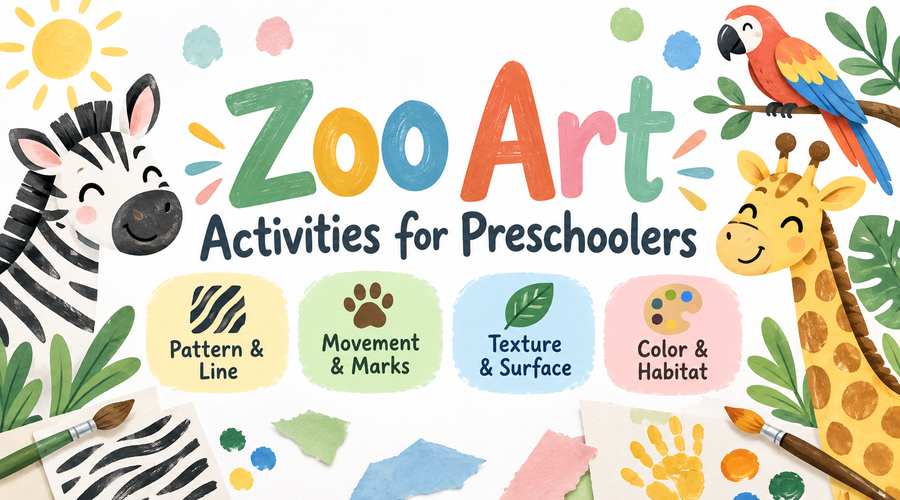
Easy zoo art activities for preschoolers can begin with one thing a child notices about an animal: zebra lines, giraffe spots, an elephant’s sweeping movement, a bird’s texture or the colors of a habitat. Offer a small set of washable materials, let the child choose how to use them, and talk about the marks, colors and textures that appear instead of asking the artwork to match a sample.
A zoo theme is naturally visual, but many zoo craft lists move straight from “animal” to “finished product.” That can be useful when the goal is following a sequence, yet it is not the only way to use the theme. NAEYC describes process-focused art as open-ended and choice-driven, with no single sample children must copy.[1]
This guide uses a different route: look at an animal, notice one visual clue, choose a way to explore it, then create. If you need movement, pretend play, storytelling, habitats and other mixed learning ideas instead of an art-only guide, use the broader Zoo Activities for Preschoolers page.
Start With the Animal, Not a Craft Sample
Preschool art can have enough structure to feel easy for the adult without deciding the child’s finished picture in advance. NAEYC contrasts product-focused projects, where children may follow directions or copy a model, with process art, where children have more control over materials and outcomes.[2]
“Here is the lion. Put the mane here, the eyes here and the nose here.” The adult knows what the final result should look like before the child begins.
“Look at the lines, shapes or textures you notice. Which tools could help you explore them?” The adult creates a manageable setup, but the child makes visual decisions.
Both approaches can have a place. This article leans process-focused because it gives the zoo theme a job beyond decoration: the animal becomes a reason to observe, compare, experiment and make choices. NAEYC also recommends noticing and commenting on what children actually make rather than fixing their work for them.[1]
Use Look → Notice → Choose → Create
You do not need a long lesson before art time. Use this short routine to turn an animal photo, book page or zoo observation into an art invitation in under a minute.
Pause on one animal instead of rushing through many. Let the child look long enough to find something interesting.
Name one visible clue: curved lines, uneven spots, bright colors, repeated scales, long movement or a rough-looking surface.
Offer two or three tools or materials. Let the child choose color, tool, pressure, direction, placement or texture.
Use the observation as a starting point, not a rule. The result may be an animal, a pattern page or something abstract.
Example: instead of “Make a zebra,” try “What kinds of lines do you notice?” Then offer two drawing tools with different widths and let the child decide what the lines become.
Choose Zoo Art Activities for Preschoolers by What They Notice
You do not need to complete all 12 ideas. Pick the route that matches what caught the child’s attention, then repeat the same art idea with a different animal later.
Pattern & Line Zoo Art
Stripes and spots are easy to recognize, but the art becomes more interesting when children can change width, spacing, direction, size and repetition. For broader pattern practice outside an art context, see Pattern Activities for Preschoolers.
Zebra Line Lab
Animal clue: zebra stripes change direction, width and spacing rather than behaving like one perfect repeated line.
White heavy paper plus two or three dark washable tools with different widths, such as a broad crayon, marker or paintbrush.
Invite long, short, straight, curved, thick and thin lines. The lines can cross, stop, repeat or leave large spaces.
Keep it open: skip the zebra outline. A page of line experiments fully meets the goal.
Giraffe Spot Printing
Animal clue: giraffe patches vary in size, shape and distance from one another. That makes them useful for comparing repeated prints without requiring an exact pattern.
A thin layer of washable paint, heavy paper and two or three large safe printing tools such as sponge pieces or smooth cardboard shapes.
Print large and small marks, place some close together and leave others far apart, then overlap a few if the child wants to test what changes.
For more pressing, stamping and texture ideas, visit Printmaking Activities for Preschoolers.
Big-Cat Pattern Layering
Animal clue: big cats can invite children to compare spots, stripe-like marks, dark and light areas, and repeated shapes.
One background color plus a drawing tool and one printing or painting tool. Keep the palette small enough that layering is easy to see.
Make one family of marks first, then add a second layer with a different tool. Compare what remains visible and what gets covered.
Ask: “Which layer do you notice first?” rather than asking whether the picture looks enough like a tiger, leopard or cheetah.
Turn Animal Movement Into Marks
Some animals are visually interesting because of how they move, not only because of their coat or color. These activities use whole-arm movement, speed and direction as art choices.
Elephant Sweep Painting
Animal clue: an elephant’s trunk can suggest long arcs, wide sweeps and changing directions.
Large paper, washable paint and one broad brush, sponge tool or roller. A standing surface can create more room for shoulder and arm movement.
Make one long sweep, one short sweep and one curved movement. Then let the child choose which movement to repeat or change.
Notice: describe direction and size—“That mark went all the way across”—instead of naming what the mark should represent.
Cheetah Speed Marks
Animal clue: a running animal gives children a reason to experiment with whether a line can look fast, slow, sudden or steady.
Large paper and two drawing tools that move easily across the surface, such as broad crayons or washable markers.
Make a slow line, then a fast line. Try short bursts, long runs and quick direction changes. Pause to compare the marks.
Keep it safe: the child can move the tool quickly while staying in one place; the activity does not require running around the room.
Monkey Swing Lines
Animal clue: swinging and climbing suggest loops, arcs, high-to-low movement and lines that change direction.
Large paper and two or three familiar drawing tools. Tape the paper securely if large arm movements tend to shift it.
Explore looping, dipping and climbing lines. A child can keep one line moving for several seconds or stop and start whenever needed.
Extend: add a second color and ask whether it should follow, cross or avoid the first line.
Explore Texture & Surface
Texture activities help children respond to fur, feathers, scales and tracks without needing advanced drawing. NAEYC notes that open-ended collage can support creativity and conversation, especially when adults avoid presenting a finished sample children are expected to copy.[3]
Bird Texture Collage
Animal clue: birds can invite comparisons such as smooth, layered, soft-looking, stiff, light and patterned.
Choose three or four material types, such as tissue paper, yarn, corrugated cardboard, plain paper and foil, plus child-appropriate glue.
Let the child choose materials by feel or appearance, tear or place larger pieces, overlap some areas and leave others empty.
Skip the bird template: the collage may suggest feathers, a nest, a habitat or simply an interesting surface.
Reptile Scale Printing
Animal clue: scales create repeated surface texture that can be explored through pressing rather than careful drawing.
Heavy paper, washable paint and one or two clean reusable texture tools such as bubble wrap or smooth corrugated material.
Press lightly, then more firmly. Rotate the texture, overlap prints or switch colors and compare which details stay visible.
Art focus: pressure, repetition and surface—not creating a correct snake or crocodile.
Clay Animal Impression Lab
Animal clue: tracks and textured surfaces can be explored by pressing objects into a soft material and observing what transfers.
Child-appropriate modeling material plus a few large, washable animal figures or safe texture objects that are easy to grasp and clean.
Press shallow and deep impressions, rotate an object, repeat a print or create a trail. Smooth the clay and start again as often as the child wants.
Notice: ask what changed when pressure, angle or direction changed. Keep tiny loose parts out of the setup.
Use Color & Habitat as Art Prompts
Not every zoo art activity needs an animal shape in the middle. Color and habitat can carry the idea, which gives children more room to compose, mix and imagine. For broader color practice, see Color Activities for Preschool.
Parrot Color-Mixing Studio
Animal clue: brightly colored birds give children permission to compare vivid colors without requiring realistic color matching.
Two or three washable paint colors, heavy paper and one or two brushes. Keep paint amounts small enough that color changes remain visible.
Place colors beside each other, overlap them and make one deliberate mixture. Pause before adding more so the child can see what changed.
Ask: “What happened when those colors met?” rather than asking for the “right” parrot color.
Habitat Color Collage
Animal clue: a habitat adds a different visual question: what colors, shapes and layers make a place feel watery, leafy, rocky or grassy?
A background sheet, large paper scraps in several related colors, glue and one drawing tool for optional additions.
Choose a habitat idea, then arrange color and texture before gluing. The child can include an animal, suggest one with a few marks or leave the habitat empty.
Keep the learning boundary clear: this is composition and color exploration, not a habitat-identification test.
One Detail From the Zoo
Animal clue: instead of asking a child to recreate a whole zoo visit or animal, start with one remembered detail.
Offer two or three familiar material families, such as crayons, washable paint and paper scraps. Do not add every supply at once.
Ask, “What is one color, shape, movement, pattern or texture you remember?” Let that one detail become the starting point for any picture or abstract artwork.
Why this one matters: it transfers the whole routine—look, notice, choose, create—into a child-led idea instead of another adult-selected animal craft.
Keep Zoo Art Open-Ended Without Making It Vague
Open-ended does not mean an adult provides a pile of supplies and walks away. A useful setup gives the child a clear place to begin and a small number of meaningful choices. NAEYC describes intentionally prepared materials and time for children to explore as part of process art practice.[2]
“Put three black stripes here.”
“Your giraffe needs brown spots.”
“That doesn’t look like an elephant.”
“What kinds of lines do you notice?”
“Which marks do you want to repeat?”
“Tell me about this part.”
If a child asks for help, demonstrate how a tool works on a separate scrap rather than completing the artwork for them. If a child wants to copy a recognizable animal, that is also a valid choice—the point is that copying is not the only acceptable outcome.
Adjust Zoo Art for Ages 3–5
Age is a starting point, not a performance target. Adjust paper size, number of materials, tool difficulty and adult setup based on the child in front of you. If fine-motor work becomes frustrating, the Fine Motor Activities for Preschoolers guide has broader hand-skill alternatives.
Use large paper, broad tools, two or three choices, minimal cutting and short art sessions. Marks, dabs, prints and simple collage placement are enough.
Add another tool, simple printing, color mixing, texture comparisons and more choices about where materials go.
Invite planning, layering, mixed media, comparison between two techniques and a short explanation of one creative decision.
Use the Same Art Routine Before or After a Zoo Visit
A real zoo visit can give children richer visual memories, but it is not required. Smithsonian’s National Zoo publishes field-trip resources that use observation and later reflection with school-age learners; this article borrows only that broad observation-to-reflection idea and simplifies it for preschool art rather than treating a K–5 resource as preschool validation.[4]
Give one simple looking mission: notice a pattern, a color or a movement. Do not turn the visit into a worksheet assignment.
Ask for one remembered detail, then use Activity 12. A short memory is enough; the goal is art, not recall testing.
Use a library book, a trusted animal photograph or a zoo education page. The art routine still works because observation is the starting material.
A Small Zoo Art Supply Shelf Is Enough
You do not need a separate craft kit for every animal. A few reusable materials can support most zoo animal art activities for preschoolers in this guide.
Washable tempera or watercolor paint, crayons and washable markers.
Heavy white paper, construction paper and clean paper scraps for collage.
Broad brushes, sponge pieces, rollers and smooth-edged cardboard tools.
Glue sticks or child-appropriate school glue for collage.
Child-appropriate modeling material for impressions and open-ended form.
A washable mat or tray, smock, damp cloth and a clear handwashing routine.
If you need to buy supplies: start with reusable basics such as washable tempera, heavyweight paper or broad brushes instead of animal-specific craft kits. One useful tool that works across many activities is usually a better value than a single-project kit.
Keep Preschool Art Materials Simple and Supervised
Choose art materials intended for children, keep original labels, supervise their use and store supplies appropriately after the activity. HealthyChildren.org, from the American Academy of Pediatrics, recommends looking for appropriately evaluated children’s art materials, avoiding products carrying hazard warnings for children, supervising use and including handwashing in cleanup.[5] The U.S. Consumer Product Safety Commission also maintains an Art and Craft Safety Guide for further reference.
- Use direct adult supervision with paint, glue, scissors and modeling materials.
- Follow the age guidance and label instructions on the actual supplies you use.
- Keep small loose pieces away from children who may still mouth objects and from younger siblings.
- Use large, easy-to-grasp tools when precise tool control is not the goal.
- Protect the work surface and clean spills promptly.
- Wash hands after the activity and store materials out of reach.
Frequently Asked Questions
What are easy zoo art activities for preschoolers?
Easy options include Zebra Line Lab, Giraffe Spot Printing, Elephant Sweep Painting, Bird Texture Collage and Parrot Color-Mixing Studio. Start with one familiar material and one animal clue rather than offering every supply at once.
What is the difference between a zoo craft and process art?
A zoo craft often works toward a recognizable finished product or follows a model. Process-focused zoo art gives children more control over color, tools, marks, arrangement and outcome. Both can be useful, but this guide is designed mainly for child-choice art exploration.
Can preschoolers make zoo animal art without templates?
Yes. Animal lines, spots, texture, movement and color already provide strong art prompts. Children can explore those visual ideas on plain paper without needing an animal outline or cut-and-paste template.
Which zoo art activities work well for a 3-year-old?
Start with large paper, broad tools and only two or three material choices. Zebra Line Lab, Giraffe Spot Printing, Elephant Sweep Painting and simple texture collage are easy to simplify without requiring precise cutting or drawing.
How can I use zoo art before or after a zoo visit?
Before the visit, invite the child to notice one color, pattern or movement. Afterward, ask for one remembered visual detail and let that detail become an art prompt. If there is no zoo visit, use a library book or trusted animal photograph instead.
Choose the Next Activity by What You Need
Keep each page in the Zoo topic cluster doing a different job. Use this guide when the goal is art exploration. Use the broad Zoo guide for movement, storytelling, pretend play and mixed learning. Use the printable library when you need a quieter, print-and-go table activity.
Enjoying the free resources? Sharing Nini Printables with another parent or teacher helps support the continued creation of practical preschool learning resources.
About This Guide
Nini Printables creates low-prep preschool and kindergarten resources designed around clear instructions and manageable setup. For this guide, each activity was selected for a visible animal-inspired art idea, meaningful child choice, reusable materials, age-adjustable setup and a clear boundary between art exploration and worksheet practice.
The process-art framing was cross-checked against NAEYC professional guidance. Zoo-visit observation was informed by Smithsonian National Zoo education resources, with the age difference stated above rather than treating school-age material as preschool validation. Material-safety guidance was cross-checked against pediatric and government sources. This is general educational activity guidance, not a developmental assessment, and the article does not claim classroom testing or professional credentials that have not been documented.
Teaching & Safety References
Reference note: the sources below are professional, institutional or government guidance pages rather than peer-reviewed research papers cited for study findings. DOI information is therefore not applicable to this reference set.
- Bongiorno, L. — How Process-Focused Art Experiences Support Preschoolers, National Association for the Education of Young Children (NAEYC). Used for process-art characteristics and adult response guidance.
- Fernando-Smith, L. — What Will We Make? Using Process Art to Spark Preschoolers’ Development, NAEYC. Used for choice-driven process art and intentional material setup.
- Samaras, T., Strasser, J., & Russo, M. J. — Using Collage to Encourage Creativity, High-Level Thinking, and Conversation, NAEYC. Used for open-ended collage guidance and the recommendation to avoid a sample children are expected to copy.
- Smithsonian’s National Zoo and Conservation Biology Institute — Field Trip & Classroom Activities. Used only as a school-age observation/reflection reference; the preschool art routine in this article is independently simplified.
- American Academy of Pediatrics / HealthyChildren.org — Choosing Safe Art & Craft Supplies for Children. Used for labeled-material selection, supervision, cleanup and handwashing guidance. See also the U.S. Consumer Product Safety Commission Art and Craft Safety Guide.