
Zoo Activities for Preschoolers: 15 Ways to Observe, Move, Care, Build & Tell
These zoo activities for preschoolers use the theme for more than animal crafts. Children ages 3–5 can observe animal features, move their bodies, pretend to care for animals, build habitats, count, compare, and tell simple stories.
Quick Answer
The most useful zoo activities for preschoolers are easy to start and give children something meaningful to do with the animal theme. Try a zoo small world, animal movement game, habitat sort, feed-the-animal counting, zookeeper dramatic play, animal observation, zoo building, simple measurement, and story play.
You do not need a classroom full of zoo materials. Toy animals are helpful, but drawings, photos, blocks, stuffed animals, paper, and movement work too.
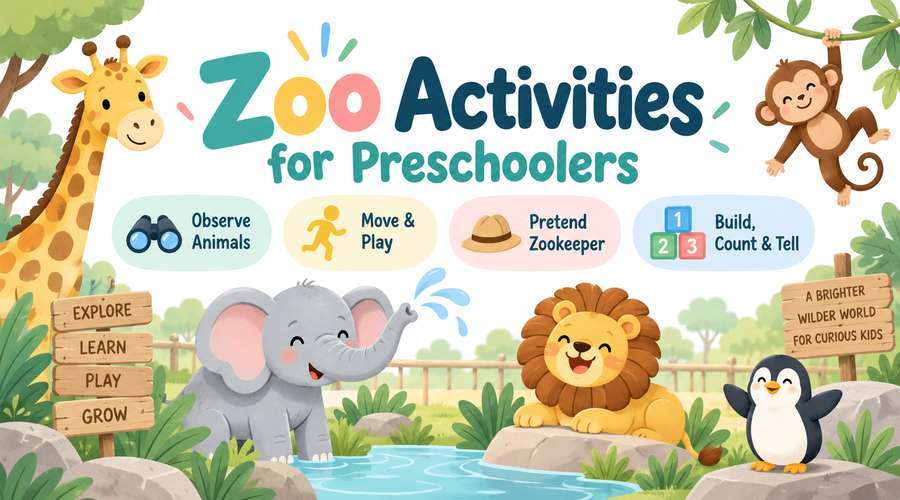
This guide is for parents, caregivers, homeschool families, and preschool educators who want zoo animal activities for preschoolers without turning the theme into a long supply list. The activities are organized around five useful actions: observe, move, care, build, and tell.
animal clues Move
like animals Care
like a keeper Build
habitats & paths Tell
zoo stories
That structure keeps the zoo theme connected to real play. NAEYC defines developmentally appropriate practice as a strengths-based, play-based approach to joyful, engaged learning.[1] Smithsonian National Zoo early-learning resources similarly use live animals, movement, songs, observation, and interactive questions to help young children engage with animal topics.[2]
Choose Zoo Activities for Preschoolers by Need
You do not need to complete all 15 ideas. Pick the activity that solves today’s need, repeat favorites, and change the challenge only when the child is ready.
Observe & Discover: Start With Animal Clues
These first activities turn looking into a real task. Children compare body features, habitats, and clues instead of only naming pictures.
Build a Zoo Small World
Place a few toy animals or animal pictures beside blocks, small boxes, paper, and a simple path. Let the child decide where each animal will go instead of giving a finished zoo layout to copy.
- Set Up
- Start with three or four animals and a small building area.
- Play
- Create spaces for animals, visitors, and a keeper. Add only the pieces the child actually uses.
- Notice
- Ask, “Why did you put this animal here?” or “What does this space need?”
- Adjust
- Use fewer animals for a simpler start. Add paths, signs, or animal groups when the child wants a bigger planning challenge.
Animal Feature Detective
Choose two or three clear animal pictures, figures, or stuffed animals. Look for visible features such as spots, stripes, feathers, a trunk, a mane, long legs, a shell, or a long neck.
- Set Up
- Use animals that look noticeably different.
- Play
- Take turns giving one clue: “I see stripes” or “I see a very long neck.”
- Notice
- Encourage the child to point to the feature that supports the answer.
- Adjust
- Make it easier with two choices. Make it harder by comparing similar animals or giving two clues before guessing.
Zoo Habitat Sort
Use broad habitat pictures or simple mats such as water, grassland, forest, and rocky or sandy land. Talk about what an animal might need in its natural habitat rather than treating a zoo enclosure as the animal’s natural home.
- Set Up
- Choose two habitat choices and four familiar animals.
- Play
- Place each animal where the child thinks it belongs, then talk about the choice.
- Notice
- Ask about visible clues: feet, fur, body shape, climbing ability, or swimming.
- Adjust
- Accept uncertainty. Use a trusted animal source to check one animal together instead of turning the game into a memory test.
For more classification practice without a zoo theme, continue with Matching Activities for Preschoolers.
Which Animal Am I?
Give two or three clues about an animal without saying its name. For example: “I am very tall. I have a long neck. I eat leaves.” Then let the child give the clues.
- Set Up
- Choose animals the child already knows.
- Play
- Use body features, movement, or habitat clues.
- Notice
- Ask which clue helped most.
- Adjust
- Show picture choices if guessing from words is difficult. For more challenge, avoid animal sounds and use descriptive clues only.
Move Like Zoo Animals
Movement gives preschool activities for zoo animals a useful no-table option. Keep the movement focused on copying, controlling, and changing actions—not on getting every animal movement scientifically perfect.
Zoo Animal Movement Game
Call out or show one animal at a time and choose a safe movement inspired by it: stomp like an elephant, stretch tall like a giraffe, waddle like a penguin, crawl like a tortoise, or swing the arms like a monkey.
- Set Up
- Clear a safe movement area.
- Play
- Try one movement for 10–20 seconds, then freeze before the next animal.
- Notice
- Compare fast/slow, high/low, big/small, and heavy/light movements.
- Adjust
- Let the child choose the animal and invent the movement when ready.
Zoo Movement Trail
Create three to five stopping points with paper signs, chalk marks, or simple verbal directions. Each stop has one animal action.
- Set Up
- Example: giraffe stretch → penguin waddle → elephant stomp → flamingo balance.
- Play
- Move through the trail in order.
- Notice
- Ask the child which movement felt easiest, hardest, fastest, or slowest.
- Adjust
- Use only two stations for a younger child. Invite an older preschooler to rearrange the trail and explain the new order.
Pretend to Be a Zookeeper
This is where a zoo theme becomes different from a general animal unit. A child can pretend to prepare food, check spaces, observe animals, answer visitor questions, and make simple care decisions.
Zookeeper Dramatic Play
Set out a few animals, bowls, a small brush, paper, a pencil, and blocks or boxes. The paper can become a simple keeper checklist with pictures or adult-written words.
- Set Up
- Choose two or three pretend jobs: check water, prepare food, observe an animal, or clean the play area.
- Play
- Let the child decide what needs to happen first.
- Notice
- Ask, “What did you notice about the animal?” or “What job comes next?”
- Adjust
- Use picture cues instead of writing. Add pretend visitor questions for a child who wants more language play.
Feed-the-Animal Counting
Give each toy animal a bowl and use large pretend food pieces such as blocks, paper circles, felt pieces, or pom-poms when they are appropriate for the child. Say, “This animal needs four pieces today.”
- Set Up
- Start with quantities the child can count accurately.
- Play
- Move one food piece at a time while saying one number word for each piece.
- Notice
- Finish by asking, “How many did the animal get altogether?”
- Adjust
- Use 1–3 for an easier version. Compare two bowls or match a numeral card to the quantity for more challenge.
For skill-first number practice, use Counting Activities for Preschoolers. This zoo activity keeps the math inside pretend animal care.
Animal Food Transfer
Move large pretend food pieces from a tray into animal bowls using hands, a spoon, or child-appropriate tongs. The point is controlled transfer, not speed.
- Set Up
- Use large, age-appropriate pieces and a shallow tray.
- Play
- Transfer one piece at a time, then return everything and repeat.
- Notice
- Compare which tool is easier to control.
- Adjust
- Use hands first. Add simple color or size sorting only when the transfer itself is comfortable.
Need a Quiet Follow-Up After Zoo Play?
Hands-on play can stay hands-on. When you need a calmer table activity, switch to a familiar skill instead of forcing the zoo theme into every worksheet.
Build, Compare & Solve Zoo Problems
Blocks, boxes, paper, and animal figures can turn zoo theme activities for preschool into simple planning and problem-solving. The adult does not need to design the finished result first.
Build an Animal Habitat
Choose one animal and build a pretend habitat with blocks, paper, fabric, or recycled boxes. Start with a question: “What might this animal need in its space?”
- Set Up
- Use one animal and a small basket of building materials.
- Play
- Add features such as shade, climbing space, water, hiding space, or room to move when they make sense for the animal.
- Notice
- Ask the child to explain one design choice.
- Adjust
- If the animal is unfamiliar, look up a reliable animal page together rather than guessing.
Smithsonian National Zoo education materials include observation and habitat-design activities. Those specific field-trip resources are labeled for K–5, so this preschool version does not copy their lesson level; it only adapts the broad idea into simple play by asking what an animal might need for food, water, shelter, and space.[3]
Build a Zoo Path
Use blocks, painter’s tape, paper strips, or craft sticks to make a route from a pretend entrance to two or three animal areas.
- Set Up
- Keep the first route short.
- Play
- Move a toy visitor or finger along the path without jumping over the route.
- Notice
- Ask, “Can we reach every animal?” or “Where does the path need to turn?”
- Adjust
- Add a bridge, dead end, second route, or simple sign when the child wants a harder planning problem.
Measure & Compare Zoo Animals
Line up a few toy animals or pictures and compare visible attributes. Keep the language concrete: taller/shorter, longer/shorter, bigger/smaller, or more/fewer in a group.
- Set Up
- Use two animals first.
- Play
- Compare one attribute at a time.
- Notice
- Ask the child to show what makes the answer visible.
- Adjust
- For more challenge, measure toy length with blocks or compare three animals in order.
Design a Simple Zoo Map
Draw one big rectangle for the pretend zoo, then add only a few places: entrance, two animal areas, a path, and a keeper area. The map does not need to look realistic.
- Set Up
- Use a large sheet of paper and thick crayons or markers.
- Play
- Place animal stickers, draw simple symbols, or let an adult label the child’s choices.
- Notice
- Use words such as next to, between, near, far, left, right, and around when they fit naturally.
- Adjust
- A younger child can place pictures instead of drawing. An older preschooler can connect the spaces with a route.
Talk, Tell & Create Without Turning It Into a Craft List
A broad zoo guide should leave room for a future art-focused page, so this section stays small. The goal is language, story, and choice rather than a collection of copy-the-sample animal crafts.
Zoo Story Adventure
Choose one animal, one place, and one simple problem. For example: “The penguin cannot find the keeper. What happens next?” Let the child tell the story aloud while moving a toy, drawing, or pointing to pictures.
- Set Up
- Use three prompts: Who? Where? What happened?
- Play
- Accept a short answer as a complete starting story.
- Notice
- Ask “What happened next?” only when the child wants to continue.
- Adjust
- Adult-scribe the child’s words for a child interested in making a book. Writing is optional.
Animal Texture Creation
Offer paper plus two or three materials such as crayons, washable paint, paper scraps, or textured rubbing surfaces. Invite the child to create an animal or simply explore marks inspired by fur, feathers, spots, scales, or skin patterns.
- Set Up
- Keep material choices limited enough to use independently.
- Play
- Ask, “What kind of texture are you making?” rather than showing a finished animal to copy.
- Notice
- Compare smooth, rough, dotted, striped, light, and dark marks.
- Adjust
- If drawing an animal feels difficult, make a texture page instead. The exploration is still the activity.
No Zoo Toys? Use What You Already Have
Good zoo activities for preschool should not depend on buying an animal set. Replace figures with whatever is easiest to access.
- Child-drawn animal cards
- Animal pictures from old magazines
- Library books opened to clear animal photos
- Stuffed animals already at home
- Simple adult-drawn animal symbols
- Written animal names for verbal guessing games
- Blocks used as pretend animals during building
- Movement-only activities with no materials
The learning goal matters more than having realistic miniatures. If an activity is about comparing, planning, counting, or storytelling, a simple substitute often works just as well.
Adjust the Activity for Ages 3–5
Age is a rough guide, not a test. Keep the same basic activity and change the number of choices, the amount of language, and how much planning the child is expected to do.
Use two choices, fewer animals, larger objects, one-step directions, and short play periods. Model one turn before asking the child to try.
Ask the child to explain a choice, compare three items, plan a route, use two clues, count a larger set, or change one part of a familiar activity.
Repeating a familiar setup is useful. A child can learn more from rebuilding the same habitat with a new idea than from rushing through a different zoo activity every day.
Before or After a Real Zoo Visit
You do not need to visit a zoo for this theme to work. If a zoo trip is already part of your plans, use it as an observation opportunity rather than a checklist of animals to collect.
During the visit: look for movement, body features, food, climbing or swimming, and features of the animal’s space. Follow all zoo signs, barriers, and staff instructions.
After the visit: build one remembered habitat, draw a favorite observation, act out a movement, or tell a short story about one animal.
Smithsonian National Zoo provides free animal and education resources that can also support at-home observation when an in-person visit is not possible.[2]
A Simple 5-Day Zoo Preschool Plan
This plan uses one main action each day. It is intentionally lighter than a full classroom curriculum so families and educators can repeat what works instead of preparing several new centers every day.
If one activity holds attention for several days, stay with it. A theme is a container for learning, not a schedule that must be completed.
Optional Supplies That Work Across Several Activities
Use what you already have first. If you are building a reusable preschool activity shelf, these items can support several zoo, counting, matching, fine-motor, and pretend-play activities:
- a small set of durable animal figures
- wooden or magnetic building blocks
- child-appropriate tongs or a small spoon
- large counters, felt pieces, or pom-poms when suitable for the child
- washable markers, crayons, and paper
- recycled boxes, paper tubes, and fabric scraps for building
- clear animal-photo books from the library
A supply is worth adding when it can be reused across several activities. No special “zoo kit” is required.
Keep Zoo Play Simple and Safe
- Choose loose parts, counters, pom-poms, and tools that are appropriate for the individual child; avoid small pieces when they present a choking risk.
- Supervise scissors, tongs, water, sensory materials, and recycled building pieces.
- Check boxes, tubes, sticks, and natural materials for sharp edges, staples, splinters, or other hazards before play.
- For a real zoo visit, follow posted barriers, feeding rules, hand-washing guidance, and staff instructions rather than turning observations into close-contact activities.
- Stop or simplify an activity when the setup becomes more demanding than the learning goal.
Frequently Asked Questions
What are good zoo activities for preschoolers?
Good zoo activities for preschoolers give children something to observe, move, count, build, compare, care for in pretend play, or talk about. Easy options include animal movement, a zoo small world, habitat sorting, feed-the-animal counting, zookeeper dramatic play, building a habitat, and simple zoo storytelling.
How do you teach a preschool zoo theme?
Choose a few familiar animals and organize the theme around actions instead of trying to cover every zoo topic. Observe animal features, move like animals, pretend to care for them, build spaces or paths, then tell a story or review what the child noticed. One or two activities per day is enough.
What can preschoolers learn from a zoo theme?
A zoo theme can support descriptive language, observation, classification, counting, comparison, fine-motor control, movement, spatial planning, pretend play, and storytelling. The exact learning goal depends on the activity; the theme itself is not a developmental assessment.
What zoo activities can I do without animal toys?
Use animal photos, child drawings, library books, stuffed animals, simple picture cards, or movement-only games. “Which Animal Am I?”, animal movement, zoo storytelling, drawing a simple zoo map, and feature comparisons can all work without toy figures.
How can I make zoo activities easier for a 3-year-old?
Use fewer animals, two clear choices, larger materials, one-step directions, and short play periods. Model one turn, let the child point or move an object instead of requiring an explanation, and stop before attention is exhausted.
Choose One Easy Next Step
Start with one activity that fits today’s time and materials. When you want a quieter follow-up, choose a free printable by skill instead of adding more prep.
Enjoying the free resources? Sharing Nini Printables with another parent or teacher helps more families find practical preschool ideas and supports the continued creation of free resources.
About This Guide
Nini Printables creates low-prep early-learning resources for preschool and kindergarten learners. For this guide, each idea was screened for a clear child action, simple setup, an observable or discussable learning goal, an easier or harder adjustment, and a reason the zoo theme adds something to the play.
The article was cross-checked against established early-childhood guidance from NAEYC and education resources from Smithsonian’s National Zoo. It does not claim classroom testing, teacher credentials, developmental diagnosis, or professional animal-care expertise. It is practical educational guidance for families and educators. Learn more about Nini Printables.
Teaching & Animal-Learning References
No peer-reviewed journal article is used for a study-specific claim in this guide, so DOI reporting is not applicable.
- National Association for the Education of Young Children — Developmentally Appropriate Practice Position Statement. Official professional guidance emphasizing strengths-based, play-based, actively engaged learning.
- Smithsonian’s National Zoo — Virtual Field Trips Bring the Smithsonian—and Its Animals—to Preschoolers Everywhere. Early-childhood education example using animals, movement, songs, interaction, and observation.
- Smithsonian’s National Zoo — Field Trip & Classroom Activities. Official education resources covering animal observation, maps, classification, and habitats. The cited habitat/field-trip activities are labeled K–5; this article uses them only as high-level content references and independently simplifies the activity format for ages 3–5.