
Snowman Preschool Art Activities: 12 Creative Process-Art Ideas for Ages 3–5
These snowman preschool art activities help adults choose a creative invitation by prep time, mess level, and the kind of choice a child is ready to make—without needing real snow or a perfect sample to copy.
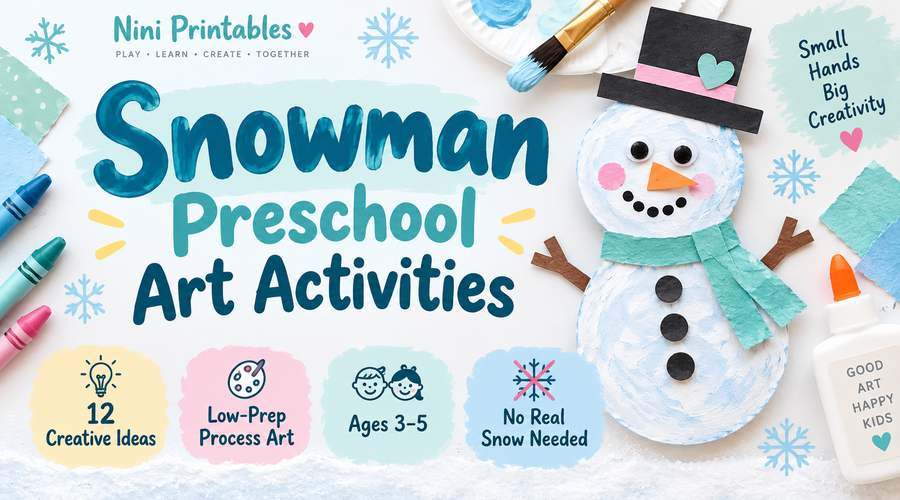
The best snowman preschool art activities give children a clear starting invitation but leave the important visual decisions to them. Set out a small group of safe materials, invite children to explore a snowman idea, and let them choose colors, marks, shapes, textures, placement, and details. For a fast start, try the Giant Gesture Snowman, Snowman Color Lab, or Three-Choice Mixed-Media Studio below.
A snowman theme is familiar enough to spark an idea, but it does not have to turn into a copy-the-sample craft. The goal of this guide is to help parents, preschool teachers, and homeschool families offer snowman art activities for preschoolers that are simple to set up and open enough for each child to make something different.
That approach matches process-focused art guidance from the National Association for the Education of Young Children (NAEYC): process-focused experiences are child-chosen, open-ended, and centered on exploring tools, techniques, and materials. NAEYC also recommends noticing and commenting on what children do rather than fixing their work or steering everyone toward the same result.[1]
Snowman Preschool Art Activities: Quick Picks
Start with the constraint that matters today. A short, successful art session is more useful than choosing the most elaborate project.
Give the Theme, Not the Answer
A snowman can be the invitation without becoming a template. In NAEYC guidance, process art is choice-driven and open-ended; adults create a thoughtful environment and give children time and space to explore materials and ideas.[2]
The theme still matters. Children can make a recognizable snowman, an abstract snowman, or move away from the original idea. The creative decisions are the point.
12 Snowman Art Invitations for Preschoolers
Each activity uses the same five-part structure: Set Out → Invite → Child Chooses → Notice → Extend. This keeps adult preparation practical while protecting the child’s creative role.
Giant Gesture Snowman
Large paper, washable paint, and one or two broad brushes or rollers.
“How big can your snowman marks become?” Let the child work standing, kneeling, or reaching across the paper.
Size, direction, number of marks, colors, and whether the marks become a snowman at all.
Talk about long and short strokes, circles, overlapping marks, and how the body moves with the tool.
Add a second tool with a different width and compare the marks it makes.
Snowman Color Lab
White paint plus two or three washable colors on a tray, paper, and brushes.
“Does a snowman have to stay white?” Invite the child to make light, dark, warm, cool, or surprising snowman colors.
Which colors meet, how much to mix, and where each new color belongs.
Use simple observations: “That blue changed when you added white.” Avoid asking for a predetermined shade.
Make one new tint deliberately, then let the child name it if they want.
Snowman Tool-Mark Studio
Paper, washable paint, and three safe tools that make different marks, such as a sponge, broad brush, and cotton swab bundle.
“Which marks could make a snowman feel fluffy, windy, bumpy, or swirly?”
Tool order, pressure, direction, color, and which marks belong inside or outside the snowman idea.
Compare what changes when the child presses, drags, taps, or twists a tool.
Ask which tool made the most surprising mark and offer more space to use it.
Make-Your-Own-Paper Snowman
Scrap paper, washable paint or crayons, glue, and child-safe scissors if appropriate.
First make decorated paper with lines, dots, blocks of color, or scribbles. Later, turn that paper into snowman pieces.
What the source paper looks like, which parts to tear or cut, and how pieces overlap.
Talk about how one artwork can become material for another.
Save leftover decorated paper for a second composition instead of requiring every scrap to be used.
Snowman Texture-Drag Painting
Thick washable paint, sturdy paper, and a few broad, smooth-edged plastic texture tools.
Spread paint, then drag a tool through it to see what tracks appear. The child can use the tracks inside, around, or instead of a traditional snowman shape.
Tool, direction, spacing, and whether to layer a second color.
Compare grooves, ridges, thin spaces, and thick paint areas.
Rotate the tool and test whether the texture changes.
Negative-Space Snowman Reveal
Large reusable paper circles, a larger background sheet, washable paint, and broad tools.
Place or lightly secure the circles as temporary masks. Paint around and across them, then lift them away.
Where circles sit, whether they overlap, paint colors, and what to add after the shapes are revealed.
Point out the difference between painted space and unpainted space without naming one as better.
Move one circle and repeat to create a second overlapping shape.
Need a Quiet, Print-and-Go Snowman Option?
Open-ended art is useful when there is time for materials and cleanup. When a quieter table activity fits the day better, the Snowman Preschool Worksheets & Activity Pack offers a separate print-and-go path for counting, matching, patterns, sequencing, pre-writing, and creative work.
More Snowman Art Ideas: Drawing, Mixed Media & Collaboration
The next six ideas keep the same child-choice structure while shifting toward drawing, mixed media, scale, imagination, and shared art.
Snowman Line Lab
Plain paper and two or three washable drawing tools with different widths.
“What kinds of lines could live on, around, or behind a snowman?” Try straight, curved, looping, zigzag, tiny, or giant lines.
Line type, pressure, placement, color, and whether lines become details, weather, movement, or something imaginary.
Describe line changes rather than guessing what the child drew.
Choose one line and repeat it in a new way—larger, smaller, closer, or farther apart.
Snowman Shadow Outline
A simple upright snowman-shaped paper or cardboard figure, a flashlight or strong lamp, large paper, and crayons.
Project a clear shadow and trace only as much of the outline as the child wants. Then move the light and see what changes.
Which outline to keep, how to transform it, and whether the shadow becomes a snowman, a creature, or an abstract shape.
Compare tall, short, wide, and narrow shadows without turning the activity into a science lesson.
Trace two positions in different colors and let the child work inside the overlapping spaces.
Three-Choice Mixed-Media Studio
Choose only three material families, such as paper, yarn, and crayons, plus glue if needed.
“What kind of snowman can these three materials make?” Keeping the set small can make choice easier without deciding the outcome.
Which material leads, what gets layered, and which parts stay empty.
Talk about contrasts such as soft/hard, flat/raised, or smooth/rough.
Offer one optional fourth material only after the child has explored the original set.
Snowman Somewhere Unexpected
Drawing paper and crayons or markers. Optional: one sheet of colored paper for collage.
“Where could a snowman appear that no one expects?” Possibilities might include the moon, a garden, a bedroom, or a tropical beach.
Setting, colors, scale, snowman details, and what happens around it.
Invite description with “Tell me about this part” instead of quizzing the child about the picture.
Add one visual clue that helps another person guess the unusual setting.
Shared Snowman Mural
A large sheet of paper, washable drawing or painting tools, and enough room for two or more children to work without crowding.
Begin with a few large open areas or circles, then let children decide together what marks, textures, patterns, and details to add.
Where to work, whether to connect ideas, and when to leave another child’s area unchanged.
Comment on shared decisions and visual connections rather than deciding whose section is “best.”
Add a second sheet beside the first if the group needs more space instead of squeezing in more details.
Rule-Breaking Snowman
Use any familiar materials from the earlier activities. Do not provide a finished sample.
“Make a snowman that breaks one snowman rule.” It might use squares, many colors, one giant body, seven arms, or no face at all.
Which “rule” to change and how far to take the idea.
Ask what choice matters most to the child. Avoid turning the activity into a checklist of silly features.
Make a second version that changes a different rule, then compare the two works.
Adjust the Invitation for Ages 3–5
Age can suggest a starting point, but it should not become a pass/fail rule. Head Start’s preschool framework describes fine-motor development as increasing control, strength, and coordination of small muscles; its preschool indicators include drawing, painting, manipulating tools, and cutting with increasing coordination.[3]
- Use larger paper and broader tools.
- Offer two or three materials instead of a full art cart.
- Pre-open containers and handle difficult setup steps.
- Allow tearing, pointing, placing, or mark making instead of requiring cutting.
- Stop while interest is still positive.
- Add one new tool or material.
- Invite a background or larger composition.
- Compare two textures, lines, or color mixtures.
- Let the child plan what to try before starting.
- Invite the child to explain one creative decision.
No Snow Outside? The Art Still Works
None of these snowman art activities requires real snow. The snowman is a visual theme, not a weather requirement. Paper, washable paint, crayons, yarn, and reusable texture tools work in warm climates, apartments, classrooms, and homes where outdoor snow play is not possible.
If the child wants broader seasonal ideas beyond snowmen, use the existing Winter Art Activities for Preschoolers guide for snow, ice, winter trees, stamping, resist, and general winter process art.
A Small Snowman Art Supply Kit Goes a Long Way
A useful art kit should support many activities instead of requiring a new purchase for every project. These categories cover most of the ideas in this guide and are also easy to reuse for other preschool themes.
Washable tempera paint, crayons, or washable markers.
Large drawing paper, heavier art paper, and clean scrap paper.
Broad brushes, rollers, sponges, and smooth-edged texture tools.
Glue sticks or child-appropriate school glue for collage work.
Child-safe scissors only when the child is ready and an adult can supervise.
A washable mat or tray, smock, damp cloth, and a clear handwashing routine.
Optional supply upgrade: if a verified affiliate link is added later, prioritize one reusable item that improves several activities—such as washable tempera paint, broad brushes, or heavyweight art paper. The guide should still work with basic materials families may already have.
Keep Preschool Art Materials Simple and Supervised
Choose art materials intended for children, read labels, and supervise preschoolers while supplies are in use. HealthyChildren.org, from the American Academy of Pediatrics, recommends choosing appropriately evaluated children’s art materials and avoiding products with hazard warnings; it also emphasizes safe cleanup and handwashing.[4]
Keep loose small parts away from younger children who may mouth objects. The U.S. Consumer Product Safety Commission explains that children’s products intended for children under 3 can be banned when small parts create choking, aspiration, or ingestion hazards.[5] For mixed-age groups, large paper pieces and broad tools are an easier default than tiny decorative items.
Frequently Asked Questions
What are easy snowman art activities for preschoolers?
Start with activities that use one surface and one or two familiar tools. Snowman Line Lab, Giant Gesture Snowman, and Snowman Somewhere Unexpected need little setup while still leaving room for the child to choose marks, colors, and details.
What is the difference between snowman art and a snowman craft?
A craft often works toward a recognizable finished product or follows a model. Process-focused snowman art gives children more control over materials, arrangement, color, and outcome. Both can be useful, but this guide is designed mainly for open-ended art experiences.
Can preschoolers do snowman art without real snow?
Yes. Every activity in this guide works with indoor art materials. Real snow is optional because the snowman is the theme rather than the material.
What snowman art works well for a 3-year-old?
Start with larger paper, broad tools, fewer materials, and invitations that do not require precise cutting or copying. Giant Gesture Snowman, Snowman Color Lab, and Snowman Tool-Mark Studio are easy to simplify.
How can snowman art be less messy?
Choose drawing, dry collage, or a three-material studio; work on a tray or washable mat; and offer small amounts of paint at a time. A quiet printable can also be a better fit on days when cleanup time is limited.
Can a snowman printable be used with these art activities?
Yes, but keep the purposes separate. Use open-ended art when the goal is creative exploration. Use the Snowman Preschool Worksheets & Activity Pack when a child needs a quieter print-and-go activity for skills such as counting, matching, patterns, sequencing, or pre-writing.
Choose the Next Snowman or Winter Activity by Goal
Keep the pages in this topic cluster doing different jobs. Use this guide for art exploration, the broad snowman guide for mixed learning and play, and the printable pack for table-based practice.
If this free guide helped, sharing Nini Printables with another parent or teacher supports the continued creation of practical preschool resources.
About This Guide
Nini Printables selected these ideas for families and early-learning settings that need practical, flexible activities for ages 3–5. The editorial criteria were simple setup, meaningful child choice, reusable materials, adjustable difficulty, realistic cleanup, and a clear boundary between open-ended art and worksheet practice. Learn more about Nini Printables.
This guide does not claim classroom testing, teacher credentials, or developmental assessment. It uses published professional and government guidance to support the sections on process art, fine-motor expectations, and material safety.
Teaching & Safety References
Reference note: the sources below are professional or government guidance pages, not peer-reviewed research papers. No DOI applies to these sources.
- Bongiorno, L. — How Process-Focused Art Experiences Support Preschoolers, NAEYC. Used for the process-art characteristics and adult-response guidance.
- Fernando-Smith, L. — What Will We Make? Using Process Art to Spark Preschoolers’ Development, NAEYC. Used for the description of choice-driven, open-ended process art and intentional material setup.
- Head Start — Preschool Perceptual, Motor, and Physical Development. Used for the fine-motor progression and drawing/cutting/tool-use examples.
- American Academy of Pediatrics / HealthyChildren.org — Choosing Safe Art & Craft Supplies for Children. Used for art-material selection, supervision, cleanup, and handwashing guidance.
- U.S. Consumer Product Safety Commission — Small Parts Ban and Choking Hazard Labeling. Used for the under-3 small-parts hazard statement.