
Winter Math Activities for Preschoolers: 15 Ways to Count, Sort, Measure & Play
Use winter as a playful setting for real preschool math: count paper snowballs, sort mittens, build patterns, compare scarf lengths, measure with blocks, and play simple number games for ages 3–5.
Quick Answer
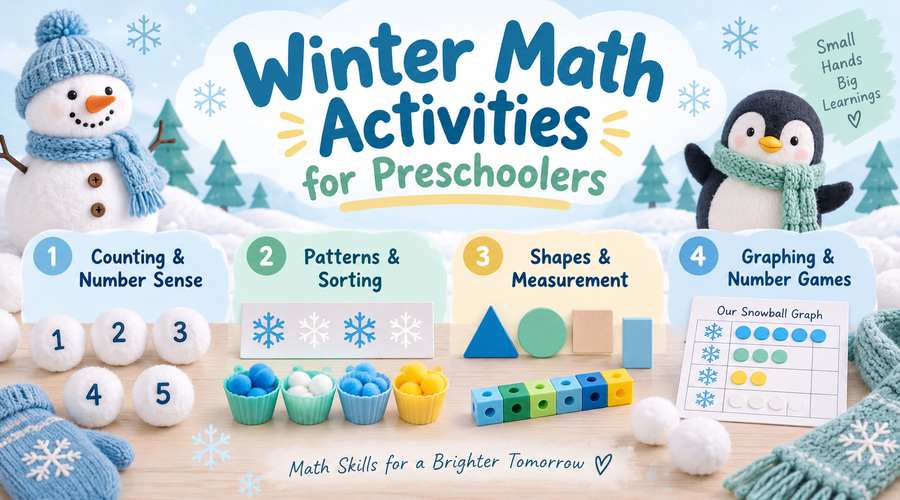
The most useful winter math activities for preschoolers give one math idea a clear job. Count paper snowballs, match mitten quantities to numerals, sort winter gear, build a repeating pattern, compare scarf lengths, measure with cubes, or make a simple picture graph. Start with one skill, keep the setup small, and let the child move real objects before adding a worksheet.
These winter math activities for preschoolers use the season as a context, not as a separate math curriculum. The goal is to make familiar preschool skills easier to notice and talk about. A child who can recite numbers may still need practice counting objects accurately. Another child may be ready to compare two groups, extend an AB pattern, or explain why one scarf is longer.
That skill-first approach matches established early-childhood math guidance. Head Start’s High Five Mathematize emphasizes numbers and operations, geometry and spatial sense, patterns, and measurement through play and everyday experiences. NAEYC’s family math guidance likewise highlights counting, sorting, comparing, measuring, building, and math talk in ordinary routines.
How these 15 ideas were selected: each activity needed one clear preschool math target, common or reusable materials, an easier or harder adjustment, and a way to work without real snow. Skills already covered in depth elsewhere on Nini Printables stay brief here and link to the dedicated guide instead of being rewritten a second time.
Start Here: Pick the Skill Before the Activity
You do not need to complete all 15 ideas. Choose one skill the child is ready to practice, repeat the activity if it works, and change the theme before changing the learning goal.
Counting, patterns, sorting, shapes, measurement, or graphing.
Let the child move, sort, build, point, or compare something concrete.
“How many?” “What comes next?” “Which is longer?” or “How do you know?”
Choose a Winter Math Activity by Skill
Why Skill-First Winter Math Works Better Than a Random Activity List
A seasonal theme is useful when it gives a familiar math idea a fresh context. It is less useful when every activity tries to teach counting, shapes, writing, addition, and crafts at the same time.
Keep the math target visible. If the activity is about one-to-one correspondence, the child should be moving one object for each count. If the goal is measurement, focus on longer, shorter, and “how many cubes long?” If the goal is patterning, make the repeating unit easy to see.
For an all-year overview of these skills, use Math Activities for Preschoolers. This winter guide stays narrower: it shows how to practice familiar preschool math with a seasonal theme.
Winter Math Activities for Preschoolers: Counting and Number Sense
These first four ideas help children connect number words, written numerals, quantities, and actions. If a child can say the number sequence but loses track of objects, slow the task down and move each object once.
Snowball Count & Move
Put 3–10 paper snowballs, cotton balls, or white pom-poms in one bowl and an empty bowl beside it. The child moves one “snowball” at a time while saying one number word for each move. Finish by asking, “How many snowballs are in the new bowl?”
- Start easier
- Use 1–3 objects in a straight row.
- Ready for more
- Show a numeral card first, then ask the child to build that quantity.
Math talk: “How can you make sure each snowball gets counted once?”
Mitten Number Match
Draw or print simple mitten cards. Put a numeral on one set and dots or small pictures on the matching set. Start with 1–5. The child counts the dots and pairs the quantity with the written numeral.
- Start easier
- Offer only two or three choices at a time.
- Ready for more
- Mix 1–10 cards and ask the child to explain how the pair matches.
For deeper numeral practice, continue with Number Recognition Activities for Preschoolers.
Roll & Build a Snowman
Roll a die, count the dots, and add that many snowman pieces to a mat. The pieces can be paper circles, buttons drawn on paper, or large counters. Repeat for several turns rather than racing to finish a picture.
- Start easier
- Use a homemade cube with only 1–3 dots.
- Ready for more
- Compare the number added this turn with the previous turn: more, less, or the same?
Moving one piece for each count also supports the same skill developed in One-to-One Correspondence Activities for Preschoolers.
Hot Cocoa: More, Less, or the Same?
Draw two mugs on paper. Place a small number of pretend marshmallows on each mug and ask which has more, which has less, or whether the groups are the same. Keep the groups small enough that the child can count them accurately.
- Start easier
- Make the difference obvious, such as 2 and 5.
- Ready for more
- Use quantities that differ by one and ask the child to prove the answer by counting or pairing objects.
Math talk: “How do you know this mug has more?”
Winter Math Activities for Preschoolers: Patterns and Sorting
Patterns ask children to notice what repeats. Sorting asks them to decide what belongs together. Both become more useful when the child explains the rule instead of only copying an adult.
Winter Pattern Strip
Use two winter pictures or two colors to make a short repeating sequence: mitten–snowflake–mitten–snowflake. Pause before the last space and ask what should come next. Let the child place the next item rather than only naming it.
- Start easier
- Copy an AB pattern directly under an adult model.
- Ready for more
- Try AAB or ABB and ask the child to circle the part that repeats.
For year-round ideas, see Pattern Activities for Preschoolers.
Sort the Winter Gear
Gather real winter clothing or use picture cards with hats, mittens, scarves, and boots. Ask the child to sort by one rule first: type, color, or size. Then mix everything again and invite a different rule.
- Start easier
- Use two groups with one obvious difference.
- Ready for more
- Let the child invent the sorting rule and explain it.
Math talk: “What did you notice that made these belong together?”
For a larger skill progression, continue with Sorting Activities for Preschoolers.
Snowflake Size Sort
Cut or draw several snowflakes in clearly different sizes. Ask the child to make small, medium, and large groups, then place three snowflakes in order from smallest to largest.
- Start easier
- Compare only one small and one large snowflake.
- Ready for more
- Order four or five sizes and ask what would belong between two existing snowflakes.
Math talk: “Which one is bigger than this one but smaller than that one?”
Need a Quiet Winter Follow-Up?
After hands-on play, switch to a short seasonal page when the child is ready to sit and review. The Winter Preschool Worksheets & Activity Pack gives you a low-prep option without turning the whole math session into worksheet time.
Winter Math Activities for Preschoolers: Shapes and Spatial Thinking
Shape learning becomes more useful when children build, compare, turn, and describe shapes—not only name them from flashcards.
Build a Shape Snowman
Offer paper circles, squares, rectangles, and triangles. Ask the child to design a snowman or winter character using the shapes. Instead of correcting the picture, talk about the shapes the child chose.
- Start easier
- Offer circles plus one other familiar shape.
- Ready for more
- Ask the child to find two different shapes with the same number of sides or explain why a triangle is not a rectangle.
Math talk: “How do you know this shape is a triangle?”
Winter Shape Hunt
Choose two or three target shapes and look for them in the room, in winter books, on clothing, or in simple winter pictures. A window may look like a rectangle, a plate like a circle, and a block face like a square.
- Start easier
- Search for one shape at a time.
- Ready for more
- Ask whether the same shape still “counts” when it is turned or made larger.
For a dedicated geometry guide, use Shape Activities for Preschoolers.
Winter Math Activities for Preschoolers: Measurement and Comparing
Measurement is one place where a winter theme can add real variety. Children can compare length and size with scarves, mittens, paper snowballs, blocks, or strips of paper—no ruler lesson required.
Measure Mittens with Cubes
Place a paper mitten beside linking cubes or same-size blocks. Line the cubes up from one end of the mitten to the other without large gaps or overlaps, then count how many cubes long it is.
- Start easier
- Measure one object and focus on lining the units up.
- Ready for more
- Measure two mittens and compare the results.
Math talk: “Why do the cubes need to start at the same end?”
Which Scarf Is Longer?
Cut three or four paper strips or ribbons to different lengths and call them scarves. Line up one end of each scarf, then ask the child to place them from shortest to longest.
- Start easier
- Compare only two scarves with a big difference in length.
- Ready for more
- Add a fourth scarf or ask where a new scarf belongs in the ordered set.
Math talk: “What changed when we lined up the ends?”
Snowball Size Challenge
Make paper or playdough snowballs in several sizes. Ask the child to find the biggest, the smallest, and two that are close in size. Then place three snowballs in order.
- Start easier
- Use two very different sizes.
- Ready for more
- Ask the child to make a new snowball that belongs between two existing sizes.
This activity works indoors in any climate and keeps the focus on comparison rather than on real snow.
Winter Math Games for Preschoolers: Graphing and Number Order
For winter math games for preschoolers, keep the rules simple enough that children can still focus on counting, number order, comparing, and taking one move at a time.
Make a Winter Picture Graph
Choose three winter pictures, such as a mitten, snowman, and mug of cocoa. In a group, let each child place one vote for a favorite. At home, roll a picture cube 10 times and record each result. Compare the columns when the graph is finished.
- Start easier
- Use two choices and ask which has more.
- Ready for more
- Ask how many more votes one column has than another, using the pictures to count the difference.
Math talk: “Which column has the most? How can you tell without starting over?”
Penguin Number Path
Draw a path of numbered boxes from 1 to 5 or 1 to 10. The child rolls a small-dot cube and moves a penguin token one box for each dot counted. Keep the path short while the child is still learning the game rules.
- Start easier
- Use a 1–5 path and a cube marked with 1–3 dots.
- Ready for more
- Ask which number comes before or after the space where the penguin lands.
NAEYC’s number-path guidance describes these games as a preschool-friendly way to practice written numerals, counting order, one-to-one movement, subitizing, and number magnitude.
Make Five with Snowballs
For a child who is already comfortable counting small sets, place two blue paper snowballs and ask how many white snowballs are needed to make five altogether. Let the child build and count the completed group.
- Start easier
- Skip this activity and keep practicing counting or comparing groups.
- Ready for more
- Try different starting quantities while keeping the total at five.
There is no need to turn this into a written equation. The value comes from seeing that a small total can be made in more than one way.
How to Adjust Winter Math for Ages 3–5
Age can be a rough guide, but the child’s current skill is more useful. Start where the child can be successful, then change only one part of the challenge at a time.
Use 1–3 objects, two choices, obvious size differences, and direct adult modeling. Repeat the same successful activity before adding new rules.
Move toward 1–5 or 1–10, match numerals to quantities, extend AB patterns, compare two groups, and explain simple choices.
Try AAB or ABB patterns, order several lengths, answer graph questions, compose five, or explain why an answer makes sense.
Avoid treating these levels as a checklist a child must finish by a birthday. The activities are educational practice, not a developmental assessment.
No Snow? The Math Still Works
Real snow is optional. Use crumpled white paper, cotton balls, playdough, paper mittens, winter picture cards, blocks, ribbons, or reusable counters. The learning goal is counting, comparing, sorting, patterning, measuring, or describing—not reproducing a snowy climate indoors.
This also makes these winter themed math activities for preschoolers easier to use in warm-weather regions, small apartments, classrooms without outdoor access, or any day when weather does not cooperate.
A Simple 5-Day Winter Math Mini Plan
Use the plan as a menu, not a schedule you must complete. Ten focused minutes with a clear skill can be more useful than a long themed lesson.
When a Winter Printable Helps
A worksheet is most useful when the picture on the page connects to something the child has already counted, sorted, measured, or compared. After a hands-on activity, choose one short page that reviews the same kind of thinking rather than starting a completely new skill.
For example, follow a snowball counting game with a simple counting page, or follow a shape-building activity with a shape review. If attention is fading, stop there; the printable is reinforcement, not the goal of the lesson.
The Winter Preschool Worksheets & Activity Pack gives you a seasonal quiet-work option. For broader winter play beyond math, continue with Winter Activities for Preschoolers.
Build a Small Winter Math Basket
Instead of preparing a different supply bin for every activity, keep a few reusable items together for the week:
- a large die or homemade 1–3 dot cube
- linking cubes or same-size blocks
- paper snowballs, mittens, and winter picture cards
- age-appropriate counters
- ribbon or paper strips for comparing length
- a reusable number path in a dry-erase sleeve
Use what you already have before buying anything new. Most of these games work with paper, blocks, homemade cards, and other ordinary classroom or household materials.
Choose age-appropriate materials and supervise activities with loose pieces. If a child still puts small objects in the mouth, use larger alternatives such as blocks, paper pieces, or large homemade cards.
Frequently Asked Questions
Which winter math activity should I start with?
Start with the skill the child is already beginning to use. If counting objects is difficult, try Snowball Count & Move. If counting is comfortable, move to comparing groups, patterns, sorting, measurement, or the Penguin Number Path. One successful activity repeated several times is more useful than rushing through the whole list.
How can I use winter math activities in a preschool classroom?
Use one activity at a math center, small group, or short circle-time follow-up. Keep the materials in one basket, model one turn, then let children repeat the same game across several days. Activities such as sorting winter gear, measuring mittens, and picture graphing also work well with pairs or small groups.
What are easy winter math activities if we do not have snow?
Use paper snowballs for counting, mitten cards for numeral matching, ribbons as scarves for length, winter picture cards for graphing, blocks for measurement, and paper shapes for snowman building. None of the 15 activities in this guide require real snow.
When should I use a winter math worksheet?
Use a short worksheet after the child has already explored the same idea with objects or movement. A counting page makes more sense after hands-on counting; a shape page makes more sense after building or finding shapes. Stop if the page becomes busywork rather than review.
How do I adapt a winter math activity for a 3-year-old?
Reduce the number of objects, offer fewer choices, model one slow turn, and keep the rule simple. For example, count 1–3 snowballs instead of 1–10, compare two scarves instead of four, or copy an AB pattern before asking the child to invent one.
Keep Winter Math Playful and Specific
The strongest winter math activities for preschoolers do not need complicated printables or advanced equations. They make one idea easy to see: one object for each count, a pattern that repeats, a group with more, a scarf that is longer, or a path where each number comes after another.
If one activity works, repeat it. Familiar games give children more time to notice the math instead of spending every session learning new rules.
Choose Your Next Winter Activity
Continue with a quiet seasonal printable, or move back to the broader Winter Activities guide when you want art, science, literacy, movement, or sensory ideas alongside math.
Enjoying the free resources? Sharing Nini Printables with another parent or teacher helps more families find the activities and supports the continued creation of practical learning resources.
About This Guide
Nini Printables creates low-prep learning resources for preschool and kindergarten children. For this guide, each idea was screened for a clear math target, simple setup, age-flexible use, and a genuine winter context. The math categories and teaching approach were then cross-checked against established early-childhood guidance from Head Start and NAEYC. The guide does not make undocumented classroom-testing or professional-credential claims.
This article is general educational guidance for parents, caregivers, homeschool families, and educators. It is not a formal developmental assessment and does not replace a school curriculum. Learn more about Nini Printables.
Teaching References
Source note: this article does not directly rely on a peer-reviewed journal paper or quote study findings that require DOI citation. DOI is therefore not applicable.