
15 Letter G Activities for Preschoolers: Easy Hands-On Ideas
Help preschoolers notice uppercase G and lowercase g, connect the letter with familiar sounds, and practice through movement, sensory play, fine-motor work, and early writing.
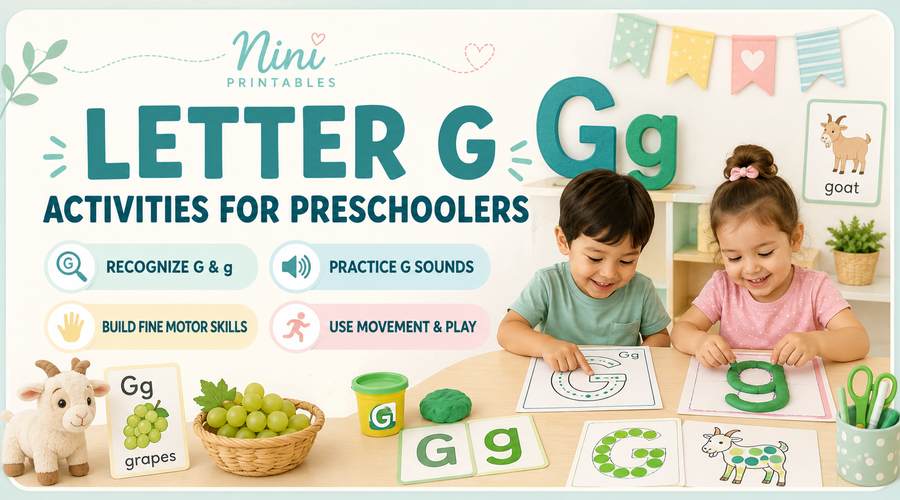
Quick Answer
Start Letter G practice with recognition: help the child find and name uppercase G and lowercase g. Then connect G with a few familiar words such as goat, grapes, gift, gum, game, and green. Add one short hands-on activity—matching, building, movement, sensory play, or finger tracing—rather than trying to complete a full worksheet lesson.
Letter G activities for preschoolers work best when they match the skill a child is practicing now. A child who cannot yet find G needs a different activity from a child who already knows the letter and is ready to connect it with a beginning sound.
This guide organizes letter G activities for preschool by skill, so parents, preschool teachers, homeschool families, and caregivers can choose a useful next step. You do not need special materials, and you do not need to complete all 15 ideas.
That gradual approach also fits established early-literacy guidance. Head Start describes alphabet knowledge as recognizing and naming uppercase and lowercase letters and discovering that letters are associated with sounds. It also describes early writing as progressing from marks and scribbles toward drawing and forming letters.[1] Reading Rockets defines alphabet knowledge around letter names, printed forms, and letter-sound associations.[2]
How Do You Teach Letter G to Preschoolers?
Begin with a small target. Show uppercase G and lowercase g, say the letter name, and let the child notice how the two forms look. Next, use a few familiar G words. Then repeat the letter through play in different places: on a card, in a book, with playdough, on the floor, or in environmental print.
If the child is still learning several letters, keep the choice set small. For example, ask the child to find G among three or four letters instead of searching a full alphabet. Once G becomes familiar, add more choices.
For broader alphabet practice, see 15 Letter Recognition Activities for Preschoolers. That guide covers the general skill, while this page focuses only on preschool activities for the letter G.
What Should Preschoolers Learn About the Letter G?
Recognize uppercase G and lowercase g
First, help the child notice that G and g are two forms of the same letter. Matching the pair, finding both forms in print, and naming them during play can build familiarity without turning the activity into a test.
Connect G with a familiar beginning sound
Use simple words that begin with the common hard G sound, such as goat, grapes, gift, gum, game, garden, and green. Say the word naturally, then briefly emphasize its beginning: “G, goat.”
Move from noticing to making
Letter recognition and letter formation are related but different skills, and children may progress unevenly across them. A child can build G with playdough, trace a large G with a finger, or walk along a giant taped G before asking for careful pencil formation. These larger movements keep attention on the letter shape while adding useful motor practice.
Which Letter G Activity Should You Try First?
Choose the next activity by what the child can already do. The goal is a short, successful step—not the hardest task available.
| If the child can… | Try next… | Why it helps |
|---|---|---|
| Does not recognize G yet | Letter G hunt | Builds visual recognition with a small choice set. |
| Finds uppercase G | G–g matching | Connects uppercase and lowercase forms. |
| Recognizes G and g | G picture sort | Adds a simple letter-sound connection. |
| Knows the common G sound | G word hunt | Moves the skill into books and everyday print. |
| Needs hands-on practice | Playdough or finger tracing | Lets the child explore the letter shape without demanding pencil control. |
15 Letter G Activities for Preschoolers
These letter G preschool activities move from finding the letter to matching, hearing, building, moving, and beginning to form it. Pick one or two activities that fit the child’s current skill. Repeating a successful activity is useful; there is no need to rush through the list.
Stage 1: Find and Recognize G
1. Letter G Hunt
Place three to five letter cards, magnetic letters, or paper letters on a table or around the room. Ask, “Can you find G?” When the child finds it, name the letter together.
Keep it easy first: Use clearly different letters before adding look-alike shapes or a larger alphabet set.
2. G or Not G Sort
Make a small pile of G cards and a second pile of other letters. Let the child sort each card into “G” or “not G.” Start with obvious contrasts, then add more letters as recognition improves.
3. Uppercase G and Lowercase g Match
Show one uppercase G card and one lowercase g card. Say, “These look different, but they are both the letter G.” Add two or three more uppercase–lowercase pairs and let the child match them.
Stage 2: Connect G With Words and Sounds
4. G Picture Hunt
Gather pictures of a goat, grapes, gift, gum, game, and garden. Mix in a few pictures that begin with other sounds. Ask the child to find the pictures that belong with G.
Say the words aloud: Preschoolers do not need to read the labels. The sound connection comes from hearing and talking about the words.
5. G Sound Basket
Place a few safe objects or picture cards in a basket. Include one or two G items, such as a toy goat, pretend gift, or green block. Name each item together and listen for the beginning sound.
6. Letter G I Spy
Look for G in a favorite picture book, cereal box, toy label, sign, or classroom poster. Say, “I spy a G,” then let the child point to it. Later, switch roles and let the child choose where to look.
Stage 3: Build and Touch Letter G
7. Playdough Letter G
Roll playdough into a long rope and curve it into a large G. Use a printed G or a hand-drawn model beside the playdough if the child needs a visual guide.
For more low-prep sensory ideas, see Preschool Playdough Activities.
8. Sticker or Dot-Marker G
Draw a large G on paper. Let the child place dot stickers along the line or use a washable dot marker to follow the shape. Keep the G large enough that the task feels like play rather than handwriting practice.
9. Finger-Trace a Large G
Trace a large G with one finger on paper, in a shallow tray of salt, or on another safe textured surface. Say the letter name while tracing. If the child loses the path, model it once and try again together.
Finger paths can be a useful bridge into pre-writing activities for preschoolers without expecting a page of pencil work.
Stage 4: Add Fine-Motor Practice
10. Grape Dot Craft
Draw a simple bunch of grapes beside a large letter G. Let the child make the grapes with dot stickers, fingerprints, or small paper circles. Say, “G is for grapes,” once or twice during the activity.
11. Green G Collage
Cut or tear green paper into easy-to-handle pieces. The child can glue the pieces inside a large G outline. Tearing paper works well when scissor control is still developing.
12. G Cutting and Paste Activity
Offer a few simple G picture cards, such as goat, grapes, gift, and garden. Let the child cut along short straight lines around the cards, then paste them beside a large G.
If scissors are the main challenge, practice the movement separately with cutting activities for preschoolers before adding a letter-sorting task.
Stage 5: Add Movement
13. Letter G Floor Hop
Place several large letter cards on the floor. Call out a letter and let the child hop to it. Include G often enough for practice, but keep a few other letters in the game so the child needs to look.
14. Go and Stop G Game
Use the word go as a movement cue. Hold up G and say, “G says /g/ in go—go!” Then let the child walk, march, or wiggle until you say stop. Keep the sound cue brief so the game stays active.
15. Giant Letter G Walk
Make a large G on the floor with painter’s tape or place a paper G on the ground. Let the child trace the path by walking, driving a toy car, or moving a finger along the line.
Variation: When the shape feels familiar, ask the child to find a smaller printed G in a book. This connects the large movement back to real print.
A Simple 5-Day Letter G Preschool Plan
You can spread the activities across a week instead of doing several in one sitting. Keep each practice period brief enough that the child can stay engaged, and stop when attention fades.
Find G and match uppercase G with lowercase g.
Use a G picture hunt or sound basket.
Build G with playdough and finger-trace it.
Make a grape or green G collage.
Play a movement game, then find G in a book.
The plan is flexible. If the child enjoys one activity, repeat it. If G is already easy to recognize, spend more time on words, sounds, or meaningful early writing instead.
Easy Letter G Words for Preschoolers
Choose concrete, familiar words whenever possible. Objects, pictures, movements, and colors are easier to turn into playful practice than abstract vocabulary.
| G word | Simple activity idea |
|---|---|
| Goat | Match a toy or picture to G. |
| Grapes | Make a grape dot craft. |
| Gift | Wrap a small pretend gift and label it G. |
| Gum | Use a picture card for a quick sound sort. |
| Game | Say “G is for game” before a movement game. |
| Garden | Look for G on a garden sign or picture. |
| Green | Go on a green color hunt. |
| Goose | Match an animal picture to the letter G. |
What About the Two Sounds of Letter G?
Preschoolers may notice that G does not always sound the same. In words such as goat, grapes, gum, and game, G uses its common hard sound. In a word such as giraffe, G has a different sound. Reading Rockets notes that English letters can represent more than one sound, which is why simple examples are more useful here than a long spelling-rule lesson.[2]
At this stage, awareness is enough. You do not need to turn the activity into a spelling-rule lesson. Start with a small group of familiar words that share the same beginning sound. If a child notices a word like giraffe, acknowledge the difference and keep reading or playing.
Letter Recognition vs. Letter Writing
Seeing G, hearing its sound, and writing it are related skills, but they are not identical. Separating them helps adults choose a task that fits the child instead of assuming that recognizing G means the child should already write it neatly.
| Skill | Goal | Letter G example |
|---|---|---|
| Recognition | Notice and name the letter. | Find G in a small group. |
| Sound awareness | Connect the letter with a familiar sound. | Hear /g/ at the start of goat. |
| Pre-writing | Build control for lines, curves, and paths. | Finger-trace a large G path. |
| Handwriting | Form a recognizable G or g with a writing tool. | Copy one clear G model. |
If the child is ready to move beyond large-motor and finger-tracing practice, continue with handwriting activities for preschoolers. That guide focuses on letter formation rather than basic recognition.
Optional Supplies for Letter G Activities
Most activities on this page can use materials already at home or in a classroom. A few reusable supplies can make setup easier, but none are required.
Useful, Not Required
- Magnetic uppercase and lowercase letters
- Washable dot markers
- Playdough
- Child-safe scissors
- Dot stickers or small paper circles
- Reusable dry-erase sleeves
These supplies are optional. Use what is already available at home or in the classroom before buying extra materials.
Frequently Asked Questions
What are easy Letter G activities for preschoolers?
Start with a Letter G hunt, uppercase–lowercase matching, a G picture sort, playdough G, a grape dot craft, or a simple movement game. Choose one activity that matches the child’s current skill and keep the directions short.
How do I teach uppercase G and lowercase g?
Show the two forms together and name them as the same letter. Then use a simple matching game. Once the pair feels familiar, look for both G and g in books, labels, signs, or name cards.
What words start with G for preschoolers?
Useful examples include goat, grapes, gift, gum, game, garden, green, and goose. Concrete words work especially well because adults can pair them with pictures, toys, colors, or movements.
Should preschoolers learn both sounds of G?
Preschoolers can notice that G sounds different in words such as goat and giraffe, but they do not need a complex spelling-rule lesson. Begin with a few familiar words that share the common hard G sound, then acknowledge other examples when they appear naturally.
How can I practice Letter G without worksheets?
Use magnetic letters, picture hunts, book searches, playdough, finger tracing, collage materials, floor games, or real objects. These activities still practice recognition and letter-sound connections while keeping the child active.
Keep Letter G Practice Short and Playful
Good Letter G practice can follow a simple progression: recognize → hear → build → move → notice in real life. Start with the step the child can manage now, repeat it enough to build confidence, and add a new challenge only when it feels useful.
For the next alphabet-specific idea, try Letter S Activities for Preschoolers. For broader alphabet practice, return to the Letter Recognition Activities guide.
About This Guide
Nini Printables creates low-prep preschool and kindergarten resources built around clear, skill-focused practice. This guide follows that same approach by separating Letter G recognition, sound awareness, hands-on motor practice, and early writing so adults can choose a manageable next step instead of simply adding more worksheets.
Editorial Approach
The literacy framework in this article is grounded in the teaching sources below. The 15 activities are practical, low-prep suggestions selected to fit those skill areas; this page does not claim that every activity has been individually tested with every preschool age or learning profile. Adults should adjust the number of choices, materials, and level of support to the learner in front of them.
Learn more about the site’s design principles and resource approach on the Nini Printables About page.
Teaching Sources
- Head Start — Planned Language Approach: Alphabet Knowledge and Early Writing. Official U.S. Head Start educational guidance. DOI: not applicable.
- Reading Rockets — Basics: Alphabet Knowledge. Literacy education reference from Reading Rockets/WETA. DOI: not applicable.
Reference note: No academic journal article is cited in this page, so there is no DOI-bearing research paper to list. Source-supported statements are marked [1] and [2] in the article.
This article provides general educational activity ideas. It is not a developmental assessment or a substitute for individualized guidance from a child’s teacher or another qualified professional.