
Preschool Letter Learning
Letter C Activities for Preschool: 14 Easy Ways to Find, Hear & Make C
These Letter C activities for preschool help ages 3–5 notice C and c, keep the curve open, hear a clear hard-C sound, and use the letter in familiar words through short activities that do not require a full worksheet lesson.
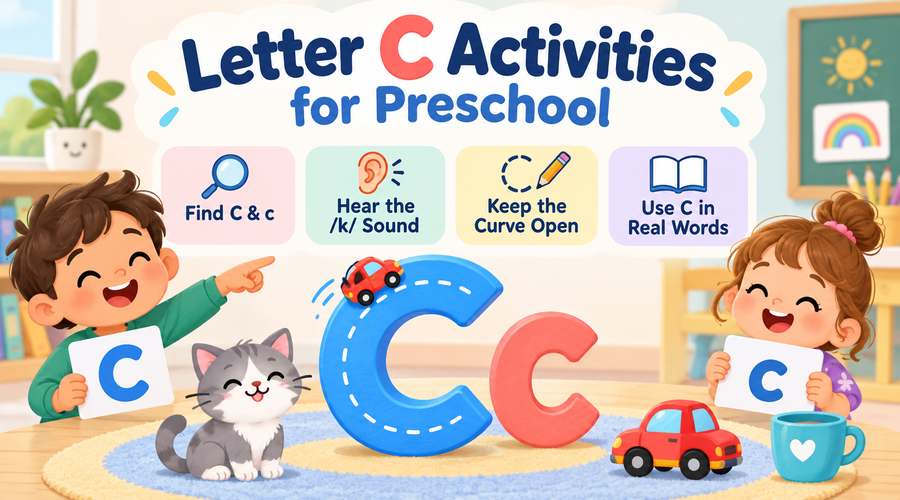
Notice uppercase C and lowercase c in a small choice set.
Compare C with O so the open curve becomes easier to notice.
Use a few familiar hard-C words such as cat, car, cup and cow.
Find C in books, labels and simple child-created word collections.
Start with the skill the child needs next. If C is still hard to spot, use a C-or-not-C game with only three or four letters. If uppercase C is familiar, match it with lowercase c. Once both forms are easy to find, add a few familiar hard-C words such as cat, car and cup. Save careful pencil formation for later; playdough, finger paths and large curves can come first.
Good letter c activities for preschool do not need to fill an entire week or ask a child to finish every idea on the page. Alphabet knowledge develops through recognizing letter forms, naming them, connecting letters with sounds and gradually using them in early writing. Head Start describes preschool alphabet knowledge in terms of recognizing and naming uppercase and lowercase letters and discovering that letters are associated with sounds.[1]
These letter C preschool activities keep that goal small and practical. Instead of treating C like a generic “letter of the week,” the activities focus on what makes C useful to notice: uppercase and lowercase forms look closely related, C is an open curve that can be compared with O, and the letter can represent more than one sound. Reading Rockets describes alphabet knowledge as learning letter names, printed shapes and letter-sound associations, and specifically notes soft C as /s/ in a word such as city.[2]
What Should Preschoolers Learn About Letter C?
Keep the target narrower than “learn the letter C.” Four small ideas are enough for this stage, and a child does not need to master them all in one sitting.
Find C among a few clearly different letters before increasing the choice set.
Notice that the two forms are similar enough to compare directly.
Compare C with O and talk about the gap instead of only asking for the letter name.
Begin with a few clear hard-C /k/ words such as cat, car, cup, cap, cow and comb.
C can also represent /s/, as in city. Preschoolers do not need a spelling-rule lesson here. For these beginner activities, use a small group of familiar hard-C /k/ words so the sound target stays clear. If a child notices a soft-C word, acknowledge it without turning the activity into a quiz.
Avoid 4 Common Letter C Teaching Traps
A useful Letter C session is often improved by removing one source of confusion rather than adding another activity. These are setup choices, not developmental rules.
Keep a beginner /k/ set consistent with words such as cat, car, cup and cow. Words such as city, circle and celery still begin with the written letter C, but they do not model the same initial sound.
Reading Rockets specifically calls attention to accurate pronunciation of letter sounds and the extra schwa adults can accidentally add.[2] Model the sound briefly, then say the whole word naturally: “/k/, cat.”
If the child is still learning to recognize C, pointing, matching, building and tracing a large curve are enough. Head Start describes early writing as progressing from marks and drawings toward letter forms rather than beginning with polished letter production.[1]
Two to four letter or picture choices can keep the target visible. Add more distractors only after the child can find C reliably; a crowded page is not automatically a stronger literacy activity.
How to Choose Letter C Activities for Preschool
The useful question is not “Which activity is cutest?” It is “What is the next small thing this child needs to notice?” That keeps preschool letter C activities focused and prevents a simple literacy task from becoming a worksheet marathon.
Start with Activity 1 and use only three or four letter choices.
Use Activity 2 to connect the uppercase and lowercase forms.
Try Activity 3 and make the open gap the thing to notice.
Move to Activities 5–8 for a simple hard-C sound connection.
Use Activities 9–12 to explore the shape with larger movements.
Try Activities 13–14 to find and use C in meaningful print and words.
Find & Recognize Letter C
Start with visual recognition before expecting writing. For broader alphabet practice across many letters, use Letter Recognition Activities for Preschoolers; this section stays specific to C and c.
C or Not C? Quick Find
Place one C card beside two or three clearly different letters such as T, X and L. Ask the child to find C, mix the cards, and repeat only a few times.
Use only two choices and keep C in the same font.
Increase the set slowly or show C in a different familiar font.
Match Uppercase C With Lowercase c
Show one uppercase C and one lowercase c. Name both, then add two or three other uppercase-lowercase pairs and ask the child to find the matching C pair.
Keep the wording simple: “These are both C. One is uppercase and one is lowercase.”
C vs O: Keep the Curve Open
Place a large C beside a large O. Ask what is different. If the child does not notice the gap, trace around each shape with a finger and pause at the open ends of C.
“O closes all the way. C stays open.”
Turning the comparison into a timed test or correcting every glance.
Environmental C Hunt
Look for C or c on a cereal box, book cover, calendar, classroom label or package. Point to one example first, then invite the child to find another.
Why this is different from a worksheet: the child learns that C appears in real print, not only on alphabet cards.
Hear the Hard-C Sound in Familiar Words
Once C and c are familiar visually, connect them with a small number of easy-to-name words. Reading Rockets recommends making explicit links between letters and sounds rather than expecting children to infer the connection on their own.[2]
Hard-C Object Basket
Gather three to five safe objects or pictures such as a toy car, cup, cap, comb and cat picture. Name each item naturally and briefly emphasize the beginning /k/ sound.
Keep the set familiar: if the child does not know an object’s name, the task becomes vocabulary guessing instead of letter-sound practice.
Does It Start With /k/?
Say or show a few simple words: cat, sun, cup, fish, car, ball. Ask the child to point when a word begins with the sound used in the hard-C examples.
Use only two choices at a time and say the words slowly but naturally.
Let the child choose a C word for you to identify.
Hard-C Picture Sort
Make two small groups: “starts like C in cat” and “not this time.” Use pictures instead of printed word labels so reading ability is not required.
Use a small set: six pictures are enough. Accuracy matters more than having a giant pile to finish.
Guess the C Clue
Give a short clue for a familiar hard-C word: “You can drink from it” for cup, “It can drive on a road” for car, or “It says meow” for cat. After the child guesses, place or point to C.
Keep C visible: the point is to connect the spoken word back to the printed letter, not just solve a riddle.
Need Broader Alphabet Practice?
If C is only one of several letters the child is learning, switch to a general recognition game rather than adding more C tasks. If the child is ready for print-and-go table work, browse the printable library separately so this article can stay focused on hands-on letter learning.
Make the Open Curve Before Expecting Neat Writing
Head Start describes early writing as progressing from marks and scribbles toward drawing and eventually forming letters.[1] That is a good reason to keep Letter C formation large and forgiving before asking for small pencil copies.
Playdough C
Roll one long piece of playdough and bend it into an open curve. Place a large printed or hand-drawn C beside the model if the child needs a visual reference.
Useful cue: if the ends touch and make O, gently reopen the gap instead of starting over.
Drive a Toy Car Around C
Draw or tape a giant C path on the floor or a large sheet of paper. Let the child drive a toy car around the curve and stop before the path closes.
Connect shape to language: “Drive around the C, then stop at the open end.”
Finger-Trace a Giant C
Use one finger to follow a large C on paper, a wipe-clean surface or another safe, simple texture. Keep the path large enough that the task is about noticing the curve, not fine pencil control.
For broader line and path work, see Pre-Writing Activities for Preschoolers.
Build C With a Rope or Fabric Strip
Place a thick rope or long fabric strip on the floor and curve it into C. Let the child adjust the ends so the shape stays open, then walk beside the curve or trace it with a hand.
If careful pencil formation is the goal later: the separate Preschool Line Tracing Worksheets can provide more structured path practice without turning this Letter C article into a tracing product page.
Use Letter C in Real Words and Print
The final step is not “write C ten times.” Give the letter a job in a familiar word, label, book or picture so the child sees why noticing C matters. Head Start’s preschool literacy framework describes children as increasingly connecting speech with print and recognizing letters they encounter in their environment.[4]
Build a Tiny C Word Collection
Choose only three to five familiar hard-C pictures or objects—such as cat, car, cup, cap and cow—and place a large C beside them. Name the items together and notice the shared first letter.
Use things the child already knows before adding new vocabulary.
Swap one or two items instead of rebuilding the whole activity.
Create a C Picture Page
Write one large C near the center of blank paper. Invite the child to draw, stamp or add simple pictures of a few C words around it. The child can tell you each word while you write a label if they want one.
No model to copy is required: one cat, one car, or even one remembered C word is enough. The page is a language-and-letter connection, not an art test.
Need a 2-, 5-, or 10-Minute Letter C Activity?
Time is often the real constraint at home and in preschool. Pick one short activity that fits the moment instead of trying to complete a full themed plan.
Try C or Not C? with two or three choices, or finger-trace one giant C.
Match C with c, compare C with O, or play Guess the C Clue.
Build a playdough C, drive a toy car around a large C, or make a tiny C word collection.
Stop. Repeating one successful activity later is more useful than finishing a long list just because it is available.
Adjust the Support Instead of Turning Age Into a Test
Ages 3–5 cover a wide range of experience with letters, sounds and writing tools. Use what the child can do now as the starting point rather than treating a birthday as a deadline.
Offer two or three choices, name the pictures aloud, use large C shapes, and let pointing or matching count as a successful response.
Mix uppercase and lowercase, add a small sound sort, or ask the child to find C in real print.
Compare C with O, explain how they are different, find C in a short label, or think of another familiar hard-C word.
Return to finger paths, playdough, rope shapes or general pre-writing activities before asking for smaller letter formation.
Optional Supplies: Keep the Letter C Setup Small
Most letter c activities for preschoolers in this guide can be done with materials already at home or in a classroom. You do not need a themed alphabet kit.
Useful for finding, sorting and uppercase-lowercase matching.
Helpful for giant letters and the open-ended C picture page.
Useful for building one large open curve without pencil pressure.
Turns a giant C path into a short movement activity.
Keeps repeated C hunts and large finger paths simple.
Use only items the child can name easily when the goal is beginning sound practice.
Buying tip: choose reusable basics that also work for other letters and preschool activities. Add affiliate links here only when a real verified destination and required disclosure are available.
Use child-appropriate art materials, follow the actual product labels, and supervise loose small items or modeling materials as needed. The U.S. Consumer Product Safety Commission maintains an Art and Craft Safety Guide for additional reference.[3]
Frequently Asked Questions
What are easy Letter C activities for preschool?
Start with a C-or-not-C find, uppercase C and lowercase c matching, a C-versus-O comparison, a hard-C object basket, or a giant C made with playdough. Use one short activity that matches what the child can do now instead of trying to complete the whole list.
Should preschoolers learn uppercase C or lowercase c first?
You can introduce them together once one form is familiar because C and c are visually similar. If both at once feels confusing, start with one clear form, then add the matching partner when the child can find it reliably.
What sound should I use for Letter C activities?
For beginner practice, a small set of familiar hard-C /k/ words such as cat, car, cup, cap and cow keeps the target simple. C can also represent /s/, as in city, but preschoolers do not need a full spelling-rule lesson in a short Letter C activity.
How can I teach Letter C without worksheets?
Use magnetic letters, household print, picture cards, playdough, a toy-car path, finger tracing, rope shapes and short beginning-sound games. These activities still connect the letter name, printed shape and sound without requiring a worksheet.
What if a child confuses C with O?
Place a large C and O side by side and make the difference visible: O closes all the way while C has an open gap. Trace each shape with a finger, then return to a small recognition game. Keep the comparison calm and brief rather than turning it into repeated correction.
Start With One C Activity Today
If C is still new, begin with C or Not C? using only a few letter choices. When C becomes easier to spot, move to C/c matching or one hard-C word game. The goal is a useful next step, not finishing all 14 ideas.
You can also compare another single-letter approach in Letter G Activities for Preschoolers. If this guide was useful, sharing it with another parent, caregiver or preschool teacher helps more families find the free resources on Nini Printables.
About This Guide
Nini Printables creates low-prep preschool and kindergarten resources designed around clear instructions, manageable setup and distinct search intent. This Letter C guide was organized around four practical needs—recognition, visual distinction, a simple sound connection and early shape/word use—rather than copying a generic letter-of-the-week template.
The literacy framing was cross-checked against Head Start and Reading Rockets guidance on alphabet knowledge, letter-sound connections and early writing. The activities are practical educational ideas, not a developmental assessment. This page does not claim undocumented classroom testing, professional credentials or guaranteed learning outcomes.
Teaching & Safety References
Reference note: the sources below are institutional or government guidance pages rather than peer-reviewed journal papers cited for study findings. DOI information is therefore not applicable to this reference set.
- Head Start — Planned Language Approach: Alphabet Knowledge and Early Writing. Used for uppercase/lowercase recognition, letter-sound association and the progression of early writing toward letter formation.
- Reading Rockets — Basics: Alphabet Knowledge. Used for the letter-name, printed-shape and letter-sound framework and for the note that C can represent a soft /s/ sound in words such as city.
- U.S. Consumer Product Safety Commission — Art and Craft Safety Guide. Used only as a general material-safety reference for optional craft supplies.
- Head Start — Literacy: Preschool. Used for the preschool print-and-alphabet framework, including growing connections between speech, print, familiar letters and associated sounds.