
Letter C Art Studio
Letter C Art Activities for Preschoolers: Paint, Print & Create With the Open Curve
These 12 Letter C art activities for preschoolers use paint, collage, printmaking, drawing and mixed media without asking every child to copy the same C craft. The letter stays visible, but the art still belongs to the child.
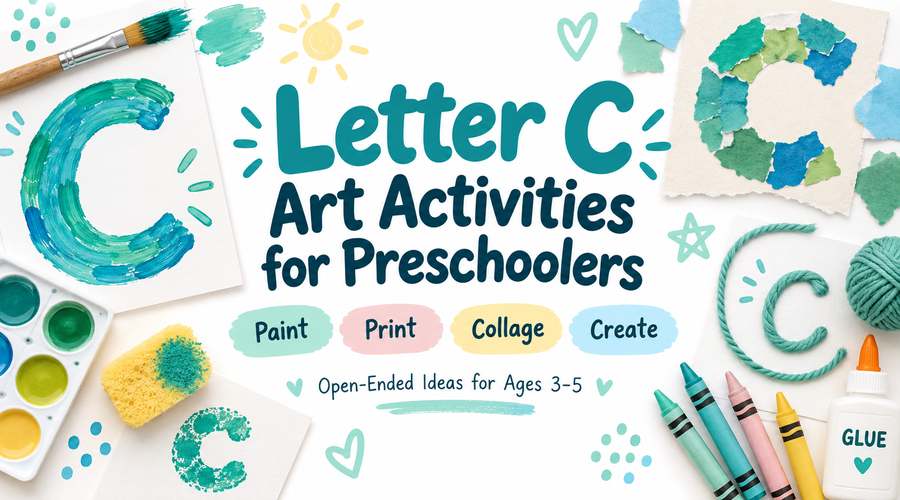
Start with the open curve or a simple C prompt.
Let the child choose a tool, color, texture or placement.
Keep more than one result possible.
Notice the C again without turning art into a quiz.
Start with one art experience that matches your setup. For almost no prep, draw one large C and invite the child to transform it. For paint, try a giant open-C brush movement or color-mixing bands. For lower-mess table work, use torn paper, yarn or a simple crayon-resist curve. Keep the C connection short; the creative choices should do most of the work.
A Letter C art lesson does not need to end with 20 identical cats, caterpillars or cookies. NAEYC describes process-focused art as open-ended exploration in which children can choose materials and techniques, with no single sample or “right” finished product to copy.[1] That makes a useful starting point for preschool art: the adult can provide a clear Letter C invitation while the child still decides what the artwork becomes.
This article stays deliberately separate from the broader Letter C Activities for Preschool guide. Recognition games, C-versus-O practice, beginning-sound sorting, playdough letters and tracing belong there. Here, the focus is art: gesture, color, printing, texture, composition and transformation.
Use C as a Starting Shape, Not a Craft Template
A useful Letter C art activity keeps the letter connection clear without deciding every artistic choice in advance. Four checks are enough.
The open curve, a C-shaped movement or one simple C prompt gives the activity a real reason to belong in a Letter C theme.
Let the child choose at least one meaningful variable: color, tool, material, position, mark or what the C becomes.
If every finished page needs to look like the adult sample, the activity is closer to a directed craft than an open art invitation.
Comment on lines, colors, pressure, texture and choices. NAEYC recommends observation and open-ended prompts rather than correcting the artwork.[2]
Pick a Letter C Art Activity by What You Need Today
One large C, crayons or markers, and no model to copy.
Use a broad arm movement and keep the right side open.
Layer large scraps around an open curve.
Explore repeated curved marks without needing a printable template.
Draw first, then reveal the curve with watercolor.
One large C-shaped space, many different marks and materials.
12 Letter C Art Activities for Preschoolers
Each activity uses the same simple pattern: set out a manageable material choice, invite one action, and keep the result open. The Letter C connection is explicit, but the page is not a disguised worksheet.
Giant Open-C Brush Painting
Use a large sheet of paper and washable paint. Make one broad C-shaped brush movement as a quick demonstration, then move the sample aside and let the child create their own open curves, thick bands, overlapping Cs or a page of sweeping marks.
Large paper, washable paint and one or two broad brushes.
“Can your brush make a curve that stays open?”
No need to trace a printed C or match the adult mark.
Letter connection: notice the opening once, then return attention to movement, paint and shape.
Color-Mixing C Bands
Draw one large, light C as a starting guide. Offer two washable paint colors plus white. The child can paint inside, beside or across the curve, mixing colors as the bands meet.
Heavy paper, two paint colors, white and a brush.
“What happens when two colors meet on the C?”
The child decides where colors mix and whether the C stays visible or partly disappears.
Negative-Space C Paint Reveal
An adult places a large removable C shape or a few broad strips of painter’s tape to suggest an open curve. The child paints freely over and around the area. Once the paint is dry, an adult removes the mask to reveal the C-shaped space.
Heavy paper, removable paper/tape mask and washable paint.
“Paint anywhere you want. We will discover what is hiding later.”
The painting matters as much as the reveal; do not direct what the surrounding marks should represent.
Adult prep: test tape on the paper first and remove it slowly after the artwork dries.
Cardboard-Edge Curve Printing
Cut several large pieces of corrugated cardboard in advance. Bend or angle an edge through washable paint and press it onto paper to make curved or broken C-like marks. Children can rotate, overlap and repeat the prints.
Large cardboard pieces, shallow paint tray and paper.
“What kind of curve can this edge print?”
Let prints overlap or drift away from a perfect C.
For more year-round ways to explore printing tools, see Printmaking Activities for Preschoolers.
Sponge-Stamp Around an Open Curve
Place a large C near the center of the page. Instead of asking the child to “fill it in,” offer one or two sponge shapes and invite stamps around, across or beside the curve. The C becomes part of the composition rather than a coloring boundary.
Large C on paper, washable paint and broad sponge pieces.
“Where do you want the next print to go?”
No rule says every stamp must stay inside the C.
Torn-Paper C Texture Collage
Offer a small tray of large paper scraps with different textures or weights. The child tears, overlaps and glues pieces around an open C curve. Some children may cover the curve; others may build a border or create a completely new shape from it.
Large paper scraps, glue stick or child-intended glue, and a bold C starter.
“Which piece do you want to use first?”
Do not prepare one finished collage for children to copy.
NAEYC notes that collage can stay open-ended when adults offer varied materials without presenting one model children are expected to reproduce.[3]
Need a Quiet Letter C Activity After Art?
Painting and collage can be active. If the next part of your day needs to be calmer, switch to a print-and-go Letter C page instead of stretching the art session past the child’s attention. The Color and Ink Saver worksheet editions use the same Letter C theme for recognition, tracing, sound and simple word work.
More Letter C Art Activities for Preschoolers: Lines, Resist & Mixed Media
Yarn-Line C Collage
Use thick yarn or wide paper strips as movable lines. Let the child curve, loop and reposition them before gluing anything down. One line may become C; several may become a whole page of open curves.
Thick yarn or wide paper strips, large paper and glue.
“Can this line bend without closing?”
Rearranging is part of the art. Glue only when the child is ready.
C Curve Crayon Resist
Invite the child to make one or more large open curves with a white or light crayon. Brush watercolor over the page and watch the wax lines appear. The child can add dots, short lines or other marks before painting.
Heavy paper, crayons and child-intended watercolor.
“What lines will show when the paint goes over them?”
Only one line needs to resemble C; the rest can be the child’s own pattern.
Turn a C Into Something New
Draw one large C and stop. Ask, “What could this curve become?” A child might turn it into part of a face, a road, a wave, an animal, a machine or an abstract design. There is no list of correct C words to choose from.
Paper and crayons or washable markers.
“What do you see in this curve?”
Do not suggest cat, car or cookie unless the child asks for ideas.
Why this stays separate from letter practice: the goal is visual transformation, not naming a beginning sound or tracing the C accurately.
Open-C Tool-Mark Studio
Offer three tools that make clearly different marks—for example a broad brush, sponge edge and cardboard scraper. Place one large C nearby as a visual prompt. Children can test which tool makes long curves, broken curves, dots or textured sweeps.
Three broad tools, washable paint and heavy paper.
“Which tool makes the kind of curve you want?”
The exploration can move away from C once the child begins comparing marks.
C-Materials Mixed-Media Studio
Choose three or four large, familiar materials that happen to start with C—for example cardboard, colored paper and cotton. The letter connection comes from the material names; the child decides how to combine them on the page.
Only a few large materials plus glue and paper.
Name the choices once, then ask, “Which material do you want next?”
Do not require the final piece to look like the letter C.
Keep vocabulary honest: choose materials the child already recognizes. This is art with a light language connection, not a C-word quiz.
Giant Collaborative C Mural
On a long sheet of paper, draw one oversized open C. Give two to four children different tools or materials and let them add marks anywhere around the curve. The shared shape holds the activity together, while each child contributes differently.
Large paper plus a limited shared set of crayons, paint tools or collage pieces.
“Find a space where you want to add something.”
No one needs an assigned section or matching color.
Adjust the Art Invitation for Ages 3–5
Use age as a rough planning clue, not a performance test. Change the amount of adult prep, the number of materials and the size of the work area based on the child in front of you.
Use larger paper, only two materials, broad tools and an adult-drawn C starter. Skip cutting and keep the session short.
Add one more tool or texture and let the child decide where the C remains visible and where it disappears under the art.
Ask what material they want first or whether they want the curve to become part of a picture, pattern or abstract design.
Switch to broad brushes, sponge printing, large collage pieces or mural-sized paper instead of asking for small detailed marks.
Letter C Art or Letter C Craft: What Is the Difference?
Both can be useful, but they solve different problems. NAEYC describes product-focused art as more likely to use teacher directions, a sample and a predetermined result, while process-focused art centers exploration, choice and more than one possible outcome.[1]
The adult may prepare pieces and know what the finished object should be. This can be useful when the goal is sequencing, assembling or following a short set of directions.
The adult chooses a manageable theme and materials, while the child decides how to use them. The C connection stays clear, but there is no single picture everyone must reproduce.
You do not have to choose one forever. Use a directed craft when following steps is the goal. Use an open art invitation when you want more experimentation, decision-making and original marks.
A Small Letter C Art Supply Kit Is Enough
Most activities on this page can be done with materials already used for preschool art. Specialty alphabet kits are optional, not required.
Heavy white paper plus a few colored sheets or large scraps.
Child-intended washable paint, watercolor, crayons or washable markers.
Brushes, sponge pieces, cardboard edges or a simple roller.
Large paper scraps, thick yarn, cardboard and other easy-to-handle pieces.
Keep purchases practical: if you need to restock, choose reusable basics such as washable paint, broad brushes, heavy paper and child-intended glue. Specialty alphabet kits are not required for any activity on this page.
Keep Preschool Art Materials Simple and Supervised
Use art materials intended for children, read the actual product labels and provide direct adult supervision. The U.S. Consumer Product Safety Commission also advises avoiding unlabeled supplies and materials with cautionary warnings for young children, and recommends keeping food and drinks out of the art area.[4]
Keep loose materials large enough for the child and the setting, store surplus supplies out of reach, and wash hands after art time. For any child with allergies, asthma or other material sensitivities, follow the product directions and individual guidance.
Frequently Asked Questions
What are easy Letter C art activities for preschoolers?
Try a giant open-C brush painting, color-mixing C, torn-paper texture collage, cardboard-edge printing, crayon resist or a drawing that starts with one large C. Choose one activity with a short setup rather than trying to complete the full list.
How can I do Letter C art without a printable template?
Use a hand-drawn C, a broad brush movement, yarn, cardboard prints or one simple open curve as the starting point. A template is not necessary when the art goal is exploration rather than copying a specific finished craft.
Does Letter C art need to be a cat, caterpillar or cookie?
No. Those can be useful craft themes, but the letter itself can also drive the art. Children can explore the open curve through paint, line, texture, printing, collage and visual transformation without making a named C object.
How do I keep a Letter C activity open-ended?
Give the child at least one real decision about color, tool, material, placement or what the C becomes. Avoid displaying one finished sample that everyone is expected to match.
What supplies do I need for Letter C art?
Paper, crayons or washable markers, child-intended washable paint, broad brushes or sponges, glue, large paper scraps, yarn and cardboard are enough for most of the activities in this guide.
Choose the Next Letter C Activity by Goal
If the child wants to keep creating, choose another paint, print or collage idea from this page. If you need broader letter play, use the hands-on Letter C guide. If you need calm table practice, move to the Color or Ink Saver worksheets instead of forcing another art project.
Prefer lower-ink pages? Use the Letter C Ink Saver Edition. If recognizing letters is the bigger need, try Letter Recognition Activities for Preschoolers. If this free guide helped, sharing Nini Printables with another parent or teacher also supports the continued creation of practical preschool resources.
About This Guide
Nini Printables creates low-prep preschool and kindergarten resources built around clear instructions, useful skill boundaries and practical home/classroom setup. This guide was organized around a Letter C-specific art idea: keep the open curve visible enough to make the theme meaningful, then give the child real choices about color, tool, texture, placement or transformation.
The process-art framing was checked against guidance from the National Association for the Education of Young Children, and the material-safety section was checked against the U.S. Consumer Product Safety Commission. This article provides general educational activity ideas; it does not claim undocumented classroom testing, professional credentials, developmental assessment or guaranteed learning outcomes.
Teaching & Safety References
- National Association for the Education of Young Children (NAEYC). How Process-Focused Art Experiences Support Preschoolers. Teaching Young Children, February/March 2014, Vol. 7, No. 3.
- National Association for the Education of Young Children (NAEYC). What Will We Make? Using Process Art to Spark Preschoolers’ Development. Used for intentional material setup, child choice and open-ended teacher prompts.
- National Association for the Education of Young Children (NAEYC). Using Collage to Encourage Creativity, High-Level Thinking, and Conversation. Used for the open-ended collage guidance and the recommendation not to give children a single model to copy.
- U.S. Consumer Product Safety Commission (CPSC). Art and Craft Safety Guide. Used for general guidance on child-intended materials, labels, supervision and safe art-area habits.